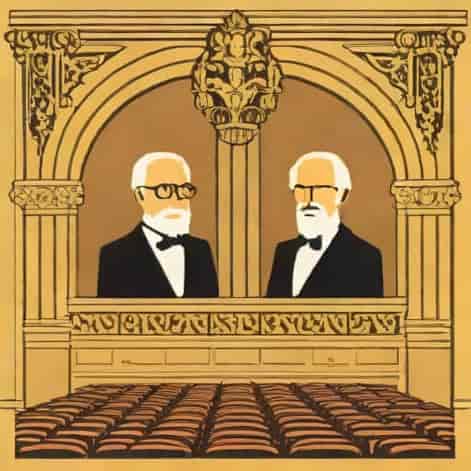
The story of the Stanislavsky and Nemirovich-Danchenko Theatre is deeply connected to the transformation of modern theater itself. At the end of the nineteenth century, Russian theater was dominated by exaggerated acting styles and artificial stage conventions that felt distant from real human experience. Against this background, two visionary figures came together with a shared desire to create a more truthful, emotionally honest form of performance. Their collaboration would leave a lasting mark on theater history and influence actors, directors, and audiences around the world.
The Meeting of Two Visionaries
Konstantin Stanislavsky and Vladimir Nemirovich-Danchenko first met in 1897 during a legendary meeting that reportedly lasted over eighteen hours. Despite their different personalities, they shared a deep dissatisfaction with the theatrical norms of their time. Stanislavsky was an actor and director searching for psychological realism, while Nemirovich-Danchenko was a playwright, critic, and teacher with a sharp understanding of dramatic structure.
Their conversation laid the foundation for what would become a revolutionary theatrical institution. Together, they envisioned a theater that prioritized ensemble acting, disciplined rehearsal, and a deep respect for the playwright’s intent.
The Birth of a New Theatre
In 1898, their collaboration resulted in the founding of the Moscow Art Theatre, which later became widely associated with the Stanislavsky and Nemirovich-Danchenko Theatre tradition. This new theater rejected the star system that dominated stages at the time and focused instead on collective performance and artistic unity.
Their early productions emphasized realism, careful character development, and subtle emotional expression. These qualities stood in sharp contrast to the melodramatic acting styles audiences were accustomed to seeing.
Stanislavsky’s Influence on Acting
Konstantin Stanislavsky is best known for developing a systematic approach to acting that sought emotional truth on stage. His ideas would later become known as the Stanislavsky System, a method that encouraged actors to explore their characters’ inner lives.
Rather than relying on clichés or exaggerated gestures, actors were trained to understand a character’s motivations, objectives, and emotional circumstances. This approach made performances feel more natural and believable, allowing audiences to connect more deeply with the story.
Key Principles of Stanislavsky’s Approach
Stanislavsky’s ideas evolved over time, but several core principles became central to his work
- Emotional truth and authenticity
- Understanding a character’s objectives
- Physical actions as a path to emotion
- Consistent ensemble performance
These principles were practiced rigorously within the Stanislavsky and Nemirovich-Danchenko Theatre, shaping generations of actors.
Nemirovich-Danchenko’s Artistic Vision
While Stanislavsky focused on acting technique and rehearsal processes, Nemirovich-Danchenko played a crucial role in shaping the theater’s artistic direction. He had a strong literary background and was deeply involved in selecting plays, working with playwrights, and refining scripts.
Nemirovich-Danchenko believed that a successful production depended on harmony between text, performance, and staging. His attention to dramatic structure helped ensure that performances remained grounded in the playwright’s intent while still allowing creative interpretation.
Landmark Productions
The Stanislavsky and Nemirovich-Danchenko Theatre gained international recognition through its groundbreaking productions of plays by Anton Chekhov. Works such asThe Seagull,Uncle Vanya,Three Sisters, andThe Cherry Orchardredefined how realistic drama could be staged.
These productions emphasized subtle emotion, pauses, and unspoken tension. Characters were portrayed as complex individuals rather than exaggerated types, which was a radical departure from traditional theater of the era.
The Role of Ensemble Acting
One of the defining features of the Stanislavsky and Nemirovich-Danchenko Theatre was its commitment to ensemble acting. No single actor was meant to dominate the stage. Instead, every performer contributed equally to the overall production.
This approach fostered discipline, mutual respect, and artistic consistency. Actors trained together, rehearsed extensively, and developed a shared understanding of the production’s goals.
Challenges and Creative Tensions
Despite their shared vision, Stanislavsky and Nemirovich-Danchenko did not always agree. Creative tensions occasionally arose, particularly regarding artistic control and leadership. Stanislavsky’s experimental tendencies sometimes clashed with Nemirovich-Danchenko’s more structured approach.
However, these differences often strengthened the theater rather than weakening it. Their contrasting perspectives created a balance between innovation and discipline, allowing the institution to evolve while maintaining its core principles.
Legacy in Modern Theatre
The influence of the Stanislavsky and Nemirovich-Danchenko Theatre extends far beyond Russia. Stanislavsky’s acting principles inspired later developments in method acting, particularly in the United States. Many famous actors and teachers adapted his ideas to suit different cultural contexts.
At the same time, Nemirovich-Danchenko’s emphasis on text and ensemble continues to shape directing practices worldwide. Together, their legacy helped redefine what theater could be.
Impact on Actor Training
Actor training programs around the world still draw heavily from the work developed at the Stanislavsky and Nemirovich-Danchenko Theatre. Exercises focused on concentration, imagination, and emotional connection remain central to many acting schools.
These techniques encourage actors to approach their craft with discipline and curiosity, fostering performances that feel alive and truthful.
The Theatre Today
The institution associated with Stanislavsky and Nemirovich-Danchenko has continued to evolve over the decades, adapting to new artistic movements while honoring its founders’ principles. Its name remains a symbol of artistic integrity and theatrical excellence.
Modern productions often blend traditional realism with contemporary interpretations, demonstrating the flexibility of the original vision.
The Stanislavsky and Nemirovich-Danchenko Theatre represents a turning point in the history of performance. Through their collaboration, two visionary artists challenged outdated conventions and created a theater rooted in truth, discipline, and human complexity. Their work reshaped acting, directing, and audience expectations, leaving a legacy that continues to influence theater across the globe. By focusing on authenticity and ensemble unity, they transformed the stage into a mirror of real life, making their contribution timeless and deeply influential.