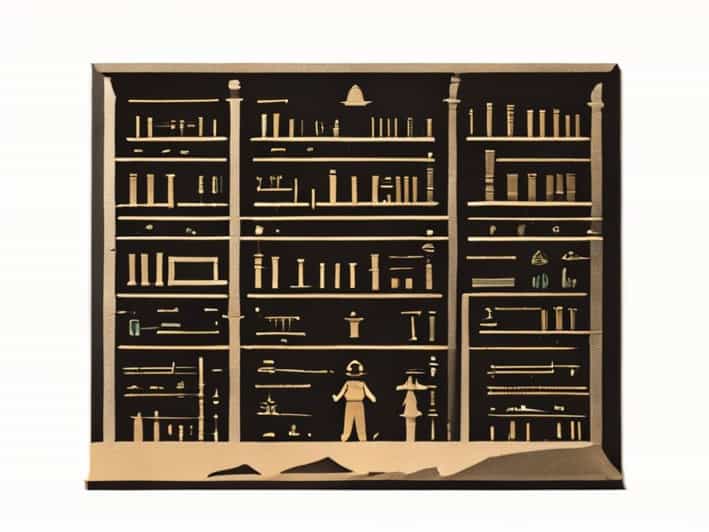
The discovery of the Library of Ashurbanipal is one of the most important moments in the history of archaeology and ancient studies. For centuries, the Assyrian Empire was known only through scattered references in classical texts and religious traditions. No one imagined that thousands of written records from this ancient civilization still lay buried beneath the ruins of a long-abandoned city. The uncovering of this library not only transformed modern understanding of Mesopotamian culture but also revealed how knowledge was preserved thousands of years ago.
The Historical Background of Ashurbanipal
Ashurbanipal was one of the last great kings of the Neo-Assyrian Empire, ruling during the 7th century BCE. He governed from the city of Nineveh, located in what is now northern Iraq. Unlike many rulers of his time, Ashurbanipal was deeply interested in learning, language, and literature.
He was educated as a scholar and could read and write cuneiform, the complex writing system used in Mesopotamia. His passion for knowledge played a major role in the creation of the library that would later bear his name.
The Lost City of Nineveh
After the fall of the Assyrian Empire in 612 BCE, Nineveh was destroyed and gradually disappeared beneath layers of sand and earth. Over time, its exact location faded from memory. By the early modern period, Nineveh existed mainly as a legendary city mentioned in ancient texts.
The ruins of Nineveh remained untouched for centuries until European explorers and scholars began showing interest in the ancient Near East during the 19th century.
Early Archaeological Interest in Mesopotamia
In the early 1800s, growing curiosity about biblical history and ancient civilizations led European scholars to search for physical evidence of ancient Mesopotamian cities. Travelers reported large mounds along the Tigris River, suggesting the presence of buried ruins.
These mounds, known locally but unexplored scientifically, became the focus of early archaeological expeditions.
The Role of Austen Henry Layard
The discovery of the Library of Ashurbanipal is closely connected to the work of Austen Henry Layard, a British archaeologist and diplomat. In the 1840s, Layard began excavating sites in present-day Iraq, including the mound known as Kuyunjik.
Kuyunjik was later identified as part of ancient Nineveh. Layard initially aimed to uncover monumental architecture, such as palaces and sculptures, rather than written records.
Layard’s Early Discoveries
- Massive palace walls
- Stone reliefs depicting battles and rituals
- Statues of winged bulls and lions
These finds confirmed that Nineveh was real and had once been a powerful capital.
The Unexpected Discovery of Clay Tablets
During continued excavations in the late 1840s and early 1850s, Layard and his assistants began uncovering thousands of clay tablets buried in the ruins of palace rooms. At first, these tablets were not fully understood or appreciated.
Many were broken or scattered, having fallen from shelves when the palace collapsed during the city’s destruction. Over time, it became clear that these tablets formed part of a vast organized collection.
Identification of the Library
As more tablets were recovered, scholars noticed that many contained colophons, short inscriptions identifying them as property of King Ashurbanipal. These notes often included phrases stating that the king had collected texts for his palace.
This evidence confirmed that the tablets belonged to a royal library, deliberately assembled and carefully maintained during Ashurbanipal’s reign.
The Scale of the Discovery
The Library of Ashurbanipal turned out to be enormous. Archaeologists eventually recovered more than 30,000 tablets and fragments. These texts covered a wide range of subjects, making the library one of the most comprehensive collections of ancient writings ever discovered.
Types of Texts Found
- Myths and epic literature
- Religious rituals and prayers
- Medical and scientific texts
- Historical records and royal correspondence
- Dictionaries and language guides
Among the most famous works discovered was the Epic of Gilgamesh, one of the oldest known literary works in human history.
How the Tablets Were Preserved
Ironically, the destruction of Nineveh helped preserve the library. When the city was burned, the clay tablets were baked by intense heat, making them harder and more durable.
This accidental firing protected the tablets from decay, allowing them to survive underground for over two thousand years.
Transportation to Europe
Many of the tablets discovered by Layard and later excavators were shipped to the British Museum in London. At the time, this was common practice, though it remains controversial today.
Once in Europe, scholars began the slow and complex process of cleaning, cataloging, and deciphering the texts.
Deciphering Cuneiform Writing
When the Library of Ashurbanipal was discovered, cuneiform writing had only recently been deciphered. Scholars worked painstakingly to translate the tablets, piecing together fragments and comparing texts.
This process took decades and required collaboration among linguists, historians, and archaeologists.
The Impact on Ancient History
The discovery of the Library of Ashurbanipal revolutionized the study of ancient Mesopotamia. For the first time, historians could read the words of the Assyrians themselves rather than relying on secondhand accounts.
The tablets revealed a society deeply concerned with knowledge, order, and tradition. They also showed that ancient scholars copied and preserved texts from earlier civilizations.
Ashurbanipal’s Vision of Knowledge
Ashurbanipal actively ordered scribes to collect texts from across his empire. He sought out rare writings and demanded accurate copies. This makes his library one of the earliest known attempts to preserve knowledge systematically.
His efforts demonstrate that libraries and archives existed long before the modern era.
Later Excavations and Ongoing Research
After Layard, other archaeologists continued excavating Nineveh and nearby sites. Additional tablets were discovered, expanding understanding of the library’s scope.
Even today, scholars continue to study the collection, discovering new meanings and connections among the texts.
The Global Importance of the Discovery
The discovery of the Library of Ashurbanipal provided invaluable insight into ancient law, science, religion, and literature. It also helped establish archaeology as a serious academic discipline.
This find demonstrated that ancient civilizations maintained complex systems of record-keeping and intellectual life.
Why the Discovery Still Matters Today
The Library of Ashurbanipal remains a cornerstone of ancient studies. It connects modern readers to the thoughts and concerns of people who lived nearly three thousand years ago.
Understanding how the library was discovered highlights the importance of preserving cultural heritage and continuing archaeological research.
A Window Into the Ancient World
The discovery of the Library of Ashurbanipal was not the result of a single moment but a process of curiosity, exploration, and scholarship. What began as an excavation for grand ruins became one of the greatest literary discoveries in history.
Through this library, the voices of ancient Mesopotamia still speak, reminding the modern world that the pursuit of knowledge has deep and enduring roots.