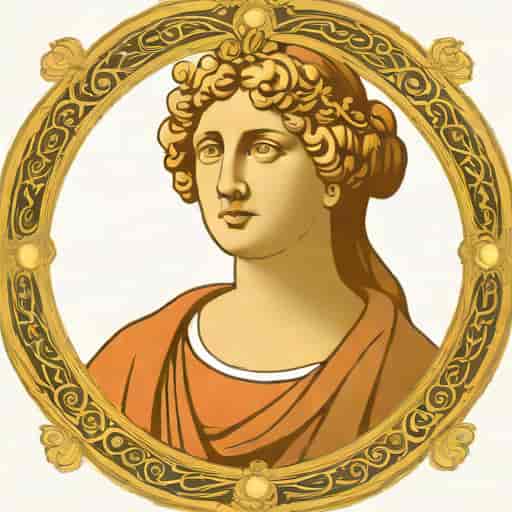
Vipsania Julia Agrippina, often simply referred to as Agrippina the Younger, was a prominent figure in Roman history whose life was intertwined with some of the most powerful and infamous personalities of the early Roman Empire. Born in 15 AD, she was the daughter of Germanicus, a celebrated Roman general, and Agrippina the Elder, making her a member of the Julio-Claudian dynasty. Agrippina’s life was marked by ambition, political maneuvering, and influence, particularly as the mother of the infamous Emperor Nero. Her story provides insight into the complex dynamics of power, family, and politics in ancient Rome, highlighting both her resilience and the challenges faced by women in positions of influence during the empire.
Early Life and Family Background
Agrippina was born into one of Rome’s most distinguished families, the Julio-Claudian dynasty. Her father, Germanicus, was a popular military leader known for his campaigns in Germania, while her mother, Agrippina the Elder, was renowned for her intelligence and strong character. This powerful lineage positioned Agrippina within the inner circles of Roman politics from an early age. Her early years were shaped by her family’s prominence as well as the political intrigues and rivalries that characterized the Julio-Claudian court. Despite the privileges of her birth, Agrippina’s life was also marked by peril, as her family often faced opposition and danger from rival factions within Rome.
Significance of the Julio-Claudian Dynasty
The Julio-Claudian dynasty, to which Vipsania Julia Agrippina belonged, was central to the early Roman Empire. Members of this family, including Augustus, Tiberius, and Claudius, wielded immense political power. Being part of this dynasty gave Agrippina access to influence, but it also exposed her to the constant risk of political intrigue, exile, and even assassination. Her family connections were both a source of strength and a potential threat, shaping the trajectory of her life and ambitions.
Marriage and Political Alliances
Vipsania Julia Agrippina’s marriages were significant not only for her personal life but also for her political influence. Her unions were carefully arranged to strengthen alliances and secure her position within the Roman elite. She first married Gnaeus Domitius Ahenobarbus, with whom she had her son, Nero, who would later become emperor. This marriage connected her to another influential Roman family, enhancing her social and political standing. Following her husband’s death, Agrippina strategically married her uncle, the Emperor Claudius, in 49 AD, solidifying her influence at the highest level of Roman politics.
Marriage to Claudius
The marriage between Agrippina and Emperor Claudius was a turning point in her life. By marrying Claudius, Agrippina positioned herself as Empress of Rome, gaining significant power and influence within the imperial court. This union also allowed her to promote her son Nero’s claim to the throne, setting the stage for his eventual succession. Agrippina’s marriage to Claudius demonstrates her political acumen, as she skillfully navigated court intrigues to secure her family’s position and advance her own ambitions.
Motherhood and the Rise of Nero
As the mother of Nero, Agrippina played a critical role in shaping the future emperor’s early life and political career. She ensured that Nero received a comprehensive education and was well-prepared for leadership. Agrippina’s influence over Nero was both personal and political, as she guided him through the complexities of Roman imperial politics and worked to secure his succession. Her efforts culminated in Nero being adopted by Claudius and eventually becoming emperor after Claudius’s death in 54 AD. Agrippina’s role in Nero’s rise highlights her strategic thinking and the power wielded by women within the Julio-Claudian dynasty, despite the patriarchal constraints of Roman society.
Political Maneuvering
Agrippina was known for her intelligence and political skill, often engaging in careful maneuvering to maintain her influence. She formed alliances with key figures in the Senate and military, navigating rivalries and consolidating power. Her strategies included controlling appointments, managing court factions, and influencing Claudius’s decisions. These actions demonstrate her ability to wield power effectively, ensuring that her son’s interests were protected and advancing her own position within the empire.
Challenges and Controversies
Despite her intelligence and influence, Agrippina faced numerous challenges throughout her life. The political environment of Rome was fraught with danger, and her ambition often attracted enemies. Her involvement in court intrigues, combined with her efforts to promote Nero, led to tensions with other members of the imperial family and political rivals. These challenges culminated in her eventual downfall, as her relationship with Nero became strained after he assumed full control as emperor.
Relationship with Nero
Initially, Agrippina exerted considerable influence over Nero, guiding his early reign and ensuring the loyalty of key political figures. However, as Nero matured and sought independent authority, tensions arose between mother and son. Nero’s desire for autonomy, combined with court conspiracies, ultimately led to Agrippina’s tragic demise. Despite her political acumen, Agrippina’s ambitions and assertiveness made her vulnerable in the volatile environment of Roman imperial politics.
Death and Legacy
Vipsania Julia Agrippina’s life came to a dramatic end in 59 AD when Nero ordered her assassination. Her death marked the conclusion of a remarkable and tumultuous life defined by ambition, influence, and political strategy. Agrippina’s legacy, however, endured through her son Nero and the impact she had on the Roman imperial court. She remains a significant historical figure, often cited as an example of the power and influence that women could wield in ancient Rome, even within a male-dominated society. Historians continue to study her life to understand the complexities of Roman politics, family dynamics, and the challenges faced by women of the imperial elite.
Historical Significance
- Demonstrated the political influence of women in the Roman Empire.
- Played a key role in shaping the early life and reign of Emperor Nero.
- Exemplified the risks and challenges of power within the Julio-Claudian dynasty.
- Her life illustrates the intersection of family loyalty, ambition, and political intrigue in ancient Rome.
- Serves as a case study for historians exploring gender, power, and succession in imperial Rome.
Vipsania Julia Agrippina, or Agrippina the Younger, remains one of the most fascinating figures of Roman history. Her life was characterized by ambition, strategic marriages, political influence, and the pursuit of power within the Julio-Claudian dynasty. As a mother, wife, and political operator, Agrippina navigated a complex and often dangerous environment, leaving a lasting impact on Roman history. Her story highlights both the opportunities and risks faced by women in positions of influence and continues to captivate historians and enthusiasts who seek to understand the intricate dynamics of ancient Rome. Through her actions and legacy, Agrippina the Younger remains an enduring symbol of power, resilience, and the intricate interplay between family and politics in one of history’s most storied empires.