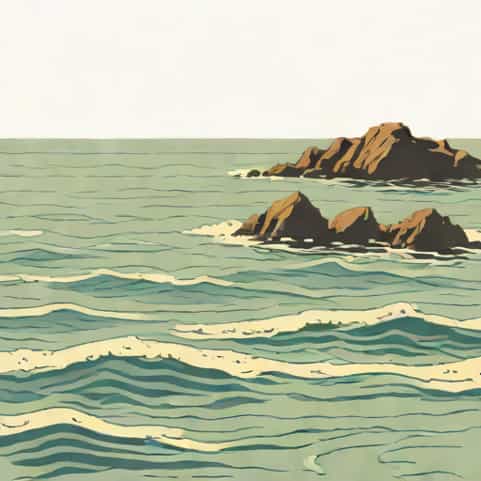
When discussing the works of Gustave Courbet, many art lovers immediately think of his groundbreaking role in Realism, but among his numerous paintings, The Calm Sea holds a special place. This work captures not only the serene beauty of nature but also Courbet’s mastery in representing the world as it truly appeared to him. Unlike the dramatic or romanticized seascapes of earlier traditions, Courbet’s The Calm Sea offers simplicity, stillness, and truth. It reflects both his devotion to naturalism and his fascination with the sea as a subject of endless inspiration. By analyzing this painting, one can better understand Courbet’s artistic vision and the cultural context in which he worked.
Gustave Courbet and the Realist Movement
Gustave Courbet was one of the most influential painters of the 19th century, leading the Realist movement in France. His goal was to move away from idealized depictions of history and myth and instead portray the world as it really was. While many of his famous works deal with rural life, laborers, or social realities, his landscapes and seascapes are equally important. They highlight his ability to translate natural environments into scenes that balance technical precision with emotional depth. The Calm Sea is one such example, where Courbet uses Realism to create an intimate and contemplative atmosphere.
The Break from Romanticism
Before Courbet, seascapes were often dominated by Romantic painters who emphasized drama, storms, or the sublime force of nature. Courbet’s decision to focus on a calm sea was a deliberate departure from this approach. Instead of grandeur or terror, he highlighted tranquility. This shift demonstrates his belief that everyday beauty was worthy of artistic attention, a central principle of the Realist philosophy.
Description of The Calm Sea
In The Calm Sea, Courbet presents a horizon where water and sky meet seamlessly, with minimal elements to distract from the scene’s serenity. The stillness of the water is emphasized by soft brushwork and subtle variations in tone, capturing the reflective quality of the ocean. The muted palette contributes to the sense of calm, using blues, grays, and earthy hues that suggest the purity of the natural world.
Techniques and Style
Courbet’s brushstrokes in this piece are restrained, avoiding unnecessary detail while still conveying texture and depth. The surface of the sea is painted with smooth transitions, reinforcing the impression of still water. His mastery of light is evident, as the gentle illumination adds dimension without overwhelming the simplicity of the composition. These stylistic choices reveal Courbet’s focus on mood rather than spectacle.
The Symbolism of the Sea
The sea has long been a symbol in art and literature, representing freedom, mystery, and the passage of time. In Courbet’s The Calm Sea, the ocean becomes a metaphor for balance and introspection. The absence of movement suggests peace and contemplation, as though the viewer is invited to pause and reflect. For Courbet, who often rebelled against academic traditions and societal expectations, the sea may have also symbolized independence and authenticity-qualities he sought to embody in his career and life.
Connection to Courbet’s Life
Courbet spent considerable time in Normandy, where he painted many seascapes. His connection to the coast provided him with direct inspiration and the opportunity to observe the sea in various moods and conditions. The Calm Sea reflects not only his artistic philosophy but also his personal experiences with nature. Later in his life, after political exile, Courbet lived near Lake Geneva, further emphasizing his lifelong attachment to water as a subject of art and meditation.
Reception and Influence
At the time of its creation, Courbet’s work was often controversial, as critics and academics were unaccustomed to such unembellished depictions. However, over time, The Calm Sea and similar works gained appreciation for their honesty and innovation. Courbet’s focus on naturalism influenced later movements, including Impressionism, which built upon his rejection of academic norms and exploration of light and atmosphere.
Legacy of Seascapes
Courbet’s seascapes, including The Calm Sea, paved the way for other artists to explore maritime themes without resorting to drama or romantic excess. Painters like Monet, Boudin, and Whistler found inspiration in Courbet’s straightforward yet evocative treatment of water and sky. His ability to find meaning in simplicity resonated with generations of artists who sought to portray nature authentically.
Analysis of Themes
Several themes emerge from The Calm Sea that continue to make the painting relevant and engaging today
- TranquilityThe painting embodies peace, encouraging the viewer to slow down and appreciate stillness in a busy world.
- RealismCourbet’s rejection of idealization makes the work relatable and accessible, emphasizing nature’s inherent beauty.
- BalanceThe horizon line and careful composition reflect harmony, suggesting a spiritual or philosophical dimension.
- RebellionBy painting an unassuming seascape, Courbet challenged the conventions of his time, asserting his independence as an artist.
Comparisons with Other Works
To fully understand The Calm Sea, it is helpful to compare it with Courbet’s other seascapes. Works like The Stormy Sea or The Wave highlight nature’s power and dynamism, while The Calm Sea captures the opposite mood. This contrast demonstrates Courbet’s versatility and his commitment to depicting nature in all its forms. Rather than limiting himself to one interpretation, he embraced the complexity of the natural world.
Influence of Earlier Masters
Although Courbet distanced himself from Romanticism, he was still influenced by earlier masters of seascapes. Artists such as Joseph Mallord William Turner and Eugène Isabey provided inspiration, though Courbet’s Realist approach set him apart. By removing dramatic exaggeration, he created something new a seascape that was both grounded in observation and rich in atmosphere.
Why The Calm Sea Still Resonates Today
Modern viewers continue to connect with The Calm Sea because its themes are timeless. In a world often dominated by noise and speed, the painting offers a moment of stillness. Its simplicity encourages mindfulness, allowing viewers to immerse themselves in the quiet beauty of nature. Furthermore, as environmental awareness grows, Courbet’s respect for the natural world feels especially relevant.
Educational and Cultural Value
For students of art history, The Calm Sea provides insight into the development of Realism and its break from academic tradition. For the general public, it serves as a reminder of the enduring power of simplicity in art. Museums that display Courbet’s works often highlight these qualities, ensuring that new generations can experience his vision firsthand.
Gustave Courbet’s The Calm Sea is more than a tranquil seascape; it is a statement of his artistic philosophy and a reflection of his personal connection to nature. By focusing on stillness rather than drama, Courbet challenged conventions and redefined what was worthy of artistic representation. His dedication to Realism, combined with his sensitivity to atmosphere and mood, created a painting that continues to inspire contemplation. Whether viewed as a symbol of peace, independence, or authenticity, The Calm Sea remains a timeless masterpiece in the history of art, capturing the essence of both the ocean and Courbet’s enduring legacy.