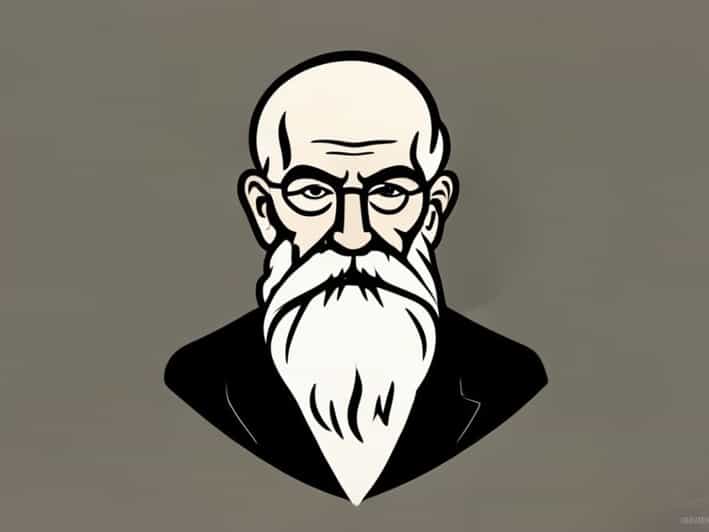
Sigmund Freud, widely regarded as the father of psychoanalysis, has often been studied for his groundbreaking contributions to the understanding of the human mind, dreams, and unconscious desires. Beyond his scientific achievements, Freud’s intellectual background and cultural environment, including his Jewish heritage, have prompted scholars to explore the connections between his ideas and Jewish mystical traditions. While Freud himself was a secular Jew and did not explicitly frame his theories within religious or mystical frameworks, some researchers argue that elements of Jewish mysticism, particularly Kabbalistic concepts, resonate subtly with his psychological theories.
Freud’s Jewish Background
Born in 1856 in Freiberg, Moravia, Sigmund Freud grew up in a Jewish family within a predominantly Christian society. Although his family was not strictly observant, Freud was exposed to Jewish cultural and intellectual traditions from an early age. His Jewish upbringing provided a rich symbolic and narrative environment, which likely influenced his fascination with human desires, morality, and inner conflict. The tension between cultural Judaism and the secular, scientific world shaped Freud’s intellectual pursuits and may have indirectly informed his interest in hidden or unconscious forces in human behavior.
Secular Judaism and Intellectual Inquiry
Freud’s approach to Judaism was largely secular. He did not participate in religious rituals and often criticized religious belief as an illusion. However, growing up in a Jewish environment steeped in tradition, storytelling, and philosophical debate exposed him to ways of thinking that valued symbolism, hidden meanings, and moral narratives. These elements echo in Freud’s work, where dreams, slips of the tongue, and neuroses are interpreted as manifestations of deeper, often concealed psychological truths.
Jewish Mystical Traditions
Jewish mysticism, particularly Kabbalah, emphasizes hidden spiritual realities, the structure of the soul, and the interconnectedness of all things. Kabbalistic thought explores the idea that what is visible in the physical world is only a surface manifestation of deeper spiritual forces. Concepts such as the sefirot, divine emanations, and the intricate balance between mystical energies provide a symbolic framework for understanding human existence in relation to the divine and the cosmos.
Core Concepts of Kabbalah
- SefirotThe ten attributes or emanations through which the infinite divine manifests in the physical and spiritual worlds.
- Ein SofThe infinite and unknowable aspect of God, which represents ultimate mystery beyond human comprehension.
- Hidden ForcesKabbalah emphasizes that the visible world is influenced by unseen spiritual forces, paralleling the notion of the unconscious mind.
- Symbolism and InterpretationMystical texts employ symbolic language, suggesting that reality is multi-layered and requires interpretation to understand its deeper truths.
The focus on hidden dimensions and symbolic interpretation in Kabbalah resonates with Freud’s exploration of the unconscious, where surface behaviors and thoughts are seen as manifestations of deeper desires and fears.
Freud and the Unconscious Mind
One of Freud’s most influential contributions to psychology is his theory of the unconscious mind. According to Freud, human behavior is often driven by unconscious desires, repressed memories, and unresolved conflicts. Dreams, in particular, serve as a window into these hidden forces, providing symbolic representations of inner psychological life. In many ways, Freud’s exploration of the unconscious mirrors the Kabbalistic belief that hidden forces shape visible reality.
Dreams and Symbolism
Freud’s interpretation of dreams relies heavily on symbolism. Just as Kabbalah uses symbols to represent spiritual truths and divine emanations, Freud argued that dreams use imagery to express repressed desires and unresolved conflicts. Both frameworks suggest that deeper understanding requires careful analysis and interpretation, whether of mystical texts or psychological phenomena.
Repression and Hidden Forces
Kabbalah teaches that human actions are influenced by unseen spiritual forces, while Freud emphasizes unconscious motivations and repressed impulses. In both systems, what is hidden significantly affects observable behavior. The idea that humans are not fully conscious of the forces driving their actions establishes a conceptual bridge between Freud’s psychology and Jewish mystical thought.
Scholarly Interpretations
Several scholars have examined possible connections between Freud’s ideas and Jewish mystical traditions. While Freud never explicitly acknowledged Kabbalistic influence, cultural and intellectual historians suggest that his upbringing in a Jewish environment shaped his symbolic thinking. The use of allegory, the focus on hidden layers of reality, and the emphasis on interpreting signs and symbols are present in both Kabbalah and Freudian psychoanalysis.
Freud as a Cultural Product
Some researchers argue that Freud’s theories should be understood within the context of Jewish intellectual culture in Central Europe. Exposure to Talmudic study, rabbinical reasoning, and mystical storytelling may have contributed to his analytical style and fascination with hidden meanings. Even though Freud’s work was scientific and secular, the structural similarities between his theories and Jewish mystical thought suggest a subtle, indirect influence.
Criticism and Debate
Despite the intriguing parallels, many scholars caution against overstating the connection between Freud and Jewish mysticism. Freud himself was critical of religious belief and viewed mystical practices as psychological phenomena rather than sources of spiritual truth. The similarities between Kabbalah and Freud’s theories may be coincidental or reflect broader human tendencies to explore hidden causes and symbolic meanings, rather than direct influence.
Balancing Influence and Innovation
It is important to recognize that Freud’s work represents a significant scientific innovation. While cultural background and exposure to Jewish mystical traditions may have shaped his intellectual lens, Freud developed a systematic and empirical framework for understanding the mind that goes beyond religious or mystical interpretation. The resonance with Jewish mysticism highlights the universality of symbolic thinking and the human desire to uncover hidden truths.
Legacy and Continuing Interest
The potential connections between Freud and Jewish mystical traditions continue to fascinate scholars, psychologists, and historians. Exploring these links provides insight into how cultural heritage can shape intellectual inquiry, even in secular or scientific contexts. Freud’s ideas about the unconscious, dreams, and repression remain influential, and examining them alongside mystical thought adds depth to our understanding of both domains.
Modern Implications
Today, Freud’s theories are applied in clinical psychology, literature, and cultural studies. Considering the potential influence of Jewish mystical traditions encourages a broader perspective on psychoanalysis, highlighting how cultural and spiritual frameworks can inform scientific thought. This intersection of psychology and mysticism provides a richer understanding of human consciousness, symbolism, and the quest for meaning.
While Sigmund Freud’s work in psychoanalysis is grounded in scientific methodology, the influence of his Jewish background and the symbolic traditions of Jewish mysticism cannot be entirely dismissed. Elements of Kabbalistic thought, such as the focus on hidden forces, symbolic interpretation, and layered realities, resonate with Freud’s exploration of the unconscious mind, repression, and dreams. Although Freud was secular and often critical of religion, his upbringing and cultural environment may have subtly shaped his intellectual approach. The study of Freud and Jewish mystical tradition demonstrates the complex interplay between cultural heritage, intellectual development, and scientific innovation, offering a nuanced perspective on one of the most influential figures in modern psychology.