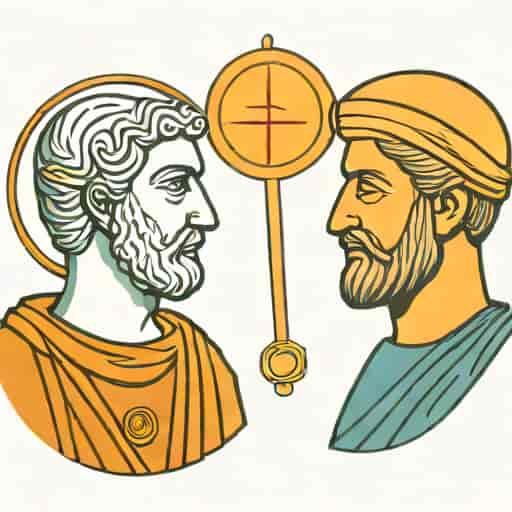
Throughout history, the ideas of Ptolemy and Aristotle dominated the fields of astronomy, physics, and natural philosophy for centuries. Aristotle’s philosophical framework and Ptolemy’s geocentric model of the universe shaped medieval and Renaissance thought, influencing scholars, scientists, and educators across Europe and the Islamic world. However, as observational techniques and mathematical understanding improved, thinkers began to question their ideas, paving the way for revolutionary shifts in science. Examining how Ptolemy’s and Aristotle’s theories were challenged reveals the evolution of human knowledge, the scientific method, and the intellectual courage required to rethink long-held beliefs.
Overview of Ptolemy’s and Aristotle’s Ideas
Before exploring the challenges to their ideas, it is important to understand the core concepts proposed by Ptolemy and Aristotle. Their theories provided a structured understanding of the universe and natural phenomena, which persisted for many centuries.
Aristotle’s Philosophical Framework
Aristotle, a Greek philosopher of the 4th century BCE, developed a comprehensive system explaining motion, causality, and the nature of the physical world. His ideas included the concept of a geocentric universe, where Earth was at the center, and natural places for elements such as earth, water, air, and fire. Aristotle also proposed principles of motion and causation that were accepted without empirical testing, emphasizing logical reasoning and observation over experimentation. His philosophy influenced not only science but also ethics, politics, and metaphysics.
Ptolemy’s Geocentric Model
Claudius Ptolemy, a Greco-Roman astronomer of the 2nd century CE, built upon Aristotle’s geocentric model to create a detailed system of planetary motion. In his work, theAlmagest, Ptolemy described planets moving in epicycles and deferents to account for retrograde motion observed from Earth. This geocentric system was mathematically sophisticated and provided a predictive framework for astronomical phenomena, which remained authoritative for over a thousand years.
Reasons for Questioning Their Ideas
Despite the dominance of Aristotle’s and Ptolemy’s theories, several factors led scholars to question their accuracy. Observational evidence, logical inconsistencies, and advancements in mathematics and instrumentation all contributed to the eventual challenge of these long-held beliefs.
Observational Evidence
One of the key reasons for questioning Ptolemy’s model was the accumulation of astronomical observations that did not align with geocentric predictions. As telescopes improved and observations became more precise, discrepancies in planetary motion, such as the irregularities in Mercury and Mars’ paths, challenged the accuracy of Ptolemaic epicycles. Similarly, Aristotle’s explanations of motion could not account for newly observed phenomena like falling bodies of different masses or the behavior of projectiles, prompting scientists to rethink his principles.
Logical Inconsistencies
Scholars also identified internal inconsistencies in Aristotle’s and Ptolemy’s theories. Aristotle’s assertion that heavier objects fall faster than lighter ones contradicted careful observations, and Ptolemy’s epicycles became increasingly complex to match observed planetary paths. These logical and mathematical complications made the models less elegant and less convincing, motivating thinkers to explore alternative explanations.
Advancements in Mathematical Techniques
Mathematical innovation played a crucial role in questioning established ideas. The development of algebra, trigonometry, and more precise geometric tools allowed astronomers to calculate planetary positions more accurately and explore models beyond simple geocentrism. These mathematical methods provided the means to test, refine, or reject traditional theories in a systematic way.
Key Figures Who Questioned Ptolemy and Aristotle
Several prominent scientists and philosophers challenged Aristotle’s and Ptolemy’s ideas, each contributing to the gradual transformation of scientific understanding during the Renaissance and early modern period.
Nicolaus Copernicus
Copernicus, a Polish astronomer of the 16th century, proposed a heliocentric model in which the Sun, not the Earth, was at the center of the universe. This revolutionary idea directly contradicted Ptolemy’s geocentric system and simplified the explanation of retrograde motion without the need for complex epicycles. Copernicus’ work,De revolutionibus orbium coelestium, laid the foundation for modern astronomy and challenged centuries of accepted wisdom.
Galileo Galilei
Galileo further challenged both Aristotle and Ptolemy through experimentation and observation. Using a telescope, he observed moons orbiting Jupiter, phases of Venus, and sunspots, all of which provided evidence against the geocentric model. Galileo also conducted experiments on falling objects, demonstrating that bodies of different weights fall at the same rate, directly contradicting Aristotle’s assertions about motion. His approach exemplified the emerging scientific method based on empirical evidence.
Johannes Kepler
Kepler refined the heliocentric model by introducing elliptical orbits, improving the predictive accuracy of planetary motion. By combining observational data from Tycho Brahe with mathematical laws, Kepler resolved inconsistencies in Ptolemy’s epicycles. His laws of planetary motion provided a more precise framework for understanding the solar system, further undermining the geocentric paradigm.
Isaac Newton
Newton synthesized the work of his predecessors, providing a comprehensive theoretical framework that explained motion and gravitation. His laws of motion and universal gravitation replaced Aristotle’s natural motion concepts and offered a unified explanation for celestial and terrestrial phenomena. Newton’s work represented the culmination of centuries of questioning and refinement, demonstrating the power of empirical evidence combined with mathematical reasoning.
Impact of Questioning Their Ideas
The questioning of Ptolemy and Aristotle transformed the trajectory of science, philosophy, and intellectual inquiry. These challenges led to a paradigm shift that laid the groundwork for modern physics, astronomy, and the scientific method.
Advancement of Scientific Thought
By critically examining the ideas of Ptolemy and Aristotle, scholars developed a more empirical and experimental approach to understanding nature. Observations and experiments became central to scientific practice, replacing reliance on authority and tradition. This shift enabled the rapid advancement of knowledge during the Scientific Revolution.
Intellectual Freedom and Inquiry
Questioning established authorities encouraged intellectual courage and curiosity. Thinkers were inspired to challenge accepted norms and pursue truth based on evidence. This cultural and intellectual shift contributed to broader developments in education, philosophy, and the arts during the Renaissance and beyond.
Foundation for Modern Science
The rejection of geocentrism and Aristotelian physics paved the way for Newtonian mechanics, modern astronomy, and eventually Einstein’s theories of relativity. Questioning long-held ideas illustrated that scientific knowledge is provisional and subject to revision, forming the core principle of scientific progress.
The ideas of Ptolemy and Aristotle were foundational in shaping early scientific and philosophical thought, yet their limitations and inaccuracies eventually prompted scrutiny and challenge. Through the work of thinkers like Copernicus, Galileo, Kepler, and Newton, their theories were systematically tested, refined, or replaced, marking a pivotal moment in the history of science. Questioning these established ideas highlighted the importance of observation, experimentation, and critical thinking in advancing human knowledge. The legacy of this intellectual courage remains central to modern science, demonstrating that progress often requires challenging long-standing assumptions and embracing evidence-based reasoning.