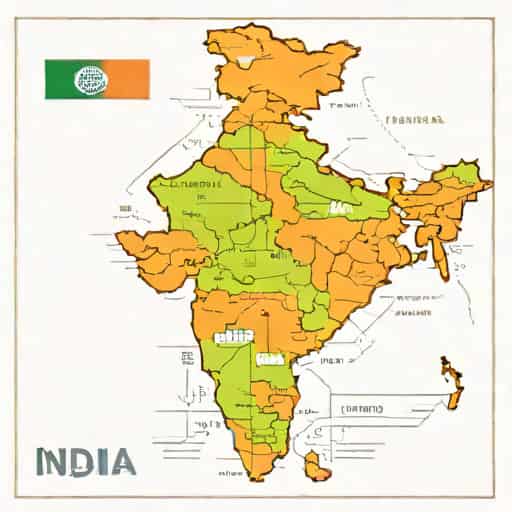
India is a vast country in South Asia, known for its diverse geography, cultures, and climates. Its territorial boundaries stretch across a significant portion of the Asian continent, making it one of the largest countries in the world both in terms of area and population. Understanding the latitudinal and longitudinal extent of India is crucial for comprehending its climatic diversity, time zones, agricultural patterns, and overall geographical significance. This topic delves into the detailed latitudinal and longitudinal range of India and explores how this affects the country’s environment and human activities.
Latitudinal Extent of India
Latitude refers to the measurement of distance north or south of the equator, expressed in degrees. India lies entirely in the Northern Hemisphere, with its territory stretching from north to south over a wide range of latitudes. The northernmost point of India is situated ataround 37°6′ Nin Jammu and Kashmir, while the southernmost point, located at Indira Point in the Andaman and Nicobar Islands, reachesapproximately 8°4′ N. This gives India a latitudinal extent of about29 degrees.
Impact of Latitudinal Range on Climate
The extensive latitudinal spread of India results in a variety of climatic zones across the country
- Himalayan Region (North)The northernmost areas experience cold alpine climates with heavy snowfall and temperate weather patterns.
- Indo-Gangetic PlainsModerate temperatures with fertile plains suitable for agriculture dominate this central northern region.
- Tropical SouthThe southernmost parts, including Kerala and Tamil Nadu, have tropical climates with high humidity and relatively stable temperatures throughout the year.
This variation in climate is directly related to India’s latitudinal positioning, influencing agriculture, vegetation, and biodiversity across the country.
Longitudinal Extent of India
Longitude measures the distance east or west of the Prime Meridian. India stretches from68°7′ Ein Gujarat, which is the westernmost point, to97°25′ Eat the easternmost point in Arunachal Pradesh. This gives India a longitudinal extent of approximately29 degrees, covering a considerable east-west distance that affects time, transportation, and communication across the country.
Impact of Longitudinal Range on Time Zones
India’s longitudinal extent creates minor variations in sunrise and sunset times across the country. While India follows a single standard time (Indian Standard Time, UTC+530), the actual local solar time can differ significantly between the eastern and western extremities. For example, sunrise in Arunachal Pradesh occurs almost two hours earlier than in Gujarat, which sometimes affects daily routines, agriculture schedules, and energy consumption.
Geographical Implications of Latitudinal and Longitudinal Extent
The combination of India’s latitudinal and longitudinal extent contributes to its remarkable geographical diversity. From the snow-capped Himalayas in the north to tropical forests and coastal regions in the south, and from arid deserts in the west to the lush valleys in the east, the country encompasses a wide array of physical features. This variation supports different types of flora and fauna, numerous agricultural zones, and varied cultural and economic activities.
Influence on Agriculture
The latitudinal and longitudinal spread allows India to cultivate a variety of crops throughout the year. In the northern plains, wheat and rice dominate, while southern regions produce tropical crops such as spices, coconuts, and rubber. The east-west climatic variations influenced by longitude also affect rainfall patterns and crop cycles, enabling multiple cropping in several states.
Influence on Biodiversity
India’s biodiversity is directly related to its geographic extent. The northern Himalayan region hosts alpine flora and fauna, whereas the Western Ghats and Eastern Ghats in the south support tropical and subtropical species. The east-west spread also creates diverse ecosystems, including deserts, wetlands, mangroves, and coastal habitats. This diversity makes India one of the 17 megadiverse countries in the world.
Strategic Importance of India’s Extent
The geographical extent of India not only affects natural and ecological aspects but also has strategic significance. The latitudinal spread brings India close to central Asia in the north and the Indian Ocean in the south, while the longitudinal extent allows it to interact with countries in both the Middle East and Southeast Asia. This positioning is crucial for trade, defense, and international relations.
Transportation and Infrastructure Challenges
Covering a wide latitudinal and longitudinal range also poses challenges for transportation and infrastructure development. Road networks, railways, and airports must cater to varied terrain and climates. For instance, constructing roads in the Himalayan region is vastly different from building highways in the coastal plains or desert areas. These geographical extents necessitate region-specific planning and sustainable development strategies.
Summary of India’s Latitudinal and Longitudinal Extent
- Latitudinal ExtentApproximately 29 degrees, from 8°4′ N (Indira Point) to 37°6′ N (Jammu & Kashmir).
- Longitudinal ExtentApproximately 29 degrees, from 68°7′ E (Gujarat) to 97°25′ E (Arunachal Pradesh).
- Influences climate diversity from alpine to tropical zones.
- Impacts agricultural patterns, biodiversity, and economic activities.
- Creates strategic significance in terms of trade, defense, and international relations.
India’s latitudinal and longitudinal extent is fundamental to understanding the country’s geographical, climatic, and ecological diversity. Stretching over 29 degrees in both north-south and east-west directions, India encompasses a wide variety of landscapes, climates, and ecosystems. This extensive range not only affects agriculture, biodiversity, and human settlement patterns but also plays a crucial role in the strategic, economic, and cultural aspects of the nation. Recognizing these extents helps in planning development, managing resources, and preserving the rich natural heritage of India. The diverse latitudinal and longitudinal spread is a defining feature that makes India unique among the nations of the world.