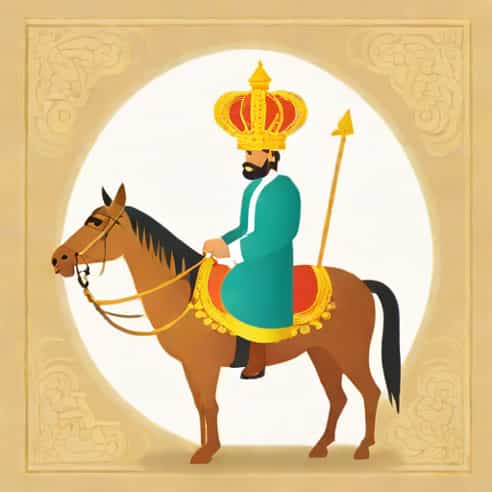
The Delhi Sultanate was one of the most significant Islamic empires in Indian history, lasting for more than three centuries and leaving a profound mark on the subcontinent’s culture, architecture, and governance. The era saw a succession of dynasties-each contributing to the development of medieval India in unique ways. However, like all empires, it eventually came to an end. The story of its last ruler, Sultan Alam Shah, marks the closing chapter of the Delhi Sultanate before the rise of the Mughal Empire. Understanding the last king of the Delhi Sultanate provides valuable insight into the decline of one of India’s greatest medieval powers.
The Decline of the Delhi Sultanate
Before exploring Sultan Alam Shah’s reign, it is essential to understand the circumstances that led to the decline of the Delhi Sultanate. The Sultanate was founded in 1206 by Qutb al-Din Aibak, a former slave of Muhammad Ghori, and it expanded significantly under subsequent rulers like Iltutmish and Alauddin Khilji. However, by the 15th century, the empire had weakened due to internal strife, corruption, and repeated invasions.
By the time the Sayyid dynasty came to power in 1414, the Sultanate’s authority had been reduced mostly to Delhi and its surrounding regions. Provincial governors had become semi-independent rulers, and foreign powers were encroaching upon Indian territories. It was within this fragile environment that Alam Shah inherited the throne.
The Rise of the Sayyid Dynasty
The Sayyid dynasty was the fourth and penultimate ruling house of the Delhi Sultanate. It was founded by Khizr Khan in 1414 after the fall of the Tughlaq dynasty. Khizr Khan had previously served as governor of Multan under the Timurids, and he claimed descent from the Prophet Muhammad through the Sayyid lineage, which lent him religious prestige.
However, unlike the powerful earlier dynasties, the Sayyids ruled a much smaller and weaker domain. They lacked the military strength and administrative organization that had once made the Delhi Sultanate a dominant power. Over time, their authority diminished further, culminating in the reign of Sultan Alam Shah, the last ruler of the dynasty and the Sultanate.
Who Was Sultan Alam Shah?
Sultan Alam Shah, whose real name was Ala-ud-Din Alam Shah, ascended the throne in 1445 following the death of his father, Muhammad Shah of the Sayyid dynasty. His reign marked the final phase of the Delhi Sultanate, which by then was struggling to maintain control even over its capital city.
Unlike many of his predecessors, Alam Shah lacked both the ambition and the resources to expand or strengthen his realm. Contemporary historians describe him as a ruler more inclined toward comfort and spiritual pursuits than military or political reform. This personal disposition contributed to the gradual erosion of the remaining power of the Sultanate.
Political Challenges and Weak Governance
By the time Alam Shah became Sultan, the political structure of the Delhi Sultanate was in disarray. Local governors and nobles acted independently, collecting taxes and maintaining armies without regard for central authority. The Sultan’s control was limited mostly to Delhi, while regions such as Punjab, Gujarat, and Bengal had long since broken away.
Moreover, the Sayyid administration faced constant pressure from regional powers like the Sharqi dynasty of Jaunpur. The Jaunpur Sultanate, under rulers such as Mahmud Shah Sharqi, sought to expand its influence toward Delhi, challenging Alam Shah’s already fragile control. With few loyal troops and little financial stability, Alam Shah was unable to resist these external threats effectively.
The Abdication of Sultan Alam Shah
One of the most remarkable aspects of Alam Shah’s reign is his decision to abdicate voluntarily-a rare occurrence among medieval monarchs. Around 1451, after ruling for about six years, Alam Shah decided to abandon Delhi and retire to Badaun, a town in present-day Uttar Pradesh. He handed control of the city and the remnants of the Sultanate to Bahlul Lodi, the Afghan governor of Punjab.
This event effectively marked the end of the Delhi Sultanate. Alam Shah lived out the remainder of his life in relative peace and obscurity in Badaun until his death in 1478. His abdication paved the way for a new political era in North India-the rise of the Lodi dynasty, which became the last ruling family before the Mughal conquest.
The Rise of the Lodi Dynasty
After Alam Shah’s departure, Bahlul Lodi established the Lodi dynasty in 1451. Bahlul was an Afghan noble who had served under the Sayyids and used his political acumen and military strength to consolidate power. Under his leadership, Delhi regained some stability and influence, although it never reached the heights of earlier Sultanate dynasties.
The Lodi dynasty lasted until 1526, when Ibrahim Lodi was defeated by Babur at the Battle of Panipat. This battle marked the beginning of the Mughal Empire and the final dissolution of the Sultanate’s legacy. In this sense, Sultan Alam Shah’s abdication was not just the end of a dynasty-it was the symbolic conclusion of an era in Indian history.
Comparing the Sayyid and Lodi Dynasties
While both the Sayyid and Lodi dynasties ruled during the declining years of the Delhi Sultanate, they differed in several ways
- OriginThe Sayyids claimed Arab descent, while the Lodis were Afghans.
- StrengthThe Sayyids were weak and largely ceremonial rulers; the Lodis were militarily stronger and sought expansion.
- LegacyThe Sayyids are remembered as the dynasty that ended the Sultanate, whereas the Lodis are seen as its final revival before the Mughal takeover.
The Legacy of Sultan Alam Shah
Sultan Alam Shah is often remembered not for his conquests or reforms but for the symbolic end of an important era. His reign reflects the fragmentation and exhaustion of a once-mighty empire. By the time he relinquished the throne, the Delhi Sultanate had already served its purpose as a bridge between the early Islamic conquests and the more centralized Mughal rule that followed.
Historians often interpret Alam Shah’s abdication as a pragmatic decision rather than a failure. Given the political chaos and lack of resources, his withdrawal from power allowed a more capable leader like Bahlul Lodi to stabilize the region. Thus, while his rule was short and uneventful, it played a quiet but crucial role in the transition of North Indian politics.
Cultural and Historical Impact of the Sultanate’s End
The end of the Delhi Sultanate marked a turning point in Indian history. Over the course of its existence, the Sultanate had introduced new administrative systems, architectural styles, and cultural exchanges between Persian, Turkic, and Indian traditions. Even after its fall, many of these influences continued under the Mughals and shaped India’s composite culture.
Monuments, mosques, and madrasas built during the Sultanate period still stand today as testaments to its legacy. The concept of centralized governance, revenue systems, and urban planning developed during this era influenced later dynasties, including the Mughals and even colonial administrations centuries later.
The story of the last king of the Delhi Sultanate, Sultan Alam Shah, is a tale of decline, transition, and renewal. His reign represents the final chapter in a long history of power struggles and cultural transformation. Although his rule was brief and largely passive, it signaled the end of medieval Islamic rule in Delhi and the beginning of a new phase under the Lodi and Mughal dynasties. The fall of the Sultanate reminds us that empires rise and fall not only through war but sometimes through quiet abdication-a reflection of both inevitability and the constant evolution of history.