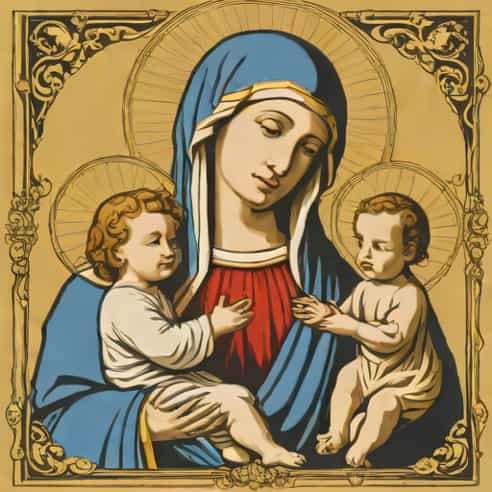
Among the many masterpieces of the Renaissance, La Madonna col Bambino by Albrecht Dürer stands out for its tender representation of motherhood and spirituality. Created by one of the greatest German artists of the 16th century, this artwork reflects Dürer’s mastery of realism, his fascination with religious themes, and his deep attention to detail. The painting of the Madonna and Child is not just a devotional image; it also serves as a profound exploration of divine love, human beauty, and artistic innovation. For art enthusiasts and historians, Dürer’s depiction of the Virgin Mary holding the infant Jesus is a window into both his artistic soul and the cultural world of the Renaissance.
The Historical Context of La Madonna col Bambino
Albrecht Dürer was born in 1471 in Nuremberg, a city that played a central role in the Northern Renaissance. During this period, artists were inspired by classical ideals from Italy but adapted them to their own cultural settings. Dürer traveled extensively, especially to Italy, where he studied the works of masters like Leonardo da Vinci and Raphael. La Madonna col Bambino, which translates to The Madonna with the Child, is one of his most beautiful interpretations of a theme that had fascinated artists for centuries. His version combines Northern precision with Italian grace, merging technical skill and emotional depth.
The Madonna and Child motif was common in Christian art, symbolizing purity, maternal love, and divine protection. In Dürer’s interpretation, these elements are treated with remarkable sensitivity. His use of light, texture, and expression gives the figures a lifelike presence that still captivates viewers today. The artwork stands as a bridge between medieval symbolism and the humanist ideals of the Renaissance.
Artistic Features and Composition
In La Madonna col Bambino, Dürer presents the Virgin Mary as a serene and gentle figure. She gazes lovingly at the infant Jesus, who rests securely in her arms. The composition draws the viewer’s attention toward their faces, emphasizing the emotional connection between mother and child. Unlike earlier, more formal depictions of the Madonna, Dürer’s version feels intimate and natural.
The background of the painting often reflects Dürer’s attention to nature. His detailed landscapes and soft lighting create an atmosphere of calmness and divine harmony. The folds of Mary’s robe are painted with incredible precision, demonstrating his mastery of texture and shadow. Dürer’s signature attention to the smallest details-such as the baby’s delicate fingers or the shimmer of fabric-reveals his belief that beauty resides in both divine and earthly forms.
Use of Color and Symbolism
The color palette in La Madonna col Bambino is rich yet balanced. Deep blues and soft reds dominate Mary’s clothing, symbolizing purity, love, and sacrifice. Gold accents may be used to highlight divinity, while the gentle glow surrounding the figures reinforces the sacred theme. Every visual element serves a symbolic purpose, guiding the viewer to reflect on spiritual truths as well as human tenderness.
Even the gesture of the child holds meaning. In some versions of Dürer’s Madonna and Child paintings, the infant Jesus raises his hand in blessing, representing his divine mission. In others, he clings affectionately to his mother, symbolizing the bond between humanity and the divine. This emotional depth is one reason Dürer’s interpretation remains timeless.
Dürer’s Technique and Influence
Albrecht Dürer was not only a painter but also a printmaker, mathematician, and theorist. His understanding of proportion, perspective, and anatomy allowed him to create figures that were both realistic and spiritually expressive. In La Madonna col Bambino, one can see his technical precision combined with emotional warmth.
He employed fine brushwork to achieve lifelike textures and subtle shading. Dürer’s mastery of chiaroscuro-the contrast between light and dark-adds depth to the scene, giving the figures a three-dimensional presence. His innovative techniques influenced many later artists in both Germany and Italy, helping to shape the course of European art.
Beyond technique, Dürer’s work expressed the growing humanist spirit of his time. By portraying sacred subjects with emotional realism, he made divine figures more relatable to ordinary people. His Madonnas were not distant icons but compassionate mothers, embodying both spiritual grace and human emotion.
The Religious and Cultural Meaning
The image of the Madonna and Child has been central to Christian devotion for centuries, representing the tender love of the Virgin Mary and the redemptive power of Jesus Christ. Dürer’s La Madonna col Bambino captures this sacred relationship in a way that speaks to both faith and art.
In the 16th century, religion played a vital role in everyday life. Paintings like this were not only admired for their beauty but also used for meditation and prayer. Viewers were encouraged to contemplate the virtues of humility, purity, and maternal love through Mary’s example. Dürer’s rendering of the Madonna connects these theological ideas to the human experience, making faith feel both personal and profound.
The Influence of Italian Renaissance Ideals
During his travels in Italy, Dürer encountered the works of Raphael and Bellini, who were masters of balance and harmony. These influences are evident in his Madonna compositions, where every element is carefully arranged to convey peace and unity. However, Dürer added his own Northern sensibility-more detailed, more introspective, and more grounded in natural observation.
This blend of Northern precision and Italian idealism gave birth to a new kind of beauty. In La Madonna col Bambino, Dürer demonstrates that art can be both spiritual and scientific, emotional and intellectual. His work helped bring the ideals of the Italian Renaissance to Northern Europe, transforming how sacred subjects were represented for generations to come.
Legacy and Lasting Appeal
Today, La Madonna col Bambino remains one of the most admired religious images in Western art. It is studied for its technical excellence, emotional impact, and cultural significance. Dürer’s devotion to detail and symbolism continues to inspire artists, historians, and admirers of sacred art around the world.
The enduring appeal of this painting lies in its universality. Even outside of its religious context, it speaks to anyone who has experienced love, care, or the bond between parent and child. Dürer’s Madonna transcends time and belief, reminding us that the essence of beauty and spirituality often lies in simple human affection.
Modern Interpretations
Art critics and scholars still debate the deeper meanings of Dürer’s Madonna paintings. Some view them as expressions of faith during a time of religious transformation; others see them as personal meditations on motherhood and purity. What remains clear is that Dürer infused his art with sincerity and intelligence, creating works that reflect both devotion and discipline.
Contemporary artists continue to reinterpret the Madonna and Child theme, but few have matched Dürer’s ability to balance divine symbolism with emotional realism. His work reminds us that great art does more than please the eye-it touches the soul and invites contemplation.
Albrecht Dürer’s La Madonna col Bambino stands as a masterpiece that unites artistry, faith, and humanity. Through his delicate portrayal of Mary and Jesus, Dürer captured the essence of love, serenity, and divine connection. His combination of technical skill and emotional depth ensures that the painting remains relevant and inspiring, even centuries after its creation. As one studies the tender expressions, the soft light, and the harmonious composition, it becomes clear that Dürer’s Madonna is not just a religious symbol-it is a timeless reflection of beauty, compassion, and the enduring power of art.