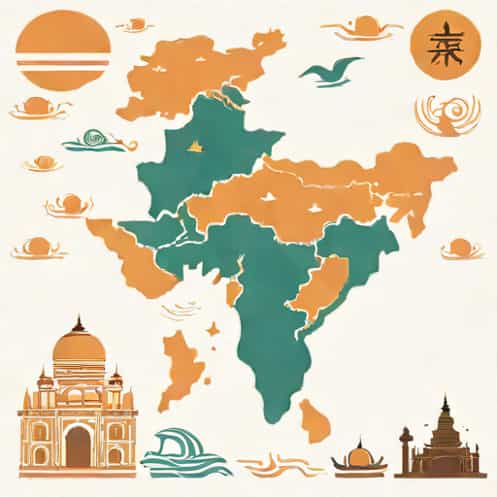
When people ask India is in which hemisphere?, they are often curious about the country’s position on the world map and how it affects its geography, climate, and seasons. India’s location plays a vital role in its diversity, from tropical beaches in the south to snowy mountains in the north. Understanding which hemisphere India lies in also helps explain why the country experiences such varied weather patterns and why its seasons are opposite to those of some other nations. Let’s explore in detail the hemispheres in which India is located and what that means geographically and climatically.
Geographical Location of India
India is situated in South Asia, bordered by countries such as Pakistan, China, Nepal, Bhutan, Bangladesh, and Myanmar. To the south, it is surrounded by the Indian Ocean, with the Arabian Sea on the west and the Bay of Bengal on the east. Geographically, India extends between latitudes 8°4² N and 37°6² N and longitudes 68°7² E and 97°25² E. This specific position places India in two major hemispheres of the Earth – the Northern Hemisphere and the Eastern Hemisphere.
India in the Northern Hemisphere
India lies entirely in the Northern Hemisphere because all of its territory is above the equator. The Northern Hemisphere includes all landmasses north of the equatorial line, which runs at 0° latitude. As a result, India experiences climatic conditions similar to other countries in this hemisphere, such as summer from March to June and winter from November to February.
Being in the Northern Hemisphere means that India’s seasons are opposite to those of countries located in the Southern Hemisphere, such as Australia and South Africa. For example, when it is summer in India, it is winter in Australia. This geographical position also affects how the sun’s rays strike the land throughout the year, influencing temperature variations and day length.
Impact of Northern Hemisphere Position
The Northern Hemisphere location impacts India’s natural environment and cultural patterns. Here are a few examples
- ClimateIndia experiences a wide range of climates, from tropical in the south to temperate and alpine in the north.
- Day and Night CycleDays are longer in the summer and shorter in the winter due to the Earth’s tilt.
- Monsoon InfluenceThe Northern Hemisphere position contributes to India’s famous monsoon season, which dominates its agricultural cycles.
- Sun PathThe sun appears in the southern part of the sky throughout the year, which is typical for countries in the Northern Hemisphere.
India in the Eastern Hemisphere
In addition to being in the Northern Hemisphere, India is also located entirely in the Eastern Hemisphere. The Eastern Hemisphere refers to the half of the Earth that lies east of the Prime Meridian, which runs through Greenwich, England, at 0° longitude. India’s longitudes – ranging from 68°7² E to 97°25² E – firmly place it in the eastern part of the world.
This location means that India is ahead of many Western countries in terms of time zones. For example, Indian Standard Time (IST) is 5 hours and 30 minutes ahead of Greenwich Mean Time (GMT+530). The Eastern Hemisphere includes many other Asian countries like China, Japan, and Indonesia, as well as parts of Europe, Africa, and Australia.
Significance of Being in the Eastern Hemisphere
India’s placement in the Eastern Hemisphere affects its time, trade, and communication with the rest of the world. Some important implications include
- Time Zone AdvantageIndia’s location allows it to work efficiently with Asian and Australian economies during their daytime hours.
- Trade RoutesBeing in the east gives India access to major international sea routes through the Indian Ocean, enhancing trade connectivity.
- Cultural and Economic LinksIndia shares its hemisphere with many nations that have historically influenced its culture, such as China and Southeast Asian countries.
India’s Coordinates and Tropic of Cancer
A unique feature of India’s geography is that the Tropic of Cancer (23°30² N latitude) passes almost through the middle of the country. This imaginary line divides India into two distinct climatic zones – the tropical region in the south and the subtropical region in the north. Because of this division, India experiences a combination of hot, humid, and moderate weather across its regions.
The presence of the Tropic of Cancer also means that the southern part of India receives more direct sunlight for a longer period during the year, contributing to its warmer climate. Northern India, on the other hand, has cooler temperatures and distinct seasonal changes.
How Hemispheres Influence India’s Climate
India’s location in both the Northern and Eastern Hemispheres greatly influences its weather and environment. The country’s climate can be broadly categorized into four main seasons summer, monsoon, post-monsoon, and winter. These variations occur due to the tilt of the Earth’s axis and India’s position north of the equator.
1. Summer Season
During the months of March to June, the sun’s rays directly hit the Northern Hemisphere, causing high temperatures across most parts of India. The northern plains and central regions often experience heatwaves, while the southern coastal regions remain relatively humid but moderate.
2. Monsoon Season
From June to September, India receives the southwest monsoon winds, which bring heavy rainfall. The monsoon is one of the defining climatic phenomena of India and is closely tied to the country’s agricultural productivity. This pattern occurs because of India’s geographical position and its exposure to both land and sea breezes within the Northern Hemisphere.
3. Post-Monsoon and Winter
After the monsoon, from October to February, the Northern Hemisphere starts tilting away from the sun. This causes cooler weather and shorter days in India. Northern states like Himachal Pradesh and Jammu & Kashmir experience snowfall, while southern regions enjoy mild, pleasant weather.
Effect of Hemispheres on Indian Culture and Agriculture
India’s position also influences its lifestyle and agriculture. Farmers plan their crops according to the hemisphere-driven seasonal patterns. For instance, crops such as rice and sugarcane thrive during the wet monsoon season, while wheat and barley are cultivated in the cooler months.
Culturally, festivals and traditions are also aligned with seasonal changes. Festivals like Makar Sankranti mark the sun’s northward movement, signifying longer days and the end of winter. These patterns are directly linked to India’s position in the Northern Hemisphere and its agricultural cycles.
Comparison with Countries in Other Hemispheres
India’s location can be better understood when compared with countries in the Southern Hemisphere. While India experiences summer in June, countries like Australia and Argentina experience winter. Similarly, during India’s winter in December, it’s summer in those southern nations. This opposite seasonal pattern happens because the Earth’s hemispheres tilt in opposite directions relative to the sun throughout the year.
To summarize, India is located in both the Northern and Eastern Hemispheres of the Earth. Its entire landmass lies north of the equator and east of the Prime Meridian. This geographical position influences everything from its time zone and trade relationships to its weather patterns and cultural traditions. The combination of hemispheric location, latitude range, and the passing of the Tropic of Cancer gives India its distinctive climate and seasonal diversity. Understanding which hemisphere India is in not only answers a simple geographical question but also reveals the deep connection between Earth’s geography and the life, culture, and environment of one of the world’s most diverse nations.