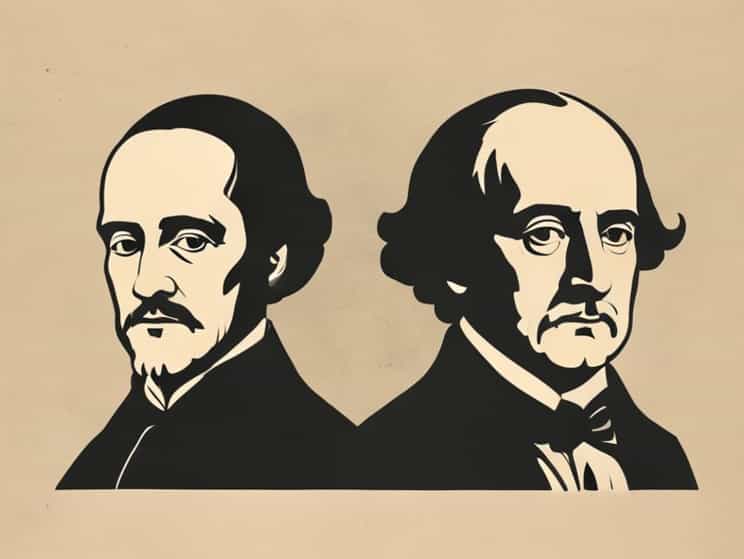
Gustave de Beaumont and Alexis de Tocqueville were two prominent French thinkers, writers, and political observers of the 19th century who are best known for their joint exploration of American society. Their travels to the United States in the 1830s provided a unique perspective on democracy, social equality, and the justice system, which they analyzed through careful observation and detailed documentation. While Tocqueville is often more widely recognized for his writings on democracy and civil society, Beaumont’s contributions, particularly regarding social reform and the prison system, are equally significant. Together, their work not only shaped political thought in France but also continues to influence modern understanding of democracy, social justice, and governance around the world.
Early Lives and Backgrounds
Alexis de Tocqueville was born in 1805 into an aristocratic family in Normandy, France. He received a classical education, studying law and developing an interest in politics and history. Tocqueville’s aristocratic background gave him insight into the workings of the French elite, but he was also deeply interested in social change and the emerging democratic ideas that were transforming Europe and the Americas.
Gustave de Beaumont, born in 1802, also came from a wealthy French family and trained in law. Beaumont shared Tocqueville’s intellectual curiosity and reformist inclinations. The two men became close friends during their studies and shared a commitment to exploring social justice and political structures. Their complementary personalities-Tocqueville’s analytical mind and Beaumont’s practical focus on social reform-made their collaboration particularly productive.
The Journey to America
In 1831, Tocqueville and Beaumont were appointed by the French government to study the American prison system. This mission, officially aimed at examining penitentiaries, provided them with a broader opportunity to observe American society. They traveled extensively, visiting prisons, courtrooms, schools, and local communities, taking careful notes on governance, social institutions, and civic life.
Observations on Democracy
Tocqueville’s observations led to his seminal work,Democracy in America, which analyzed the principles, strengths, and challenges of American democracy. He noted the importance of civil associations, the role of religion in public life, and the influence of equality on social behavior. Tocqueville admired the American system of local self-government, which he believed fostered civic responsibility and political engagement among ordinary citizens.
Beaumont’s Focus on Social Reform
While Tocqueville concentrated on political institutions and philosophical analysis, Beaumont was more concerned with practical social issues. He closely studied prisons, penal reform, and the treatment of marginalized populations, including women and the poor. Beaumont later publishedMarie, or Slavery in the United States, which focused on the moral and social consequences of slavery, highlighting his enduring concern for justice and humanitarian reform.
Key Works and Contributions
Democracy in America
Tocqueville’sDemocracy in Americaremains a cornerstone of political science and sociology. It examines the balance between liberty and equality, the dangers of tyranny of the majority, and the unique American adaptation of democratic principles. Tocqueville emphasized that equality of conditions was the defining characteristic of American society and explored both its positive effects on opportunity and its potential drawbacks in creating social conformity and mediocrity.
Marie, or Slavery in the United States
Beaumont’sMarieprovided a detailed account of slavery and its effects on both enslaved people and society at large. Beaumont was one of the first European observers to document the social and moral impact of slavery in the southern United States. His writings highlighted the contrast between American ideals of liberty and the reality of human bondage, emphasizing the ethical responsibility to address social injustices.
Prison Reform and Social Justice
Both Tocqueville and Beaumont studied the American penitentiary system with a focus on reform. They were impressed by the emphasis on rehabilitation rather than mere punishment in some states, such as Pennsylvania. Beaumont, in particular, advocated for reforms that emphasized humane treatment, education, and moral guidance for prisoners. Their work influenced prison reform debates in France and contributed to the broader conversation on social justice in Europe.
Collaboration and Intellectual Partnership
The collaboration between Tocqueville and Beaumont was based on a combination of friendship, shared intellectual curiosity, and complementary skills. Tocqueville’s philosophical and analytical perspective allowed for a deep exploration of democratic theory, while Beaumont’s practical focus ensured that social issues were thoroughly examined. Their partnership demonstrates the value of combining theoretical and applied approaches to understanding society and governance.
Methodology of Observation
During their travels, Tocqueville and Beaumont employed rigorous observational methods. They conducted interviews, attended public meetings, and studied social institutions directly. This empirical approach allowed them to develop nuanced insights and avoid overgeneralizations. Their detailed notes and firsthand accounts contributed to the accuracy and lasting impact of their publications.
Impact on Political Thought
The work of Tocqueville and Beaumont continues to influence political thought, social policy, and democratic theory. Tocqueville’s analysis of civil society, the balance of power, and the role of public opinion remains relevant in understanding modern democracies. Beaumont’s writings on social reform, particularly regarding slavery and penal systems, provide a moral framework for addressing injustice and inequality.
Influence in France
In France, their observations contributed to debates on democracy, social reform, and legal modernization. Their analysis helped shape policies aimed at improving civil institutions and protecting individual rights. The emphasis on balancing freedom with social responsibility remains a key element of French political discourse.
Global Relevance
Internationally, Tocqueville’s insights into the dynamics of democracy have informed studies in political science, sociology, and history. Scholars and policymakers continue to draw on their observations to understand how societies balance equality, liberty, and social cohesion. Beaumont’s focus on ethical and humanitarian considerations provides a template for addressing human rights and social justice issues globally.
Legacy and Recognition
While Alexis de Tocqueville is often the more celebrated figure due to the enduring influence ofDemocracy in America, Gustave de Beaumont’s contributions are equally important for their emphasis on social reform and humanitarian issues. Together, they demonstrated that careful observation, critical thinking, and ethical concern are essential to understanding society. Their work remains a model for scholars, policymakers, and reformers seeking to analyze and improve the social and political structures of their own countries.
Key Lessons from Their Work
- The importance of balancing equality and liberty in a democratic society
- The value of empirical observation in understanding social and political systems
- The necessity of addressing social injustices alongside political reform
- The enduring relevance of civil institutions and community engagement
Gustave de Beaumont and Alexis de Tocqueville were pioneering thinkers whose observations of American society provided profound insights into democracy, social reform, and human rights. Their travels, publications, and analysis highlighted the interconnections between political structures and social conditions, demonstrating the importance of both theory and practice in understanding society. Tocqueville’s focus on democratic institutions and civil society, combined with Beaumont’s dedication to social justice and reform, created a lasting intellectual partnership that continues to influence political thought, social policy, and global discussions on equality and liberty. Their legacy reminds us that understanding and improving society requires careful observation, moral awareness, and a commitment to justice.