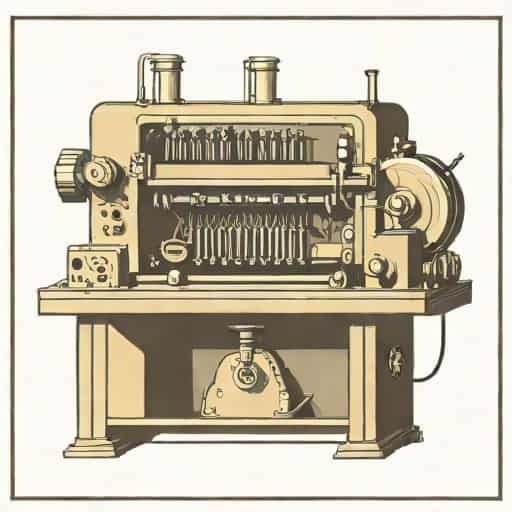
Deutsche Hollerith-Maschinen Gesellschaft mbH, often abbreviated as DEHOMAG, was a German company central to the early history of data processing and punched card technology. Founded in 1910, its story intersects with innovations in electromechanical computation, national censuses, historical upheavals, and the formation of IBM’s presence in Germany. Its legacy is complex technical achievement, commercial growth, but also moral and political entanglements during turbulent periods. This topic explores who DEHOMAG was, how it operated, and what its enduring significance is.
Origins and Founding
DEHOMAG was established on 30 November 1910 by Willy Heidinger in Berlin. The name means German Hollerith Machines Company, referencing Herman Hollerith’s punched card technology-a system of data input and processing using cards with holes to represent information. DEHOMAG acquired license rights from the Tabulating Machine Company (later becoming IBM) to manufacture, rent, and maintain Hollerith machines in Germany. This machine-based method of data tabulation was cutting-edge at the time, owing to its application in official functions like population censuses. The adoption of these machines marked an early chapter in Germany’s mechanization of data processing.
Early Operations and Growth
After its founding, DEHOMAG provided punched-card machines, card sorters, tabulators, and related equipment. Its earliest clients were German states needing census work, statistical agencies, and government bodies collecting data. Over time, private firms also became customers. The growth of administrative demands and commercial data use steadily increased its workforce. By the 1930s, DEHOMAG employed several thousand people, producing and renting out Hollerith punch card sorting and tabulating machines.
Acquisition and Relationship with IBM
Like many early technology firms, DEHOMAG’s finances were subject to external pressures. In 1922, in the aftermath of hyperinflation in Germany, the company faced license debts. To meet financial challenges, DEHOMAG sold 90% of its shares to the Computing-Tabulating-Recording Corporation (CTR), an American company led by Thomas J. Watson. CTR later renamed itself IBM in 1924. Thus, from 1922 onward, DEHOMAG was effectively a German subsidiary of what became IBM. Despite the ownership ties, it operated under German Bureaucratic and political conditions.
Operations under the Nazi Regime
During the 1930s and 1940s, DEHOMAG was deeply involved with governmental contracts, especially in national census taking and public administration. In Nazi Germany, data processing technologies like punched card machines were used for public administration, demographic surveying, and by extension, in systems that aligned with state control and surveillance. DEHOMAG’s technology was part of the infrastructure used by the state.
Product Development
DEHOMAG didn’t just rent or import machines-it also developed its own devices. One example is the tabulating machine D 11, built around 1935, which could perform tabulation of card data in ways more suited to German administrative needs. There were also sorters, punch machines, and related mechanical devices adapted to office and government use. The firm expanded its manufacturing facilities, including factories in Lichterfelde (Berlin) and Sindelfingen, among others.
Wartime and Forced Administration
With the outbreak of World War II and after the United States entered the war, DEHOMAG, as a German company owned largely by an American-rooted corporation, came under special oversight as a Feindbetrieb (enemy-operated business) for a time. There were trusteeship and advisory boards installed to regulate its operations. Some profits were placed in trust or supervised accounts. Leadership changes followed, including appointment of officials by the Reich economy ministry, removal of earlier directors, and adaptation of the company to wartime needs.
Post-War Transition and Rebranding
After the war, DEHOMAG went through reconstruction and legal and financial restitution. Berlin’s factory had suffered damage, some assets were frozen or seized during the conflict. By 1946, the company’s value was assessed, and it regained its facilities and capital to some extent. In 1949, DEHOMAG was renamed Internationale Büro-Maschinen Gesellschaft mbH, but this was simply the German form of IBM-reflecting post-war realignment and the return of full control to what had become IBM Deutschland. The renaming marked the formal transition from the old DEHOMAG identity into IBM’s German subsidiary.
Impact and Legacy
DEHOMAG’s influence extends beyond its lifespan. Some key aspects of its legacy include the following
-
Early Data Processing PioneerDEHOMAG was among the first firms in Germany to introduce mechanized data processing with punched cards. Its work laid groundwork for later computer technologies and administrative automation.
-
Technological Infrastructure for Bureaucracy and GovernmentThe machines provided by DEHOMAG supported large scale governmental tasks like censuses and statistical administration.
-
Controversial Role in Historical EventsBecause DEHOMAG’s tools were used in Nazi Germany by governmental bodies, its history is entangled with morally troubling uses of data for surveillance, identification, and persecution. Historians have researched the degree of DEHOMAG’s involvement and the responsibility of corporate entities in such misuse.
-
Evolution into IBM GermanyAfter 1949, DEHOMAG ceased to exist under its own name, but its business, staff, technologies, and patents continued under IBM Deutschland. That means its legacy also lives on in modern computing and corporate developments in Germany.
Lessons from the DEHOMAG Story
The history of Deutsche Hollerith Maschinen Gesellschaft mbH (DEHOMAG) offers several lessons relevant today in discussions about technology, ethics, business, and data privacy
-
Licensing and Global PartnershipsDEHOMAG shows how early tech firms depended on licensing foreign patents (Hollerith’s system), and how those relationships shaped corporate evolution, including mergers and acquisitions.
-
Technology and State PowerIt demonstrates how data technologies can support both productive administrative tasks and state surveillance, depending on political context. The company’s tools were neutral in design but used in state functions. This raises ethical questions about accountability in data processing.
-
Adaptation Through CrisesThe company survived inflation, war, and political upheaval by adapting changing management, ownership, rebuilding infrastructure. Yet it also paid a price in terms of complicity or forced cooperation.
-
Tech Heritage MattersThe mechanical punched card machines, tabulators, sorters and the processes pioneered by DEHOMAG are part of the technological lineage leading to modern computers, data centers, and the handling of big data. Understanding this heritage informs how we view data, privacy, and technology today.
Deutsche Hollerith Maschinen Gesellschaft mbH was more than a business-it was a pioneer in data processing technology, a witness to historical shifts, and a reminder that machines are tools shaped by their users and their contexts. Its transformation into IBM Germany reflects both continuity and change-how innovations evolve, industries adapt, and companies must navigate moral challenges as well as technical ones. Today, DEHOMAG is remembered not only for the punched cards and tabulating machines but also for the questions its history raises about technology, power, and responsibility.