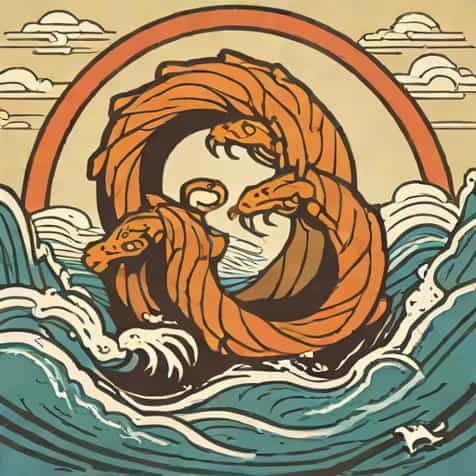
In the rich world of Greek mythology, few stories capture the imagination as vividly as the tale of Scylla and Charybdis. These two monstrous beings inhabit opposite sides of a narrow strait, presenting an impossible choice for sailors navigating the treacherous waters. The story is best known from Homer’s epic, theOdyssey, where Odysseus must carefully steer his ship to avoid destruction. Understanding what Scylla and Charybdis represent sheds light not only on ancient mythology but also on the timeless human experience of facing difficult choices where danger lurks on all sides.
The Mythical Origins of Scylla
Scylla is traditionally depicted as a fearsome sea monster with multiple heads and sharp teeth, often emerging from rocky cliffs. According to myth, she was originally a beautiful nymph, transformed by the jealous sea goddess Amphitrite into a creature that devours sailors. Positioned on one side of the strait, Scylla symbolizes imminent danger that strikes quickly and without warning. Ancient texts describe her as consuming six of Odysseus’ men at once, emphasizing the lethal threat she posed to anyone who ventured too close.
Scylla’s Symbolism
Beyond her physical depiction, Scylla represents unavoidable hazards and the destructive forces of nature. In a broader sense, she can symbolize challenges in life that are beyond human control, requiring courage, skill, and strategy to navigate. Her presence in stories underscores the idea that some dangers cannot be entirely avoided but must be confronted with careful planning and awareness.
The Mythical Origins of Charybdis
On the opposite side of the strait lies Charybdis, a massive whirlpool capable of swallowing entire ships. According to legend, Charybdis was once a mortal woman transformed into a monstrous force by Zeus as punishment for her greed. Unlike Scylla, whose threat is immediate and visible, Charybdis represents hidden dangers that can engulf those who underestimate their surroundings. The whirlpool pulls water in and spits it out, creating turbulent currents that are nearly impossible to navigate safely.
Charybdis’ Symbolism
Charybdis embodies uncontrollable and overwhelming forces that can consume individuals if they are not cautious. In life, this may represent situations where one is at risk of being overwhelmed by circumstances, emotions, or external pressures. Her character emphasizes vigilance, awareness, and the importance of strategic decision-making when facing unpredictable challenges.
The Narrow Strait Navigating Between Danger
The strait between Scylla and Charybdis is central to their story and is where the metaphorical meaning becomes clear. Sailors, including Odysseus, must navigate the narrow channel with extreme precision. Steering too close to Scylla guarantees immediate loss, while veering toward Charybdis risks being swallowed whole. The myth illustrates the concept of choosing the lesser of two evils, a principle that has entered common language as between Scylla and Charybdis. This phrase is used to describe situations where one must make difficult choices, each with its own risks.
Lessons from Navigation
The challenge of passing between Scylla and Charybdis teaches several life lessons. It emphasizes careful planning, awareness of potential dangers, and the acceptance that some risks are unavoidable. The story encourages individuals to evaluate situations thoughtfully, prioritize which dangers to confront, and accept consequences with resilience. These lessons remain relevant not only in literary contexts but also in real-life decision-making.
Scylla and Charybdis in Literature and Culture
The enduring power of these mythological creatures extends far beyond Greek epics. Writers, poets, and philosophers have drawn upon their symbolism to discuss human conflict, peril, and decision-making. In literature, the strait often represents moral dilemmas, ethical conflicts, and personal struggles. The image of navigating between two monstrous forces has become a universal metaphor for navigating complex challenges.
Modern Interpretations
Today, references to Scylla and Charybdis appear in political discourse, psychology, and everyday language. People use the expression to describe navigating between two difficult options, highlighting the relevance of ancient myths in contemporary life. The myth continues to inspire creativity in storytelling, art, and education, serving as a tool to explore the human experience of risk and consequence.
Psychological and Philosophical Implications
On a deeper level, Scylla and Charybdis can be interpreted psychologically. Scylla may represent immediate, tangible fears that one must confront, while Charybdis symbolizes underlying, uncontrollable anxieties. Together, they illustrate the complexity of human decision-making and the interplay between visible dangers and hidden threats. Philosophically, the story explores themes of fate, free will, and the inevitability of challenges in life, reinforcing the idea that resilience and strategic thinking are essential virtues.
Metaphorical Use in Everyday Life
The metaphor of navigating between Scylla and Charybdis is useful in everyday life. It can describe situations in which individuals must make difficult choices, such as balancing work and personal life, making ethical decisions in business, or navigating social and political pressures. By recognizing the dangers represented by Scylla and Charybdis, people are encouraged to approach challenges with thoughtfulness, courage, and adaptability.
Scylla and Charybdis remain among the most compelling figures in Greek mythology, representing danger, decision-making, and human resilience. The story teaches timeless lessons about facing challenges, navigating risk, and making choices when no option is without peril. From their origins in theOdysseyto their presence in modern language and culture, these mythological creatures continue to resonate. Understanding what Scylla and Charybdis are helps us appreciate the richness of myth, the complexity of human experience, and the enduring relevance of ancient stories in guiding moral, psychological, and practical decision-making today.