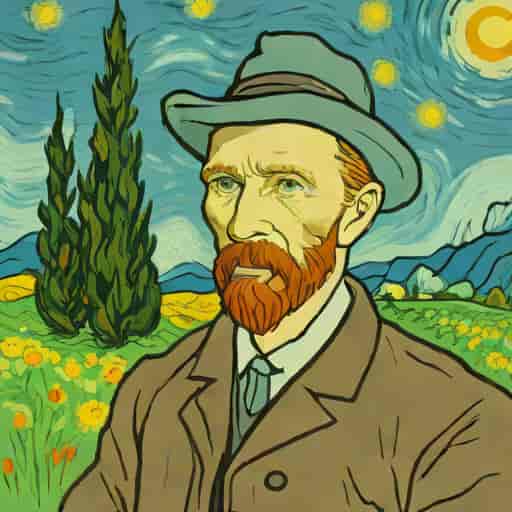
Vincent van Gogh’s portrait of Armand Roulin stands as one of the compelling examples of his late artistic period, reflecting both the intensity of his brushwork and his deep interest in capturing human emotion. Painted in 1888, this work depicts Armand Roulin, the son of Joseph Roulin, a close friend and confidant of van Gogh during his time in Arles. The portrait exemplifies van Gogh’s ability to transform a simple representation of a young man into a study of character, personality, and psychological depth. Through vivid colors, bold strokes, and an intimate perspective, van Gogh created a piece that goes beyond mere likeness to convey a rich narrative of connection, friendship, and artistic expression.
Background of Armand Roulin
Armand Roulin was the youngest son of Joseph Roulin, a postman in Arles, who became a trusted friend of Vincent van Gogh during his time in the south of France. The Roulin family frequently served as subjects in van Gogh’s portraits, allowing the artist to explore different aspects of human expression and character. Armand, as a young boy, offered van Gogh the opportunity to portray youthful innocence and familial bonds. The relationship between the artist and the Roulin family went beyond simple acquaintance, as van Gogh often found comfort and stability in their presence amid his personal struggles and mental health challenges.
Joseph Roulin and the Family Connection
- Joseph Roulin was a postman and close friend of van Gogh.
- The Roulin family became recurring subjects in van Gogh’s portraits.
- Van Gogh’s connection to the family provided emotional support during his time in Arles.
- Armand’s portrait represents the personal and artistic bond between the family and the artist.
- The series of Roulin portraits reflect van Gogh’s interest in capturing diverse human expressions.
Artistic Context
The portrait of Armand Roulin was painted during a prolific period for van Gogh in Arles, a time marked by experimentation with color, texture, and composition. This era, often referred to as his Arles period, saw van Gogh exploring intense hues, thick impasto, and dynamic brushstrokes. Portraits from this time are characterized by their emotional intensity and vibrant visual language, which van Gogh used to convey psychological depth. The depiction of Armand Roulin reflects these characteristics, emphasizing the young subject’s presence and vitality through the interplay of color and line.
Stylistic Features of the Portrait
- Bold, expressive brushwork emphasizing movement and vitality.
- Vivid color palette highlighting contrasts and emotional tone.
- Focus on facial expression to convey character and personality.
- Attention to clothing and background details to contextualize the subject.
- Use of thick impasto to create texture and dimensionality.
Symbolism and Interpretation
The portrait of Armand Roulin can be interpreted as a reflection of van Gogh’s fascination with human character and emotional authenticity. Armand’s youth and familial connection evoke themes of innocence, trust, and the significance of personal bonds. Van Gogh’s approach to the portrait goes beyond mere representation, aiming to reveal the inner life of his subject. The vibrant colors and dynamic strokes are not only aesthetic choices but also symbolic devices, conveying the vitality, energy, and emotional resonance of the young sitter.
The Role of Family in van Gogh’s Work
- Van Gogh often depicted the Roulin family to explore interpersonal relationships.
- Family portraits allowed the artist to study character development across ages.
- Armand Roulin represents youth and potential within the family series.
- The artist’s choice of family subjects reflects his search for stability and emotional connection.
- Portraits serve as both personal homage and artistic exploration of human emotion.
Technique and Medium
Van Gogh used oil on canvas for the portrait of Armand Roulin, employing techniques that highlight his mastery of color and texture. The painting features bold, dynamic brushstrokes that define the contours of the face, hair, and clothing, creating a sense of depth and movement. Van Gogh’s layering of pigments and attention to tonal variation allows the portrait to capture both the physical likeness and the psychological essence of the young subject. The medium and technique contribute to the work’s expressive power and enduring appeal.
Technical Highlights
- Use of oil paints to create rich, vibrant colors.
- Impasto technique for texture and visual depth.
- Dynamic brushstrokes conveying energy and personality.
- Attention to light and shadow for realistic yet expressive effects.
- Harmonization of background and figure to emphasize subject focus.
Reception and Legacy
The portrait of Armand Roulin, along with other Roulin family portraits, has been celebrated for its artistic innovation and emotional depth. Art historians often cite these works as prime examples of van Gogh’s ability to combine vivid color, expressive technique, and psychological insight. The painting continues to be studied for its contributions to portraiture and modern art, illustrating van Gogh’s enduring influence on subsequent generations of artists. Collectors and institutions recognize its value both as a masterpiece of technique and as a document of van Gogh’s personal and artistic world.
Impact on Art History
- Influence on modern portraiture through expressive color and brushwork.
- Recognition as part of van Gogh’s exploration of human emotion in art.
- Continued study in art history and academic research.
- Inspiration for contemporary artists seeking to merge personal narrative with visual expression.
- Integration into museum collections and exhibitions as an iconic example of late 19th-century art.
Van Gogh’s portrait of Armand Roulin remains a significant work within his body of art, illustrating his mastery of color, form, and psychological insight. By capturing both the physical likeness and inner essence of Armand, van Gogh created a piece that resonates with viewers on multiple levels. The portrait exemplifies the combination of technical skill and emotional depth that characterizes van Gogh’s most celebrated works. Through the depiction of Armand Roulin, van Gogh not only celebrated youth and familial connection but also reinforced his position as one of the most influential artists in history, whose works continue to captivate and inspire audiences worldwide.