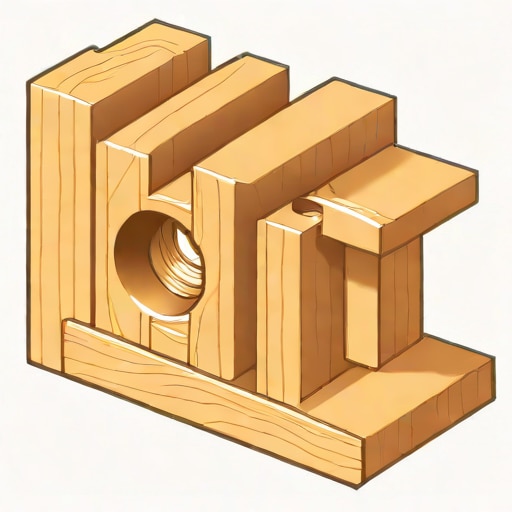
The stub mortise and tenon joint is a fundamental woodworking technique that provides both strength and simplicity in joinery. This type of joint is often used when the full length of a traditional tenon is not necessary, or when space constraints limit the depth of the mortise. Unlike standard mortise and tenon joints that extend deeply into the receiving piece, stub joints are shallower but still maintain structural integrity for many applications. Woodworkers appreciate stub mortise and tenon joints for their efficiency, ease of construction, and versatility. These joints are commonly found in furniture making, cabinet construction, and timber framing, demonstrating that even simplified versions of classic joinery can offer significant utility and durability.
Understanding the Stub Mortise and Tenon Joint
A stub mortise and tenon joint consists of two main components the mortise, which is a cavity cut into one piece of wood, and the tenon, which is a projection on the end of another piece that fits into the mortise. In a stub joint, the tenon is shorter than a typical tenon, resulting in a shallower mortise. This makes it ideal for situations where the receiving piece cannot accommodate a full-length tenon, such as in thin panels or narrow rails. Despite the reduced depth, a properly crafted stub joint can still provide a secure connection that resists twisting, pulling, and lateral movement, especially when combined with glue or mechanical fasteners.
Advantages of Stub Mortise and Tenon Joints
- Space EfficiencyStub joints require less material depth, making them suitable for thinner workpieces and compact designs.
- Ease of ConstructionThe shorter tenon and mortise make the joint easier to cut accurately, reducing the time and effort needed for assembly.
- Strong and DurableWhen properly fitted, stub mortise and tenon joints provide sufficient structural integrity for many furniture and frame applications.
- VersatilityThese joints can be used in a variety of woodworking projects, from cabinetry to lightweight timber frames, offering adaptability in design.
- Minimal Material WasteSince the mortise is shallow, less wood is removed during construction, preserving more of the original material.
Design Considerations
When designing a stub mortise and tenon joint, several factors must be considered to ensure a proper fit and optimal strength. The width and thickness of the tenon should be proportional to the mortise to achieve a snug connection without causing splitting. The depth of the mortise should balance strength with the limitations of the receiving piece. Additionally, wood selection plays a critical role; hardwoods like oak, maple, and cherry provide greater durability, while softwoods may require reinforcement. Proper planning ensures that the joint maintains its structural function while fitting within the constraints of the project.
Cutting Techniques
There are multiple ways to cut stub mortise and tenon joints, depending on the tools available and the desired precision
- Hand ToolsTraditional methods involve marking the mortise and tenon with a gauge, cutting the mortise with chisels, and sawing the tenon to size. This allows for precise control and fine adjustments for a perfect fit.
- Router or DrillPower tools like routers or drill presses can speed up mortise cutting while maintaining accuracy. Templates or guides help ensure consistency across multiple joints.
- Mortising MachineFor repetitive work or larger projects, a mortising machine can efficiently cut clean, square-ended mortises, saving time and reducing manual effort.
Tenon Crafting
The tenon in a stub mortise and tenon joint must be carefully shaped to match the mortise. Typically, the tenon has shoulders that sit flush with the surface of the wood, providing additional stability. Dry-fitting the tenon into the mortise before applying glue is recommended to check alignment and fit. Minor adjustments can be made using a chisel, rasp, or sandpaper. A well-fitted tenon ensures that the joint resists movement and maintains its strength over time.
Assembly and Finishing
Once the mortise and tenon are prepared, assembly usually involves applying wood glue to the tenon and inserting it into the mortise. Clamping the pieces together ensures uniform pressure and promotes a strong bond. Excess glue should be removed before it dries to prevent staining the wood. After curing, sanding and finishing the surrounding surfaces creates a smooth, seamless appearance. Stub mortise and tenon joints can also be reinforced with pegs, dowels, or screws for additional strength in high-stress applications.
Applications in Woodworking
Stub mortise and tenon joints are widely used across different types of woodworking projects
- CabinetryRails and stiles in cabinet doors often employ stub joints due to their space efficiency and sufficient strength.
- Furniture FramesLightweight tables, chairs, and benches can use stub joints to create strong yet simple frame connections.
- Panel AssembliesThin panels or decorative woodwork benefit from stub joints because they preserve material while providing a secure fit.
- Timber FramingIn some traditional timber frame constructions, stub joints are used for minor structural connections where full-length tenons are unnecessary.
Common Challenges
Creating stub mortise and tenon joints requires precision, and woodworkers may encounter certain challenges
- Depth AccuracyCutting the mortise too deep or too shallow can weaken the joint or affect alignment.
- Tenon FitAn overly tight tenon can split the wood, while a loose tenon reduces strength.
- AlignmentEnsuring that the mortise and tenon are perfectly aligned is crucial for flush joints and structural stability.
- Tool MarksDull tools or improper technique can leave rough surfaces, requiring additional finishing work.
Tips for Mastery
Mastering stub mortise and tenon joints comes with practice and attention to detail. Accurate marking, careful cutting, and consistent dry-fitting are essential. Using sharp tools reduces errors and allows for cleaner cuts. Sanding and fine-tuning the joint ensures a snug fit without gaps. By following proper techniques, woodworkers can achieve joints that are both strong and aesthetically pleasing, making stub mortise and tenon joints an essential skill in both traditional and modern woodworking.
The stub mortise and tenon joint is a versatile and practical solution for woodworking projects that require strong, compact connections. Its shallow design makes it suitable for thin panels and constrained spaces, while still providing structural integrity when properly executed. By understanding the principles of mortise and tenon construction, carefully crafting the tenon, and executing precise assembly, woodworkers can create durable, attractive joints. Whether used in cabinetry, furniture, or timber framing, the stub mortise and tenon joint demonstrates that simplicity and strength can coexist in joinery, making it an enduring technique in the art of woodworking.
Ultimately, stub mortise and tenon joints offer a combination of efficiency, strength, and elegance. With practice and attention to detail, these joints can enhance the quality and durability of woodworking projects, reflecting the timeless value of skilled craftsmanship and thoughtful design.