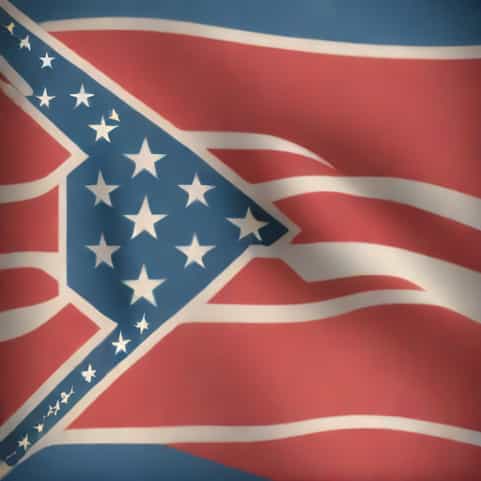
The flag commonly associated with the Confederacy is one of the most debated and historically complex symbols in American history. While many people recognize the familiar red flag with the blue cross and white stars, known today as the Confederate battle flag, it is important to understand that this was not the official national flag of the Confederate States of America. The Confederacy actually adopted several official flags during its existence from 1861 to 1865, each with distinct designs, purposes, and historical contexts. Understanding the real flag of the Confederacy requires exploring the differences between the national flags, battle flags, and the ways these symbols have been interpreted and misrepresented over time.
The First National Flag Stars and Bars
The first official national flag of the Confederate States of America was adopted on March 4, 1861, and is commonly referred to as the Stars and Bars. This flag featured three horizontal stripes-two red and one white-with a blue canton in the upper left corner containing a circle of white stars representing each member state of the Confederacy. Initially, the Stars and Bars symbolized the unity of the seceded states and served as the official national emblem for ceremonial and governmental use. However, in battle, it quickly became apparent that the flag was easily confused with the Union’s Stars and Stripes, especially at a distance, prompting the need for a distinct military banner.
Design and Symbolism
- StripesTwo red and one white stripe represented the blood of the soldiers and the purity of the Confederate cause as perceived by its leaders.
- CantonThe blue field with white stars symbolized the union of the Confederate states.
- StarsInitially seven, the stars increased to reflect the total number of seceded states, creating a sense of unity and identity.
The Confederate Battle Flag
Contrary to popular belief, the red flag with the blue X, edged in white and adorned with stars, widely recognized today as the Confederate flag, was actually the Confederate battle flag, not the official national flag. This flag was designed for military use to avoid confusion on the battlefield and became one of the most iconic symbols of the Confederacy. Commanders quickly adopted it for its distinctiveness and visibility, and over time, it came to represent the Confederate cause in public memory and popular culture.
Design Characteristics
- Cross of St. AndrewThe diagonal blue cross with white borders was inspired by the saltire and symbolized strength and unity.
- StarsThirteen stars represented the states of the Confederacy, forming a circle within the cross.
- BackgroundThe red field ensured high visibility on the battlefield and distinguished it from Union flags.
The Second National Flag Stainless Banner
In May 1863, the Confederate government introduced the Second National Flag, known as the Stainless Banner. This design incorporated the battle flag as the canton in the upper left corner, with the remainder of the flag a solid white field. The white field symbolized purity and the Confederate struggle, while the inclusion of the battle flag acknowledged its popularity and effectiveness as a military symbol. However, the all-white design led to practical issues, as it could be mistaken for a flag of surrender when fully extended or in low wind conditions.
Design and Usage
- The canton preserved the recognizable battle flag for continuity and identity.
- The extensive white field was meant to convey peace and integrity.
- The flag served primarily for official governmental and ceremonial purposes rather than active combat, although it was still used by military units.
The Third National Flag
Recognizing the practical problems with the Second National Flag, the Confederacy introduced a third national flag in March 1865. This flag retained the battle flag canton but added a vertical red stripe along the fly end. This change was intended to reduce the chance of the flag being misinterpreted as a white flag of surrender. Although adopted very late in the Confederacy’s existence, it represents the final effort to balance symbolism with practicality.
Key Features
- Retained the blue saltire with white stars in the canton.
- Added a red vertical stripe to maintain visibility and distinction.
- Served as the final official national flag of the Confederate States of America.
Common Misconceptions
Many people conflate the Confederate battle flag with the national flags of the Confederacy, leading to widespread misunderstanding about which flag truly represented the Confederate States. The battle flag, although historically significant, was never the official national symbol. This distinction is important for historical accuracy, educational purposes, and discussions about symbolism in contemporary debates. Understanding the difference helps contextualize both the historical use and the modern interpretations of Confederate imagery.
Reasons for Misinterpretation
- The battle flag’s widespread use by military units and public displays overshadowed the official national flags.
- Post-Civil War adoption in cultural and political contexts reinforced the battle flag as the emblematic symbol of the Confederacy.
- Lack of public exposure to the First, Second, and Third National Flags contributes to historical confusion.
Modern Controversy and Interpretation
The Confederate battle flag has become one of the most controversial symbols in modern America. While some view it as a representation of Southern heritage and history, others associate it with slavery, racism, and white supremacy. Historical scholarship emphasizes that while the flag has historical significance, its modern usage often carries connotations far removed from its original military context. For those studying the real flag of the Confederacy, distinguishing between historical fact and contemporary interpretation is essential.
Educational and Cultural Considerations
- Teach the distinctions between the official national flags and the battle flag to preserve historical accuracy.
- Understand the regional and cultural perspectives that have influenced the symbolism of Confederate flags over time.
- Recognize the evolving meanings as the flags have been used in political, social, and cultural contexts beyond the Civil War.
The real flag of the Confederacy encompasses a variety of designs that served different purposes from 1861 to 1865. The First National Flag, or Stars and Bars, the Second National Flag, or Stainless Banner, and the Third National Flag all reflect official government usage, while the battle flag, though iconic, was primarily a military emblem. Understanding these distinctions is essential for anyone studying American Civil War history or engaging in discussions about Confederate symbols today. Accurate knowledge of the flags’ designs, purposes, and historical contexts allows for a more nuanced comprehension of the Confederacy and its visual legacy.
- The Confederate States of America had multiple official national flags, including the Stars and Bars, Stainless Banner, and Third National Flag.
- The familiar red flag with the blue saltire and white stars was primarily a battle flag, not the national flag.
- The First National Flag was quickly adopted but caused confusion on the battlefield, prompting alternative designs.
- The Stainless Banner introduced a white field to symbolize purity but had practical visibility issues.
- The Third National Flag added a red vertical stripe to improve visibility and distinguish it from a surrender flag.
- Misconceptions about the Confederate battle flag often overshadow the official national flags in popular understanding.
- Modern interpretations of the battle flag are controversial and carry cultural and political implications.
- Historical accuracy requires distinguishing between battle flags and national flags in Civil War studies.
- Official flags of the Confederacy reflect both symbolism and practicality in the context of 19th-century warfare and government.
- Understanding the real flag of the Confederacy provides a comprehensive view of its history, usage, and legacy.