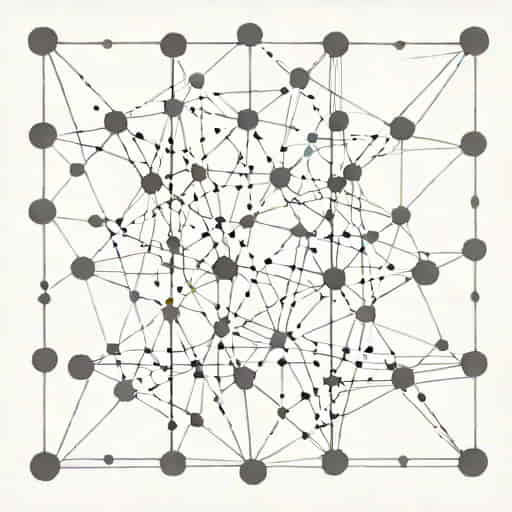
Random tensor networks with nontrivial links have become an intriguing area of study in modern theoretical physics and quantum information science. They offer a fascinating bridge between quantum entanglement, geometry, and statistical mechanics. Unlike simple tensor networks, which have straightforward link structures, random tensor networks with nontrivial links introduce complex interconnections that can mimic the behavior of curved spacetime or intricate quantum systems. Understanding their properties not only deepens our grasp of entanglement and holography but also opens doors to applications in quantum computing and condensed matter physics.
Understanding Tensor Networks
A tensor network is a mathematical framework used to represent complex quantum states efficiently. It breaks down large, high-dimensional tensors essentially multidimensional arrays into networks of smaller, interconnected tensors. These connections, called links, represent shared indices between tensors and encode correlations or entanglement between subsystems. Tensor networks simplify calculations that would otherwise be impossible due to exponential growth in data size.
In quantum physics, tensor networks serve as graphical tools that visualize and compute the structure of many-body quantum states. Popular forms include Matrix Product States (MPS), Projected Entangled Pair States (PEPS), and Multiscale Entanglement Renormalization Ansatz (MERA). Each structure has a specific purpose depending on the dimensionality and type of system under study.
What Makes Random Tensor Networks Unique
Random tensor networks (RTNs) differ from standard tensor networks because they incorporate randomness into the tensors themselves or the connections between them. Instead of assigning fixed values to tensor components, random tensors use statistically distributed values, often drawn from Gaussian ensembles. This randomness makes RTNs particularly useful for modeling complex quantum systems where exact structure is unknown but statistical behavior is predictable.
The idea is that random tensor networks capture universal properties of entanglement rather than specific microscopic details. This makes them valuable in exploring phenomena like quantum chaos, holography, and black hole information paradoxes. RTNs can approximate random quantum states that mimic those found in strongly interacting systems.
Nontrivial Links and Their Importance
The term nontrivial links refers to connections between tensors that go beyond simple or local pairings. In a trivial tensor network, each tensor might connect only to its nearest neighbors in a predictable grid pattern. However, in a network with nontrivial links, connections may span long distances, form loops, or create topologically complex structures. These nonlocal links profoundly alter the behavior and geometry of the network.
Nontrivial connections can represent long-range correlations in quantum systems, akin to entanglement between ptopics that are spatially separated. They can also simulate geometries found in theories of quantum gravity, where spacetime emerges from entangled quantum degrees of freedom.
Applications of Random Tensor Networks with Nontrivial Links
Random tensor networks with nontrivial links are not merely theoretical curiosities. They have practical and conceptual implications across multiple disciplines of physics and information theory. Their versatility allows them to describe systems ranging from quantum spin chains to emergent spacetime geometries.
- Holographic dualityRTNs provide a simplified model for the AdS/CFT correspondence, a fundamental concept in quantum gravity that connects theories of gravity in a bulk spacetime with quantum field theories on its boundary.
- Quantum error correctionNontrivial connections in RTNs naturally implement quantum error-correcting properties, reflecting how information may be preserved across complex entangled networks.
- Condensed matter systemsThey can model disordered or highly entangled materials, providing insights into phase transitions, thermalization, and quantum criticality.
- Complex network theoryRTNs share similarities with random graphs used in statistical mechanics and network science, offering bridges between quantum and classical systems.
Mathematical Structure of Random Tensor Networks
At the core of any tensor network is the contraction of indices mathematically summing over shared dimensions. In random tensor networks, these contractions are performed on randomly assigned tensors, leading to statistical properties rather than deterministic results. The geometry of the network, determined by the arrangement of links, influences how information and correlations propagate through the system.
Entanglement and Geometry
One of the most remarkable features of RTNs is their ability to relate quantum entanglement to geometric structures. In holographic theories, for example, the entanglement entropy of a region corresponds to the area of a minimal surface in a higher-dimensional space. RTNs with nontrivial links can reproduce this relationship, suggesting that spacetime geometry itself may emerge from quantum entanglement patterns.
This idea aligns with the Ryu-Takayanagi formula, which connects entanglement entropy and spatial geometry in the context of the AdS/CFT correspondence. Random tensor networks provide an accessible framework to simulate and test these ideas numerically.
Building Random Tensor Networks with Nontrivial Links
Constructing a random tensor network begins with choosing a network topology essentially a graph defining how tensors are connected. In models with nontrivial links, this topology includes both local and long-range connections. Each tensor is assigned randomly generated components, often normalized to ensure unitary or isometric properties. The contractions between tensors define the resulting quantum state.
Examples of Nontrivial Structures
- Looped NetworksIncluding closed loops allows for feedback between tensors, which affects correlation functions and entropy scaling.
- Hierarchical ConnectionsSome models use multiscale or tree-like connections that mirror the structure of MERA but include random weights.
- Hypergraph NetworksInstead of simple pairwise connections, hypergraphs link multiple tensors simultaneously, introducing complex entanglement patterns.
The resulting network often requires advanced numerical techniques to analyze, including Monte Carlo sampling or replica methods. Researchers study average properties such as entanglement entropy, correlation functions, and mutual information across random ensembles.
Recent Developments in the Field
Recent theoretical work has extended the study of random tensor networks with nontrivial links into new domains. For example, researchers are exploring how adding nonlocal or topologically constrained links changes the entanglement structure and scaling laws. Others are investigating connections to random matrix theory and statistical mechanics of disordered systems.
Moreover, there is growing interest in connecting RTNs to neural networks. Some physicists suggest that learning algorithms could optimize random tensor networks to reproduce physical observables or simulate quantum systems more efficiently. These hybrid approaches could lead to breakthroughs in both quantum simulation and artificial intelligence.
Challenges and Open Questions
Despite their promise, random tensor networks with nontrivial links pose significant challenges. Analytically computing properties across random ensembles remains complex due to the high-dimensional integrals involved. Simulating large networks also demands substantial computational resources. Moreover, while RTNs capture many qualitative features of holography and entanglement, it remains uncertain how accurately they describe real physical systems.
Another open question concerns the universality of their behavior whether different forms of randomness or link structures lead to the same macroscopic properties. Understanding this could provide deep insights into how geometry and gravity emerge from quantum information.
Future Directions
The study of random tensor networks with nontrivial links continues to expand as researchers explore new mathematical tools and computational methods. Future directions include linking RTNs to experimental realizations in quantum simulators or optical lattices. By implementing random interactions and nontrivial connectivity patterns, experimental physicists could test theoretical predictions in controlled environments.
Additionally, integrating machine learning techniques could help identify optimal network configurations for specific physical problems. As quantum computing evolves, RTNs may also serve as a foundation for new algorithms that exploit randomness for robustness and efficiency.
Random tensor networks with nontrivial links represent a fascinating frontier in the intersection of physics, mathematics, and information theory. By introducing randomness and complex connectivity, these models go beyond traditional tensor networks, capturing the essence of entanglement and emergent geometry. They offer valuable insights into quantum gravity, holography, and many-body physics, while also inspiring novel computational methods. Though challenging to analyze, their study promises to deepen our understanding of the quantum structure of reality and the intricate web connecting information, matter, and space itself.