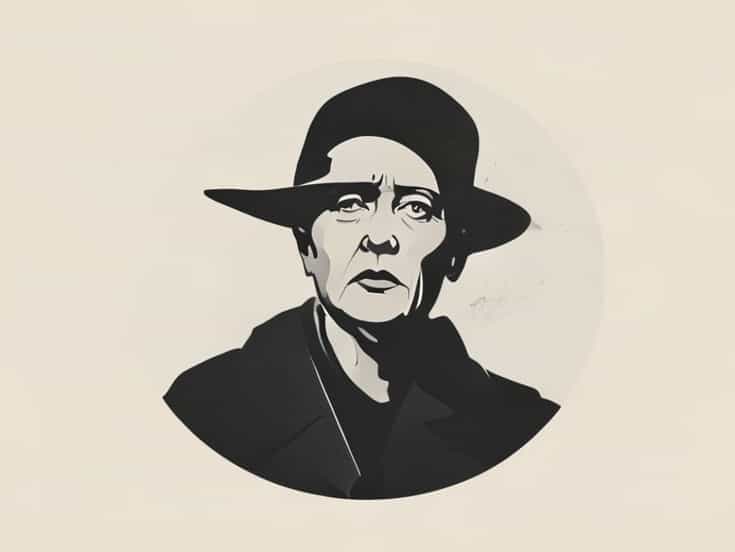
Wislawa Szymborska grew up in a Europe marked by violence, fear, and political upheaval, and the experience of war left a lasting imprint on her life and writing. Born in Poland in 1923, she came of age during one of the darkest periods of the twentieth century. World War II disrupted her education, shaped her worldview, and influenced the quiet but powerful themes that later defined her poetry. Rather than writing directly about battles or heroism, Szymborska explored the human consequences of war in subtle, reflective ways that continue to resonate with readers around the world.
Early Life in a Country at War
Wislawa Szymborska was a teenager when World War II began. Poland was invaded in 1939, and daily life quickly became dangerous and uncertain. Schools were closed or restricted under Nazi occupation, forcing many young people, including Szymborska, to pursue underground education. This experience exposed her early to the fragility of institutions and the resilience required to survive under oppression.
Living under occupation meant constant fear, shortages of basic goods, and the presence of violence as part of everyday reality. These formative years shaped her sensitivity to suffering and injustice. While she rarely described specific wartime events in her poetry, the atmosphere of threat and moral confusion became an undercurrent in her work.
The War’s Impact on Her Education and Career
The war interrupted Szymborska’s formal education, delaying her academic development. After the war ended, she resumed her studies in literature and sociology, but the intellectual environment had changed. Poland fell under communist rule, and writers were expected to conform to political expectations.
Her early career was influenced by this pressure, and some of her first published poems reflected the dominant ideology of the time. However, the experience of war had already taught her to question absolute truths and rigid narratives. This inner skepticism later led her to distance herself from propaganda and adopt a more independent poetic voice.
War as a Background, Not a Spectacle
One of the most distinctive ways war affected Wislawa Szymborska was through her refusal to dramatize it. Unlike poets who focused on vivid descriptions of combat, she chose to examine war’s aftermath and its quiet effects on ordinary people. Her poems often explore what happens after history’s loud events have passed.
This approach reflects a deep understanding that war does not end when weapons fall silent. Instead, it lingers in memory, behavior, and language. By focusing on individuals rather than armies, Szymborska highlighted how war reshapes identity and moral responsibility.
Moral Ambiguity and Human Responsibility
Experiencing war at a young age made Szymborska acutely aware of moral ambiguity. She understood that extreme circumstances force people into impossible choices. This awareness appears frequently in her poetry, where characters are rarely purely innocent or guilty.
Rather than offering moral judgments, she posed questions. Who is responsible for suffering? How does chance determine survival? Why do some lives continue while others end abruptly? These themes reflect a worldview shaped by witnessing how war disrupts simple ideas of good and evil.
The Language of Loss and Absence
War also influenced Szymborska’s treatment of loss. Her poems often deal with absence, silence, and what remains unsaid. This can be traced back to a generation marked by death, displacement, and missing voices.
Instead of expressing grief in dramatic terms, she used restraint. Simple images, everyday objects, and calm observations carry emotional weight. This understated style mirrors how people living through war learn to suppress strong emotions in order to endure.
Irony as a Response to Trauma
Irony became one of Szymborska’s most recognizable literary tools, and it can be seen as a response to the trauma of war. Faced with propaganda, lies, and exaggerated rhetoric, she learned to distrust grand declarations.
Her ironic tone allowed her to question official versions of history and expose contradictions without direct confrontation. This subtle resistance reflects lessons learned during wartime, when speaking openly could be dangerous and survival often depended on reading between the lines.
War and the Value of Ordinary Life
Another lasting effect of war on Szymborska’s poetry is her focus on ordinary life. Having witnessed how quickly normal routines can be destroyed, she developed a deep appreciation for small, everyday moments.
In many poems, she draws attention to insignificant details a room, a gesture, a passing thought. These elements become meaningful precisely because war has shown how fragile they are. Her work suggests that history is not only shaped by major events but also by countless unnoticed lives.
Distance from Heroic Narratives
Szymborska avoided heroic narratives of war that glorify sacrifice or national pride. Growing up amid destruction made her skeptical of stories that justify suffering in the name of higher causes.
Instead, she emphasized the cost of such narratives. Her poems remind readers that behind every historical slogan are individuals who experience fear, confusion, and pain. This perspective offers a quiet but powerful critique of how societies remember war.
Influence on Her Later Worldview
The war did not only affect Szymborska’s poetry; it shaped her broader worldview. She remained wary of ideologies that claim absolute certainty and valued doubt as a moral stance. This attitude can be traced back to witnessing how rigid beliefs contributed to violence and exclusion.
Her writing encourages readers to question, reflect, and remain humble in the face of history. War taught her that certainty can be dangerous, while empathy and curiosity can help preserve humanity.
Legacy of a War-Shaped Poet
Wislawa Szymborska’s experience of war left a permanent mark on her life and work, even when it remained unspoken. Rather than turning her poetry into historical testimony, she transformed wartime lessons into universal reflections on human existence.
Through irony, restraint, and attention to ordinary life, she showed how war affects not only nations but individual minds and moral choices. Her poetry continues to speak to readers because it captures the quiet, lasting impact of conflict in a way that feels both deeply personal and widely relevant.