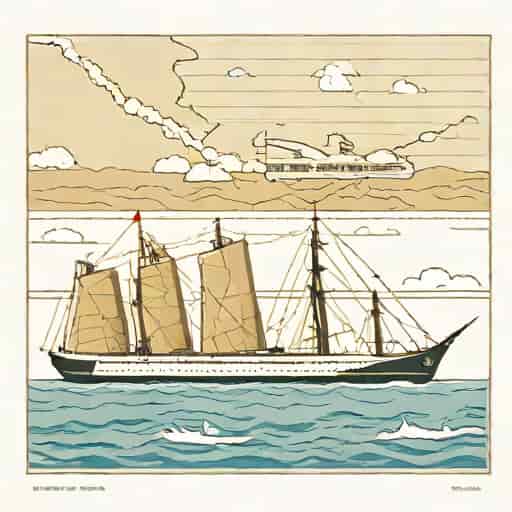
The sinking of the Titanic remains one of the most discussed maritime disasters in history, not only because of the scale of the tragedy but also because of the lingering questions surrounding it. Among the most debated issues is the nearby presence of another ship, the SS Californian. For decades, people have asked how far was the Californian from the Titanic on the night of April 14, 1912, and whether its proximity could have changed the outcome. This question blends navigation facts, eyewitness accounts, and later investigations into a complex historical puzzle.
The Night of the Titanic Disaster
On a calm and icy night in the North Atlantic, the Titanic struck an iceberg shortly before midnight. The ship was considered unsinkable by many, yet within a few hours it would be lost, taking more than 1,500 lives.
At the same time, other ships were navigating nearby shipping lanes. Among them was the SS Californian, a British cargo vessel that would later become central to controversy and blame.
Introducing the SS Californian
The SS Californian was a smaller ship compared to the Titanic, primarily used to transport cargo rather than passengers. On the night of the disaster, it had stopped for the night due to heavy ice in the area.
The ship’s engines were shut down, and its wireless operator had gone off duty, a decision that would later be heavily scrutinized.
How Far Was the Californian from the Titanic
The exact distance between the Californian and the Titanic has been debated for more than a century. Estimates vary depending on which sources and testimonies are considered.
Most modern historians and maritime experts estimate that the Californian was between 5 and 20 miles away from the Titanic at the time of the sinking.
Why Distance Estimates Vary
Navigation in 1912 relied on less precise tools than those used today. Ships calculated positions based on celestial navigation, dead reckoning, and visual observations.
Errors in recorded positions, combined with the darkness of night and the lack of clear reference points, contributed to conflicting distance estimates.
Visual Sightings Between the Ships
One of the most compelling aspects of the Californian story is that crew members reported seeing lights from another ship during the night. These lights were later believed by many to be from the Titanic.
The visibility of these lights suggests that the distance may have been closer than some estimates indicate.
What the Californian Crew Reported
- A large ship was visible on the horizon
- Rockets were seen in the sky
- The ship appeared to stop and then disappear
The Role of Signal Rockets
The Titanic fired distress rockets in an attempt to signal nearby vessels. These rockets were white, not red, which caused confusion.
The crew of the Californian saw rockets but did not interpret them as distress signals, partly due to common maritime practices at the time.
Could the Californian Have Reached the Titanic
This question is closely tied to how far the Californian was from the Titanic. If the ship was within 5 to 10 miles, it may have been able to reach the scene before the Titanic sank.
If the distance was closer to 20 miles, response time would have been longer and possibly ineffective.
Speed and Ice Conditions
The Californian was surrounded by ice fields, which had caused it to stop for the night. Navigating through ice would have slowed any rescue attempt.
Even so, some experts argue that cautious movement could still have allowed the ship to reach survivors in lifeboats.
Investigations After the Disaster
Both British and American inquiries investigated the actions of the Californian. These inquiries sought to determine responsibility and clarify the distance between the two ships.
The findings were critical of the Californian’s failure to respond, though they did not conclusively agree on an exact distance.
British Inquiry Findings
The British inquiry concluded that the Californian was close enough to have rendered assistance had it responded promptly to the rockets.
This conclusion implied a distance of less than 10 miles, though no precise measurement was established.
American Inquiry Perspective
The American inquiry was even more critical, suggesting that the Californian was in plain sight of the Titanic and ignored clear distress signals.
This view reinforced the belief that the ships were relatively close to one another.
Modern Reassessments of the Distance
In recent decades, historians and scientists have revisited the question using modern navigation analysis and simulations.
Some studies suggest that optical illusions caused by atmospheric conditions may have made ships appear closer or farther away than they actually were.
The Role of Atmospheric Refraction
Cold water and warm air can bend light in unusual ways, a phenomenon known as atmospheric refraction. This can distort the apparent position of ships and lights.
Such conditions may explain why the Californian crew misjudged the distance and size of the ship they were observing.
Estimated Distance Based on Modern Analysis
Taking into account refraction, ship speeds, and recorded positions, many modern experts place the Californian approximately 10 to 12 miles from the Titanic.
This distance suggests that while rescue was possible, it would not have been immediate or guaranteed.
Why the Distance Still Matters Today
The question of how far was the Californian from the Titanic is not just about miles and nautical charts. It represents a broader discussion about responsibility, communication, and decision-making in emergencies.
The tragedy led to major changes in maritime safety regulations, including 24-hour radio monitoring.
Lessons Learned from the Californian Controversy
The events of that night highlighted the dangers of miscommunication and assumption. The Californian crew did not fully understand the signals they saw.
This misunderstanding, combined with uncertainty about distance, contributed to inaction.
Public Opinion and Historical Debate
Public opinion has often been harsh toward the Californian, viewing it as a ship that failed to act when lives were at stake.
However, historians continue to debate whether the crew’s decisions were reasonable given the information they had at the time.
So, how far was the Californian from the Titanic? While estimates range from about 5 to 20 miles, most modern analyses place the distance at roughly 10 to 12 miles. This distance was close enough that the Californian could see the Titanic’s lights and rockets, yet far enough to create uncertainty and hesitation.
The enduring mystery surrounding this distance reminds us that small gaps in communication and understanding can have enormous consequences. The story of the Californian remains a powerful lesson in maritime history, emphasizing the importance of vigilance, clarity, and timely action at sea.