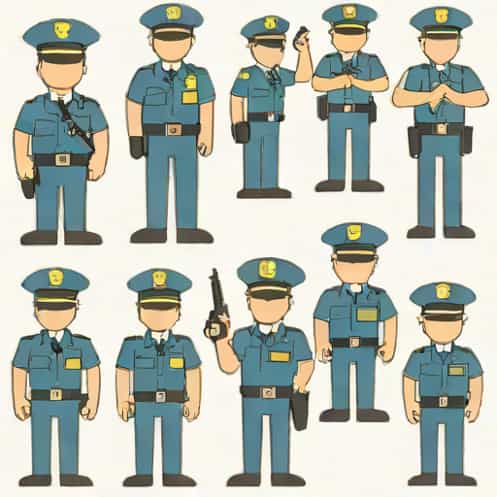
When people refer to a group of policemen, they often wonder what the correct collective noun should be. While English has specific group terms for animals like a flock of birds or a pack of wolves, collective nouns for professions can be more flexible. The phrase group of policemen may sound simple, but in everyday and formal English, there are several words that can describe this collective depending on the situation, the number of officers, and the context in which they operate. Understanding these terms gives insight not only into language but also into the structure of law enforcement itself.
Common Terms for a Group of Policemen
In English, there isn’t just one universally accepted term for a group of policemen. Several collective nouns are used, each carrying its own nuance and tone. Here are the most common ones you might encounter
- Police ForceThis is the most widely accepted and formal collective term for policemen. It refers to an organized body responsible for maintaining law and order in a specific region. For example, we say The New York Police Force or The local police force responded quickly.
- Police DepartmentA more administrative term, used particularly in the United States. It refers to the official organization of police officers working under a jurisdiction, such as The Los Angeles Police Department.
- SquadA smaller, specialized group within a police department, often assigned to particular duties such as narcotics, homicide, or traffic control. For instance, The homicide squad arrived at the crime scene.
- UnitSimilar to a squad, a unit typically refers to a team of officers trained for specific operations like bomb disposal, SWAT missions, or cybercrime investigation.
- PatrolThis term is used to describe officers working together to monitor a certain area. A patrol might include a few officers traveling in vehicles or on foot to maintain public safety.
These terms are often interchangeable depending on how formal or specific one wishes to be. While force is broad and institutional, squad or unit refers to smaller, operational groups within that force.
Historical Origin of the Term Police Force
The phrase police force dates back to the 19th century, when modern policing systems began to form. The word police itself comes from the Greek term polis, meaning city, and the French word policer, which means to maintain order. Early forms of organized law enforcement appeared in ancient civilizations, but the concept of a structured and uniformed force was popularized in England with the creation of the Metropolitan Police Service in 1829, founded by Sir Robert Peel. This is why British policemen are still sometimes called Bobbies, a nickname derived from Peel’s first name.
From then on, the idea of a police force spread worldwide, symbolizing discipline, hierarchy, and authority. The collective noun force emphasizes the organized and powerful nature of policing, distinguishing it from informal groups or temporary assemblies of officers.
Regional Variations in Terminology
Different countries and cultures have adopted their own collective nouns or terminologies for a group of policemen. The meaning can slightly shift based on context and local usage. Here’s how it varies across regions
- United StatesPolice department and squad are common. Officers often work in smaller squads within the larger department.
- United KingdomPolice force or constabulary is typical. The term Metropolitan Police or simply the Met refers to the police service of London.
- IndiaThe term police department or police service is used. In some states, divisions like crime branch or special task force describe specific groups.
- Canada and AustraliaPolice service is preferred, highlighting the community-oriented aspect of law enforcement rather than the authoritative tone of force.
These differences reflect cultural perspectives on law enforcement. For instance, countries emphasizing community relations may prefer service, while those focusing on authority and order might retain force.
Other Informal Collective Nouns for Policemen
Aside from formal and institutional terms, English speakers sometimes use informal collective nouns or phrases when referring to policemen in a casual or humorous tone. These are not official but can appear in media, literature, or everyday conversation
- A squad of policemenOften used in crime stories or movies when referring to a group responding to an incident.
- A patrol of officersSuggests a smaller team assigned to a specific area or street.
- A troop of policeLess common but used metaphorically to describe a large gathering of officers, especially during major events or protests.
- A line of policemenRefers to officers standing together, such as during crowd control situations.
While not grammatically incorrect, some of these terms sound unusual in formal writing. For official contexts, police force or department remains the preferred choice.
The Role and Organization of a Police Force
To understand why police force is such a fitting collective noun, it helps to look at how policing is organized. A police force is a structured organization, often divided into ranks, divisions, and units. Each group has its duties, from community policing to criminal investigation. This hierarchy reflects coordination and discipline-qualities that justify the term force.
For example, within one police department, there may be
- A traffic control unit responsible for road safety and accident response.
- A detective squad handling criminal investigations and intelligence gathering.
- A special operations team (such as SWAT) for high-risk missions.
- Administrative officers managing documentation and communication.
These teams, though distinct, work together under one command, symbolizing the strength and unity of the entire force.
Why Collective Nouns Matter
Collective nouns like group, force, or squad do more than describe quantity-they express character. Calling a collection of policemen a force conveys authority and power. Referring to them as a service highlights protection and community engagement. Meanwhile, unit or squad reflects teamwork and specialization. Language shapes perception, so the choice of word can influence how society views its police.
In communication, especially in journalism, accuracy in terminology matters. For instance, writing a squad of officers arrested the suspect gives a sense of a tactical, coordinated action, while the police force arrested the suspect implies institutional involvement.
So, what is a group of policemen called? The most appropriate collective noun depends on context. Formally, it’s called a police force or police department. Within that structure, smaller groups may be referred to as a unit, squad, or patrol. Informally, people might simply say a group of policemen without sounding incorrect. Each term carries its own tone-some emphasizing authority, others teamwork or service.
Understanding these distinctions not only enhances your English vocabulary but also provides insight into how society views law enforcement. Whether you’re writing a report, studying English, or simply curious about language, knowing that a group of policemen is often called a police force gives you a clearer, more precise way to express one of the most vital institutions in any community.