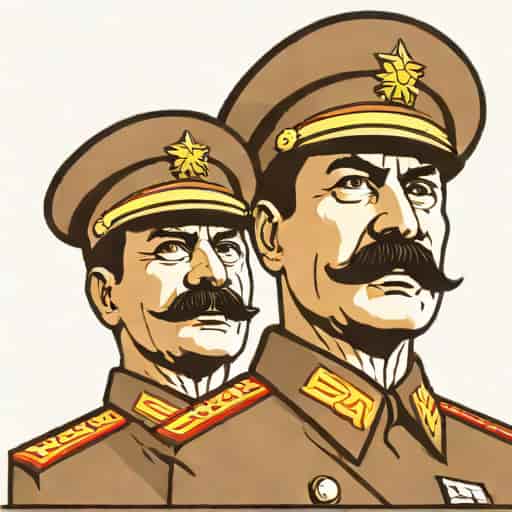
The collectivisation policy of Joseph Stalin was one of the most transformative and controversial initiatives in Soviet history, fundamentally reshaping agriculture, rural society, and the Soviet economy. Launched in the late 1920s and continuing through the 1930s, collectivisation aimed to consolidate individual peasant farms into large, state-controlled collective farms known as kolkhozes and sovkhozes. This policy was presented as a step toward modernising agriculture, increasing production, and financing rapid industrialisation. However, it was also marked by widespread resistance, social upheaval, and severe human suffering, making it a defining aspect of Stalin’s rule and Soviet history.
Background of Collectivisation
Following the Russian Revolution of 1917 and the civil war that ensued, the Soviet Union faced the challenge of rebuilding its economy. Agriculture was largely traditional, inefficient, and fragmented, with millions of peasants owning small plots of land. The state sought to accelerate industrialisation to compete with Western powers, and it required significant grain supplies and financial resources to achieve this goal. Stalin and the Communist Party argued that collectivisation would increase agricultural efficiency, enable mechanisation, and ensure a steady supply of grain for urban workers and export markets.
Objectives of Stalin’s Collectivisation Policy
- Consolidation of LandMerge individual peasant plots into collective farms to centralize control over agriculture.
- Increased Grain ProductionEnsure surplus grain could be used to feed urban populations and support industrialisation.
- MechanisationPromote the use of tractors, ploughs, and other machinery to modernize farming techniques.
- Political ControlReduce the independence of wealthier peasants (kulaks) and strengthen state authority in rural areas.
- Financing IndustrialisationGenerate revenue through grain sales domestically and internationally to fund industrial projects.
Implementation of Collectivisation
The policy began in earnest in 1929, when Stalin announced the acceleration of collectivisation as part of the first Five-Year Plan. The process was highly coercive and often violent. Peasants were pressured to join collective farms voluntarily, but those who resisted, particularly wealthier kulaks, were labeled as enemies of the state and faced persecution, deportation, or execution. Local party officials and the secret police played a major role in enforcing compliance, often using propaganda, intimidation, and punitive measures to achieve the goals of the policy.
Formation of Collective Farms
Collective farms, or kolkhozes, were formed by pooling land, livestock, and equipment from individual peasants. Farmers worked together and shared output according to labor contribution and state quotas. Sovkhozes were state-run farms where workers received wages rather than profits. The state set production targets and determined the distribution of grain, leaving little room for individual initiative. While the government promised that collectivisation would improve productivity, the disruption of traditional farming methods and the loss of personal incentives often had the opposite effect in the short term.
Resistance and Repression
Resistance to collectivisation was widespread among peasants who were reluctant to surrender their land, livestock, and independence. Some peasants slaughtered their animals rather than hand them over to the state, while others destroyed crops or fled to urban areas. The state responded with brutal repression, targeting kulaks as class enemies. Many were executed, sent to labor camps, or exiled to remote regions such as Siberia. This campaign of repression was intended to break opposition, consolidate state control, and send a warning to other peasants about the consequences of defiance.
The Kulak Problem
Kulaks were wealthier peasants who owned more land and resources than the average farmer. Stalin portrayed them as exploiters of poorer peasants and obstacles to socialist progress. The campaign against kulaks involved confiscation of property, arrests, deportations, and executions. This not only eliminated a perceived class threat but also instilled fear in rural populations, ensuring compliance with collectivisation policies. However, it also removed experienced farmers from the agricultural system, contributing to inefficiencies and reduced productivity in the short term.
Impact on Agriculture and Society
The collectivisation policy had profound effects on Soviet agriculture and rural life. While it succeeded in creating large, centralized farms, it also caused significant disruption. Many peasants lacked the skills or motivation to work effectively on collective farms, and mechanisation efforts were often limited by shortages of equipment and expertise. Grain production initially fell, contributing to food shortages and famines in several regions. The most catastrophic of these was the Holodomor in Ukraine from 1932 to 1933, which resulted in millions of deaths due to starvation.
Social Changes
Collectivisation transformed the social structure of the countryside. Traditional village communities were reorganized into collective units, and private ownership of land was largely eliminated. The policy strengthened the Communist Party’s presence in rural areas, as local officials oversaw production, distribution, and ideological education. Peasants became dependent on the state for access to resources, and rural life was fundamentally altered. Despite these hardships, the policy eventually allowed the state to maintain control over agricultural production and secure resources for industrialisation.
Economic and Political Outcomes
From an economic perspective, collectivisation was a mixed success. In the short term, it caused disruptions, famine, and widespread suffering. However, by the late 1930s, the Soviet state had established greater control over agriculture, enabling it to extract grain for urban consumption and export. This extraction helped finance industrialisation projects, contributing to the rapid development of heavy industry and infrastructure in the Soviet Union. Politically, collectivisation solidified Stalin’s authority and demonstrated the power of the state over individual citizens, reinforcing the totalitarian nature of the regime.
Long-Term Consequences
While collectivisation achieved some of its goals, such as state control of agriculture and support for industrialisation, it came at enormous human and social cost. Millions of peasants suffered from famine, displacement, and violence. The policy also disrupted traditional farming knowledge and practices, which affected productivity for years. Despite these challenges, collectivisation remained a central feature of Soviet economic policy throughout Stalin’s rule and shaped the structure of Soviet agriculture for decades.
Stalin’s collectivisation policy was a radical attempt to reshape the Soviet countryside, increase agricultural production, and support industrialisation. It involved the forced consolidation of individual farms into collective and state-run units, accompanied by widespread repression and violence against those who resisted. While the policy ultimately strengthened state control and contributed to economic development, it also caused immense human suffering, famine, and social upheaval. Collectivisation remains one of the most significant and controversial aspects of Stalin’s rule, illustrating the tensions between state power, economic goals, and the lives of ordinary citizens. Understanding this policy provides insight into the mechanisms of authoritarian governance, the costs of rapid social engineering, and the historical context of Soviet industrialisation and political control.