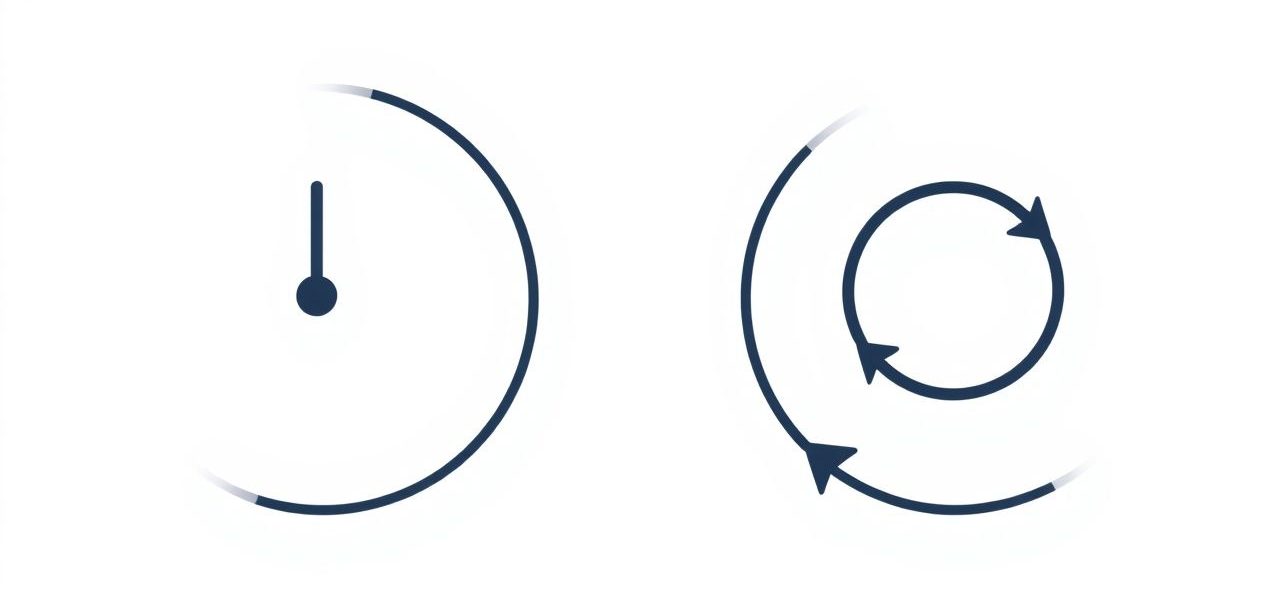
Understanding the concept of clockwise and anticlockwise movement is essential in many areas of life, from learning directions to interpreting scientific and mathematical diagrams. These two terms describe the direction of rotation or movement around a central point. Clockwise refers to the same direction as the hands of a clock, while anticlockwise (also called counterclockwise) is the opposite direction. These movements are commonly used in geometry, physics, sports, and even daily routines. By exploring practical clockwise and anticlockwise examples, students and learners of all ages can develop spatial awareness and directional understanding.
Definition of Clockwise and Anticlockwise
What Does Clockwise Mean?
Clockwise means rotating or moving in the same direction as the hands on a traditional analog clock: from the top to the right, then down, to the left, and back up.
What Does Anticlockwise Mean?
Anticlockwise is the reverse of clockwise. It refers to rotation or movement in the opposite direction to a clock’s hands: from the top to the left, then down, to the right, and back up.
Examples of Clockwise Movement
1. Clock Hands
The most common and obvious example is the movement of the hands on a clock. The hour, minute, and second hands all move clockwise.
2. Screwing a Bolt
Turning a screwdriver to tighten most screws or bolts typically requires a clockwise motion. Righty-tighty is a popular phrase that helps people remember this.
3. Car Racetracks
Some motor racing tracks, especially in the United States, have cars running in a clockwise direction.
4. Turning a Key to Lock
In many locks, turning a key clockwise engages the lock mechanism, securing the door or drawer.
5. Volume Knobs
Traditional radio or speaker knobs increase the volume when turned clockwise.
6. Microwave Plate
The rotating plate inside most microwave ovens turns clockwise during operation.
7. Stirring Liquid
If you stir a drink with a spoon in a clockwise manner, the liquid swirls in the same direction. This example is easy to visualize and replicate.
Examples of Anticlockwise Movement
1. Ceiling Fan Rotation
Some ceiling fans rotate anticlockwise during summer to push air downward and cool the room.
2. Opening a Jar
Most jar lids need to be turned anticlockwise to open. The phrase lefty-loosey is often used to remember this action.
3. Bicycle Pedals (Backward)
Pedaling backward on a bicycle rotates the pedals anticlockwise. Though it doesn’t usually move the bike, it demonstrates the direction clearly.
4. Undoing Screws
To loosen screws, bolts, or nuts, you usually turn them anticlockwise. This applies to many types of fasteners in mechanical work.
5. Gymnastic and Dance Spins
Many gymnasts and dancers spin anticlockwise during performances, especially when turning left from the center position.
6. Wall Clocks in a Mirror
Looking at a clock through a mirror creates an illusion of anticlockwise movement. This makes an interesting teaching example for understanding direction.
7. Washing Machine Drum
Some washing machines alternate between clockwise and anticlockwise rotations to clean clothes more effectively. The anticlockwise motion helps balance and redistribute the load.
Applications of Clockwise and Anticlockwise Concepts
1. In Geometry
In geometric transformations, particularly rotation, clockwise and anticlockwise are used to describe the direction in which a shape is turned around a point. Angles are often measured accordingly, with clockwise rotations considered negative and anticlockwise positive.
2. In Physics and Engineering
Torque and angular momentum are concepts in physics where direction matters. A clockwise torque may indicate a force turning an object right, while anticlockwise suggests the opposite. These terms are fundamental in mechanical engineering.
3. In Navigation and Map Reading
Understanding clockwise and anticlockwise directions is helpful when reading compasses or following directional instructions, especially when turning left or right around a central point.
4. In Everyday Problem Solving
Simple activities like changing a light bulb, unscrewing a cap, or using tools rely on understanding these directions. Teaching kids with examples like opening jars or turning knobs helps build practical skills.
Activities to Teach Clockwise and Anticlockwise
- Clock Drawing: Have children draw a clock face and use arrows to show clockwise and anticlockwise movement.
- Simon Says Game: Give instructions like turn your hand clockwise or walk in an anticlockwise circle.
- Paper Spinner: Create a paper spinner and rotate it to demonstrate directions.
- Dance Steps: Teach simple dance moves or spins that require rotating left (anticlockwise) or right (clockwise).
How to Remember the Difference
Use the Clock as a Guide
Since everyone is familiar with a standard clock, visualize the hands moving from 12 to 3 to 6 to 9 to 12 again. That’s clockwise. Reversing that flow is anticlockwise.
Righty-Tighty, Lefty-Loosey
This common saying helps people remember that turning things to the right (clockwise) tightens, and to the left (anticlockwise) loosens. It’s especially useful for tools and jars.
Use Arrows and Labels
Draw arrows with CW for clockwise and ACW for anticlockwise next to actions or diagrams in notebooks. Visual reinforcement helps with memory.
Real-Life Examples for Kids
- Toy Cars: Some remote-controlled cars can turn in circles; ask children which way the car is turning.
- Playground Swings: Observe how a roundabout moves sometimes clockwise, sometimes anticlockwise depending on who pushes.
- Spinning Tops: Let kids spin tops and identify the direction they rotate.
- Games with Dice: Move game pieces clockwise or anticlockwise on the board depending on the rules.
Importance of Direction in Motion
Mathematical Precision
In math and physics, the difference between clockwise and anticlockwise motion is more than just a direction. It can affect calculations of force, momentum, and rotational angles.
Understanding Mechanics
In engineering, wrong rotation direction can cause mechanical failure. That’s why understanding clockwise vs. anticlockwise motion is vital in tool usage and machine maintenance.
Effective Communication
When giving instructions especially in technical or safety-critical settings using the correct directional terms prevents confusion and errors.
Learning the difference between clockwise and anticlockwise movement is more than a classroom exercise it’s a skill used every day. From opening jars to driving, using tools, and navigating maps, these directional terms are part of daily life. Clear understanding and plenty of practice with clockwise and anticlockwise examples make it easier to grasp and apply these concepts across a wide range of practical and academic situations. Whether teaching children or training adults in technical fields, illustrating real-world examples helps reinforce the importance and meaning of these essential directional movements.