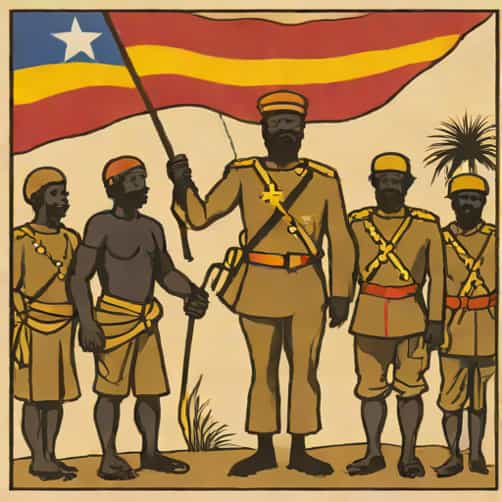
The Belgian enslavement of Congo remains one of the darkest and most tragic chapters in human history. During the late 19th and early 20th centuries, millions of Congolese people suffered under a brutal colonial regime that was driven by greed, exploitation, and the desire for profit. What began as a European king’s private project turned into a system of forced labor, violence, and unimaginable suffering. The legacy of this period continues to shape the Congo’s history, identity, and struggle for justice even today.
The Origins of Belgian Rule in Congo
The story of the Belgian enslavement of Congo begins with King Leopold II of Belgium. In the 1870s, Leopold sought to expand his power and wealth by establishing colonies overseas. Using the guise of humanitarian and scientific exploration, he commissioned expeditions into Central Africa, led by explorers like Henry Morton Stanley. Leopold claimed that his mission was to bring civilization, Christianity, and progress to Africa. However, his true goal was to gain control of Congo’s rich natural resources.
By 1885, at the Berlin Conference, European powers officially recognized Leopold’s claim to the Congo Free State a vast territory roughly the size of Western Europe. Despite the name, the Congo Free State was anything but free. It was the private property of King Leopold, who ruled it independently from the Belgian government. Under his rule, Congo became a site of one of the most exploitative and violent systems of forced labor ever recorded.
The Exploitation of Natural Resources
The Belgian enslavement of Congo was primarily driven by economic motives. The region was rich in valuable natural resources, including ivory, rubber, and minerals. With the invention of the automobile and the growing demand for rubber, Leopold saw an opportunity to make enormous profits. The Congolese population was forced to collect rubber from wild vines deep in the forests, a task that required long hours of labor under harsh conditions.
Villages were given quotas of rubber they had to produce each month. If they failed to meet these demands, they faced severe punishment. Men, women, and even children were subjected to whipping, mutilation, and execution. One of the most infamous atrocities was the practice of cutting off the hands of workers who did not fulfill their quotas, as a form of proof for the overseers that bullets were not wasted.
System of Forced Labor
The Belgian colonial administration created a system that essentially enslaved the Congolese population. Villagers were forced into labor for months at a time without pay. Soldiers of the Force Publique, a colonial army made up of African conscripts under Belgian officers, enforced these brutal labor policies. The soldiers often burned villages, kidnapped family members, and executed resisters to maintain control.
The forced labor system extended beyond rubber production. Congolese people were also compelled to build roads, railways, and infrastructure for European settlers. They were treated not as human beings but as tools for the enrichment of the colonial state and the European elite.
Consequences of Brutality
The results of this exploitation were catastrophic. Historians estimate that between 1885 and 1908, the population of Congo was reduced by as many as 10 million people due to killings, famine, disease, and the collapse of traditional society. Entire communities were destroyed, and the trauma of violence left deep scars that would persist for generations.
Families were torn apart, local economies were disrupted, and cultural traditions were undermined. The psychological impact of living under constant threat of punishment and death had a lasting effect on the Congolese people. It is no exaggeration to describe Leopold’s rule as a genocide driven by economic greed and imperial ambition.
The Role of International Pressure
As reports of the atrocities in Congo began to spread, international outrage grew. Missionaries, journalists, and humanitarian organizations played a key role in exposing the horrors of the Belgian regime. One of the most significant figures in this movement was British journalist E.D. Morel, who documented the abuses in his publications and helped found the Congo Reform Association.
Morel’s efforts, along with testimony from missionaries such as George Washington Williams and Roger Casement, brought global attention to the crimes being committed in the Congo Free State. Graphic reports and photographs showing mutilated victims shocked the public and forced European governments to take notice. Under mounting international pressure, King Leopold was eventually compelled to hand over control of the Congo Free State to the Belgian government in 1908.
The Transition to the Belgian Congo
Although Leopold’s personal rule ended, the suffering of the Congolese people did not immediately stop. The territory became a formal Belgian colony known as the Belgian Congo. While some of the worst atrocities were reduced, forced labor and racial discrimination continued under the new administration. The Belgian government maintained strict control over political and economic life, and Congolese citizens remained excluded from positions of power.
Education was limited, and the economy was structured to serve Belgian interests. Raw materials were extracted and sent to Europe, while the Congolese population received little benefit from their labor. Social mobility was nearly impossible, and any attempts to resist or demand equality were suppressed.
Legacy of Colonialism
The long-term impact of the Belgian enslavement of Congo is still visible today. The colonial system destroyed traditional governance structures, created deep economic inequality, and set the stage for political instability. When Congo finally gained independence in 1960, it lacked the infrastructure, education, and leadership necessary to build a stable government.
The country has since faced decades of conflict, corruption, and exploitation much of it tied to the same natural resources that once attracted European colonizers. The psychological and social scars left by centuries of violence continue to affect the nation’s development and identity.
Remembering the Victims
Recognizing the suffering of the Congolese people during this period is crucial for understanding both African and European history. Millions of men, women, and children lost their lives in a system that prioritized wealth over humanity. Their stories deserve to be remembered, not only as a warning against future atrocities but also as a call for justice and historical accountability.
In recent years, there have been growing calls for Belgium to acknowledge and apologize for its colonial crimes. Statues of King Leopold II have been protested or removed, and discussions about reparations and education have gained momentum. These efforts represent small but important steps toward confronting a painful past that has too often been ignored.
Lessons from the Belgian Enslavement of Congo
The tragedy of the Belgian enslavement of Congo serves as a powerful reminder of the dangers of unchecked power and greed. It exposes how the language of civilization and progress was used to justify exploitation and violence. The episode also illustrates the importance of international advocacy and awareness it was only through global pressure that reform became possible.
- It highlights the need for ethical governance and transparency in global trade.
- It demonstrates the value of human rights movements in exposing injustice.
- It emphasizes the long-term consequences of colonialism on nations and peoples.
- It reminds us that history must be remembered honestly, even when it is painful.
The Belgian enslavement of Congo was not just a historical tragedy it was a profound moral failure that continues to echo across generations. Millions of innocent lives were destroyed in the pursuit of wealth and empire. The events of this period reveal the depths of cruelty that can arise when human beings are stripped of their dignity and reduced to mere instruments of profit. Understanding and acknowledging this history is essential, not only for honoring those who suffered but also for ensuring that such injustices never occur again.
Today, as the world continues to grapple with issues of exploitation, inequality, and racial injustice, the lessons from the Congo remain as relevant as ever. Remembering the past is not simply about mourning it is about learning, changing, and committing to a more just and humane future.