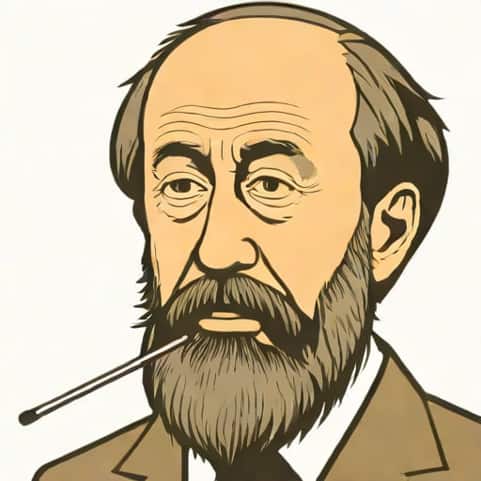
Aleksandr Solzhenitsyn is widely regarded as one of the most influential Russian writers and dissidents of the 20th century, best known for his critical works exposing the brutal realities of the Soviet Union’s labor camp system and authoritarian regime. His literature provided a powerful and unflinching insight into political oppression, forced labor, and the human spirit’s resilience under extreme conditions. Solzhenitsyn’s work gained international attention not only for its literary merit but also for its courage in confronting a government that sought to suppress truth and dissent. His writings helped shape global understanding of Soviet life and contributed to broader discussions about freedom, morality, and human dignity.
Early Life and Background
Aleksandr Isayevich Solzhenitsyn was born on December 11, 1918, in Kislovodsk, Russia. He grew up during a tumultuous period in Russian history, witnessing the aftermath of the Russian Revolution and the establishment of the Soviet regime. His early experiences in a society marked by political repression and ideological control would later influence his literary perspective. Solzhenitsyn studied mathematics and physics before joining the Soviet Army during World War II, where he served as an artillery officer and began to observe the harsh realities of the Soviet system firsthand.
World War II and Imprisonment
During World War II, Solzhenitsyn’s criticisms of Stalin and the Soviet government led to his arrest in 1945 for writing derogatory comments in private letters. He was sentenced to eight years in a labor camp followed by internal exile. His experiences in the Gulag-a network of forced labor camps-formed the basis for much of his later writing. Solzhenitsyn’s time in the camps exposed him to the extreme suffering, injustice, and moral compromises endured by millions under Soviet rule, providing a harrowing foundation for his literary career.
Major Literary Works
Solzhenitsyn’s literary reputation rests on several key works that combine historical documentation, personal experience, and narrative storytelling to explore the human cost of political oppression.
One Day in the Life of Ivan Denisovich
Published in 1962, this novella recounts a single day in the life of a prisoner in a Soviet labor camp. The protagonist, Ivan Denisovich Shukhov, endures grueling physical labor, meager rations, and harsh conditions, yet finds moments of personal dignity and small victories. The book’s publication in the Soviet Union was groundbreaking because it openly discussed the existence of the Gulag system and criticized the regime’s treatment of political prisoners. It became an international sensation and established Solzhenitsyn as a major literary and political figure.
The Gulag Archipelago
Solzhenitsyn’s three-volume work, The Gulag Archipelago, is considered his most significant and influential contribution. Written between 1958 and 1968, it documents the Soviet forced labor camp system in meticulous detail, combining survivor testimonies, historical research, and personal observation. The work exposes the extent of state terror, mass arrests, and systemic abuses, painting a comprehensive picture of the mechanisms used to control and oppress citizens. The Gulag Archipelago had a profound impact internationally, influencing public perception of the Soviet Union and contributing to discussions about human rights and totalitarianism.
Other Notable Works
- Matryona’s PlaceA short story highlighting rural Russian life and moral values under Soviet conditions.
- Cancer WardA novel set in a hospital that explores the physical and psychological effects of living under an oppressive regime.
- August 1914Historical fiction examining the early days of World War I and the decline of Imperial Russia.
Themes in Solzhenitsyn’s Writing
Solzhenitsyn’s work is characterized by recurring themes that reflect his deep engagement with morality, politics, and human resilience.
Exposing Political Oppression
One of Solzhenitsyn’s most important contributions was revealing the brutality of the Soviet political system. His writing detailed the arbitrary arrests, forced labor, and systemic violence that defined life under Stalinist rule. By documenting these realities, Solzhenitsyn became a moral witness to the suffering of millions.
Moral and Spiritual Exploration
Many of Solzhenitsyn’s works explore questions of conscience, ethics, and the struggle between good and evil. His characters often face profound moral dilemmas, demonstrating the complexities of human behavior in oppressive conditions. This emphasis on spiritual integrity and moral courage became central to his literary philosophy.
Resilience and Human Dignity
Despite the bleak subject matter, Solzhenitsyn’s works emphasize the human capacity for resilience, hope, and personal dignity. Characters like Ivan Denisovich find ways to assert their individuality and moral strength, offering a testament to the enduring human spirit even in the face of extreme adversity.
Recognition and Controversy
Solzhenitsyn received international acclaim for his courage and literary skill. He was awarded the Nobel Prize in Literature in 1970 for his ethical commitment to literature and his exposure of Soviet injustices. However, his works also generated controversy both within and outside Russia. The Soviet government viewed him as a dissident and a threat, eventually expelling him from the country in 1974. In the West, some criticized him for conservative social views, though his literary achievements were widely respected.
Exile and Later Life
After his expulsion from the Soviet Union, Solzhenitsyn lived in the United States, where he continued writing and speaking out about political and cultural issues. In 1994, after the fall of the Soviet Union, he returned to Russia, where he spent the remainder of his life focusing on historical and philosophical works until his death in 2008.
Legacy
Aleksandr Solzhenitsyn is best known for his role as a chronicler of Soviet repression and a defender of moral and ethical principles in literature. His works continue to be studied for their historical importance, literary merit, and insight into the human condition under totalitarian regimes. By documenting the lives of ordinary people under extraordinary oppression, Solzhenitsyn left an enduring legacy that combines literary artistry with moral testimony.
Influence on Literature and History
- Inspired a generation of writers and journalists to explore human rights abuses and political oppression.
- Raised global awareness of the realities of life under Soviet rule.
- Demonstrated the power of literature as a tool for social and ethical critique.
Aleksandr Solzhenitsyn is best known for exposing the harsh realities of the Soviet Union through his writings, particularly in works like One Day in the Life of Ivan Denisovich and The Gulag Archipelago. His literature combines personal experience, historical research, and moral reflection to create a vivid portrayal of human endurance in the face of political oppression. Beyond his literary contributions, Solzhenitsyn’s courage and ethical commitment have made him a symbol of resistance to tyranny and an enduring voice for human dignity and freedom. His influence extends beyond literature into global conversations about justice, morality, and the responsibilities of citizens and governments alike.