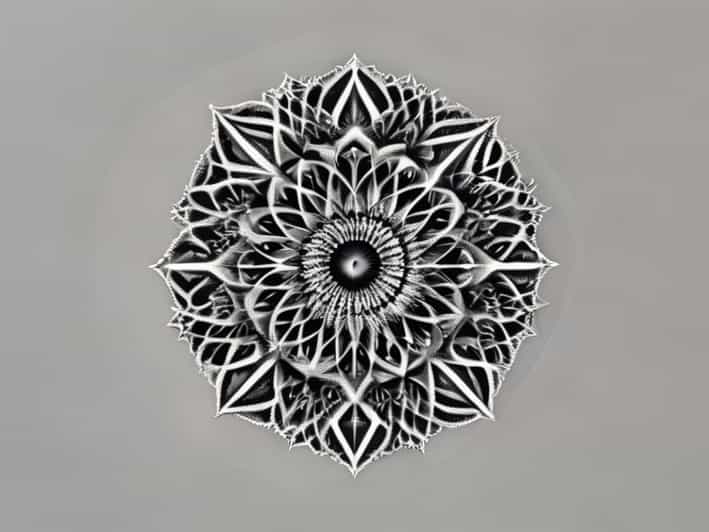
The concept of fractal geometry in nature, particularly the work of Benoît Mandelbrot, has revolutionized the way we understand patterns and structures in the natural world. Fractals are complex shapes that display self-similarity, meaning that their patterns repeat at different scales. In nature, these patterns can be observed in phenomena such as coastlines, mountain ranges, clouds, tree branches, and even the structure of blood vessels. Mandelbrot’s exploration of fractal geometry provided a mathematical framework to describe irregular and fragmented shapes that traditional Euclidean geometry could not easily explain. Understanding la geometría fractal de la naturaleza Mandelbrot allows scientists, artists, and mathematicians to analyze natural forms with greater precision and insight, revealing the hidden order within apparent chaos.
What is Fractal Geometry?
Fractal geometry is a branch of mathematics that studies shapes exhibiting self-similarity and complex patterns that repeat at different scales. Unlike classical geometry, which deals with smooth and regular forms such as circles and triangles, fractal geometry can describe irregular and fragmented structures found in nature. The concept was popularized by Benoît Mandelbrot in the 20th century, who coined the term fractal to capture the idea of shapes that are too irregular to be described by traditional geometric concepts but exhibit an underlying pattern or order.
Characteristics of Fractals
- Self-similarity Parts of the fractal resemble the whole structure at various scales.
- Complexity from simplicity Simple mathematical rules can generate intricate and infinitely detailed patterns.
- Fractional dimension Fractals can have dimensions that are not whole numbers, reflecting their complexity.
- Iteration Fractals are often created through repeated mathematical processes or algorithms.
- Natural appearance Many fractals mimic patterns observed in nature, making them valuable for modeling real-world phenomena.
Mandelbrot and the Study of Fractals
Benoît Mandelbrot, a mathematician of Polish-French descent, introduced fractal geometry in the 1970s and demonstrated its relevance to natural phenomena. He observed that many objects in nature, from clouds and mountains to rivers and coastlines, displayed patterns that were self-similar across different scales. Mandelbrot’s work challenged the traditional view that natural forms could be explained solely through Euclidean geometry. His famous Mandelbrot set, a visual representation of complex mathematical equations, became an iconic symbol of fractal geometry and provided a foundation for analyzing natural and abstract patterns mathematically.
Significance of Mandelbrot’s Work
- Provided a mathematical framework for studying irregular natural shapes.
- Demonstrated that complexity in nature could emerge from simple iterative rules.
- Enhanced understanding of phenomena like turbulence, biological growth, and geological formations.
- Influenced computer graphics, art, and modeling techniques based on fractal principles.
- Opened new avenues for interdisciplinary research linking mathematics, physics, and biology.
Fractal Geometry in Nature
Fractal geometry is evident in numerous natural forms and processes. One of the most striking examples is the branching pattern of trees and blood vessels. Both systems exhibit self-similarity, as small branches resemble larger ones, and small blood vessels mimic the structure of larger arteries. Coastlines also display fractal properties, with smaller curves and indentations replicating the overall shape of the coastline. Other examples include mountain ranges, clouds, snowflakes, lightning bolts, and certain plant structures. The fractal approach allows scientists to measure and model these complex forms more accurately than traditional geometry.
Examples of Natural Fractals
- Tree branches The recursive pattern of branches and twigs follows fractal geometry principles.
- Coastlines Measuring a coastline reveals repeating curves at different scales, a phenomenon known as the coastline paradox.
- Clouds Cloud formations display irregular, self-similar shapes that can be modeled using fractals.
- River networks River branching patterns exhibit fractal-like distribution, with smaller tributaries resembling larger rivers.
- Mountain ranges The ruggedness of mountains can be analyzed using fractal dimensions to describe their irregular surfaces.
Applications of Fractal Geometry
The study of fractals has applications in various fields, extending beyond pure mathematics to practical problems and technological innovations. Scientists use fractal models to analyze phenomena that exhibit complex patterns, predict natural behavior, or simulate environmental processes. In medicine, fractal geometry helps in understanding biological structures like the branching of the lungs or blood vessels. In computer graphics and digital art, fractals enable the creation of realistic landscapes, textures, and procedural designs. Fractals also play a role in physics, signal processing, and even economics, demonstrating the broad relevance of Mandelbrot’s insights.
Key Applications
- Environmental modeling Fractals are used to study terrains, coastlines, and forest patterns.
- Medical imaging Fractal analysis helps interpret the complexity of organs and biological networks.
- Computer graphics Fractal algorithms generate realistic natural scenes and textures.
- Physics and engineering Modeling turbulent flows, material structures, and network connectivity.
- Financial markets Mandelbrot applied fractal mathematics to analyze irregular patterns in stock prices and economic data.
The Mandelbrot Set and Its Importance
The Mandelbrot set is a mathematical set of points in the complex plane that produces a distinctive fractal shape when plotted. It is defined by a simple iterative equation, yet its visualization reveals infinitely complex boundaries that never repeat exactly. The Mandelbrot set became a symbol of fractal geometry because it visually demonstrates how simple rules can generate infinite complexity. In studying nature, the Mandelbrot set provides a conceptual model to understand self-similarity, recursive patterns, and the idea that complexity can arise naturally without external design. This insight bridges mathematics and natural observation, showing the power of fractal thinking in scientific exploration.
Implications for Science and Art
- Encourages interdisciplinary research by connecting mathematics with natural sciences.
- Inspires digital art and creative visualizations based on fractal patterns.
- Helps scientists develop accurate models for predicting natural phenomena.
- Offers insights into chaotic systems and the underlying order in seemingly random structures.
- Promotes the use of computational methods to analyze and simulate complex systems.
La geometría fractal de la naturaleza Mandelbrot offers a powerful lens through which to understand the complexity and beauty of the natural world. By identifying self-similar patterns, iterative processes, and fractional dimensions, fractal geometry provides a framework for analyzing forms that traditional Euclidean geometry cannot explain. From the branching of trees and blood vessels to the shapes of coastlines and clouds, fractals reveal hidden order and consistency in nature’s apparent chaos. Mandelbrot’s contributions have influenced mathematics, science, art, and technology, demonstrating that simplicity and complexity coexist in natural systems. Understanding fractals allows us to appreciate the intricate patterns that govern the world around us and provides tools for modeling, predicting, and creating in ways that were previously unimaginable.