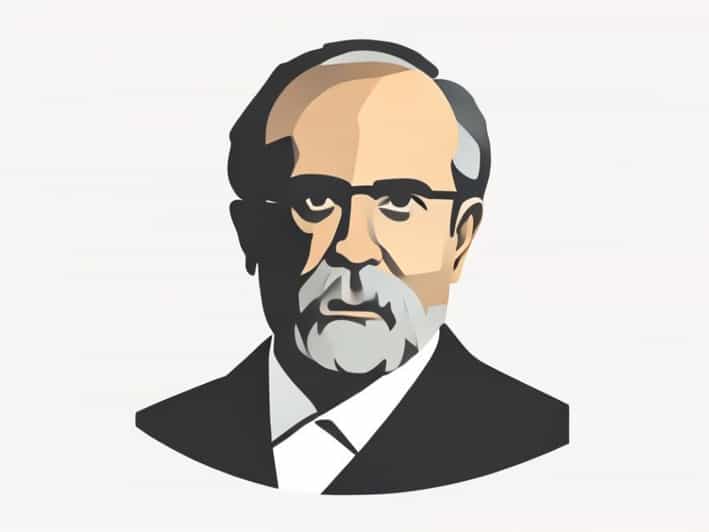
Paul A. Samuelson is widely regarded as one of the founders of modern economics, whose contributions shaped the way economists analyze and understand markets, policy, and global financial systems. Born in 1915, Samuelson’s work bridged theoretical concepts with practical applications, making economics more scientific and mathematically rigorous. Over his long and influential career, he developed groundbreaking models, authored foundational textbooks, and received the Nobel Prize in Economic Sciences in 1970. His research has left a lasting legacy in areas such as consumer theory, public finance, welfare economics, and international trade, influencing both academics and policymakers around the world.
Early Life and Education
Paul Anthony Samuelson was born in Gary, Indiana, and showed an early interest in mathematics and economics. His academic talents earned him a place at the University of Chicago, where he studied under influential economists and developed a strong foundation in economic theory. Later, he pursued graduate studies at Harvard University, where he refined his understanding of advanced economic analysis and began exploring the application of mathematical methods to economics. Samuelson’s early exposure to rigorous academic environments prepared him for a career that would revolutionize economic thought.
Influences and Mentors
- Joseph Schumpeter, whose theories on innovation and economic cycles influenced Samuelson’s thinking.
- Alfred Marshall, whose principles of microeconomics helped Samuelson understand consumer and firm behavior.
- John Maynard Keynes, whose ideas on macroeconomics inspired Samuelson’s work in stabilizing national economies.
These influences guided Samuelson in combining classical economics with modern mathematical approaches, setting the stage for his contributions to the field.
Contributions to Economics
Samuelson’s impact on economics is vast, with key contributions that transformed the discipline into a more analytical and empirical science. He emphasized the use of mathematics to model economic behavior, which allowed for more precise predictions and policy analysis.
Consumer Theory and Welfare Economics
One of Samuelson’s most notable contributions was in consumer theory, where he introduced the concept of revealed preference. This approach allows economists to infer consumer preferences based on observed choices, without relying solely on utility functions. In welfare economics, Samuelson developed models to evaluate how different policies and market conditions affect societal well-being, providing tools to assess efficiency and equity in economic systems.
Foundations of Modern Macroeconomics
Samuelson also played a pivotal role in modern macroeconomics, particularly in synthesizing Keynesian principles with neoclassical methods. He formalized the Keynesian model, creating a framework for analyzing fiscal and monetary policy’s impact on employment, inflation, and economic growth. This synthesis, often referred to as the neoclassical synthesis, became the standard approach for economic analysis in the mid-20th century and influenced governments’ economic policies worldwide.
International Trade and Finance
In the field of international economics, Samuelson contributed to the understanding of trade theory and capital flows. He helped develop the factor-price equalization theorem, which explains how trade affects wages and returns on capital in different countries. His work laid the foundation for modern trade policy analysis and international economic theory, helping economists understand the benefits and complexities of global trade.
Textbooks and Educational Legacy
Paul Samuelson was not only a leading researcher but also a transformative educator. His textbook, Economics An Introductory Analysis, first published in 1948, became one of the most widely used economics textbooks in the world. By combining rigorous analysis with clear explanations and real-world examples, Samuelson made complex economic concepts accessible to generations of students. The textbook went through multiple editions and translations, influencing economic education globally.
Key Features of Samuelson’s Textbook
- Integration of microeconomics and macroeconomics in a cohesive framework.
- Use of mathematical models to explain economic principles.
- Illustrations of economic theory through practical examples.
- Focus on policy implications and real-world applications.
Through his textbooks, Samuelson trained millions of students, many of whom became economists, policymakers, and business leaders, extending his influence far beyond his own research.
Nobel Prize and Recognition
In 1970, Paul A. Samuelson became the first American to receive the Nobel Memorial Prize in Economic Sciences. The award recognized his pioneering work in transforming economics into a mathematically grounded, analytical discipline. Samuelson’s Nobel Prize highlighted his contributions to economic theory, policy analysis, and the practical application of economics in society. His recognition cemented his status as a leading figure in the history of modern economics.
Impact of Nobel Recognition
- Raised the profile of economics as a scientific discipline.
- Validated the use of mathematical methods in economic research.
- Encouraged future economists to pursue rigorous theoretical and empirical analysis.
- Enhanced the global influence of American economic thought.
Influence on Policy and Society
Samuelson’s work extended beyond academia into practical policy. His research provided guidance on issues such as taxation, social welfare programs, monetary policy, and international trade. Policymakers around the world used Samuelson’s models and frameworks to make informed decisions aimed at stabilizing economies, promoting growth, and improving social welfare. His ability to bridge theory and practice made him a trusted advisor and thought leader in economic policy circles.
Legacy in Policy and Governance
- Frameworks for assessing fiscal and monetary policies.
- Models for evaluating social welfare programs and taxation systems.
- Guidance on trade agreements and international economic policies.
- Influence on central banks and governmental economic planning.
Honors, Awards, and Continued Relevance
Beyond the Nobel Prize, Samuelson received numerous honors, fellowships, and awards recognizing his contributions to economics. His work continues to be cited, studied, and built upon in contemporary economic research. Scholars still rely on Samuelson’s models and approaches to analyze current economic challenges, from financial crises to international trade disputes and social policy debates. His ideas remain central to both theoretical and applied economics.
Enduring Influence
- Foundation for modern microeconomics and macroeconomics.
- Influence on generations of economists through education and mentorship.
- Application of economic theory to policy-making and global finance.
- Continued relevance in economic modeling, research, and teaching.
Paul A. Samuelson, the founder of modern economics, revolutionized the field through his innovative research, teaching, and policy work. His contributions to consumer theory, welfare economics, macroeconomic analysis, and international trade laid the foundation for contemporary economic thought. Through his textbooks, he educated millions of students and shaped generations of economists. Samuelson’s Nobel Prize and global recognition reflect his profound impact on both theory and practice. Today, his legacy endures in economic research, policy-making, and education, solidifying his role as one of the most influential economists of the 20th century and a true pioneer in modern economics.