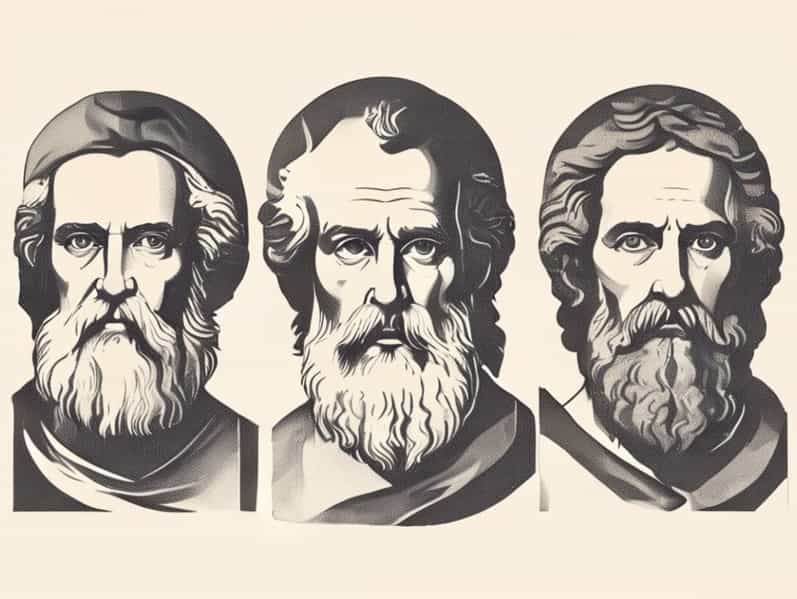
Long before modern science developed tools to observe atoms and subatomic ptopics, ancient Greek thinkers were already asking deep questions about the nature of reality. Among them, Leucippus and his student Democritus stand out for proposing a bold and influential idea that everything in the universe is made of tiny, indivisible ptopics moving in empty space. Their ideas, often grouped under the term atomism, challenged mythological explanations and laid early foundations for scientific thinking. Understanding the five main principles of Leucippus and Democritus helps explain how early philosophy shaped later views of matter, nature, and existence itself.
Background of Leucippus and Democritus
Leucippus is considered the founder of atomism, though very little is known about his life. Democritus, his more famous student, expanded and systematized these ideas, ensuring their survival through later writings and references. Together, they developed a materialistic view of the universe that rejected supernatural causes and focused instead on natural laws.
Their philosophy was revolutionary because it claimed that the complexity of the world could be explained by simple principles. Rather than gods shaping every event, they argued that natural processes governed by necessity were enough to explain reality.
Principle One Everything Is Made of Atoms and Void
The most fundamental principle of Leucippus and Democritus is that all things consist of atoms and void. Atoms are tiny, solid, indivisible ptopics, while the void is empty space that allows atoms to move.
This idea directly opposed other philosophers, such as Parmenides, who denied the existence of empty space. For the atomists, the void was essential. Without it, motion would be impossible, and change could not occur.
Why Atoms and Void Matter
According to this principle, everything we see, touch, or experience results from different arrangements of atoms in the void. There are no mysterious substances beyond these two elements. This simple framework allowed the atomists to explain diversity in nature using a small number of basic concepts.
Principle Two Atoms Are Indivisible and Eternal
Leucippus and Democritus argued that atoms cannot be divided into smaller parts. The word atom itself comes from a Greek term meaning uncuttable. Atoms are also eternal, meaning they are never created or destroyed.
Change in the world does not come from atoms appearing or disappearing, but from atoms rearranging themselves. When an object is formed, atoms come together. When it is destroyed, atoms separate and form new combinations.
Implications of Indivisible Atoms
This principle eliminated the need for creation myths involving sudden beginnings or endings. Instead, the universe is in constant motion, with atoms endlessly combining and separating according to natural necessity.
Principle Three Atoms Differ in Shape, Size, and Arrangement
Another key idea is that atoms are not all identical. They differ in shape, size, weight, and arrangement. These differences explain the variety of substances in the world.
For example, hard materials are made of tightly packed atoms with strong interlocking shapes, while softer materials consist of smoother, loosely arranged atoms. Taste, texture, and even smell were explained through atomic interactions.
Explaining Qualities Through Atoms
Democritus believed that qualities like sweetness or bitterness do not exist objectively in objects. Instead, they arise from how atomic shapes interact with our senses. This distinction between objective reality and subjective experience was highly advanced for its time.
Principle Four Motion Is Natural and Eternal
Motion plays a central role in the philosophy of Leucippus and Democritus. Atoms are always in motion, moving through the void in various directions. This motion does not require an external cause such as a god or prime mover.
Leucippus famously stated that nothing happens at random, but everything from reason and necessity. Atomic motion follows natural laws, even if humans cannot always predict outcomes.
Necessity Instead of Chance
While atomic movements may appear random to observers, they are governed by necessity. This idea introduced an early form of determinism, suggesting that events happen because of prior causes rather than divine intervention.
Principle Five The Universe Operates Without Purpose or Design
The fifth major principle is that the universe has no inherent purpose or final goal. Unlike philosophers such as Plato or Aristotle, Leucippus and Democritus did not believe nature acted for a specific end.
Everything happens because of mechanical interactions between atoms. Worlds form and dissolve naturally, without intention or moral meaning imposed from outside.
A Radical View of Nature
This principle was controversial because it removed humanity from a central, privileged position in the cosmos. Humans are simply collections of atoms, subject to the same natural laws as everything else.
Ethical and Philosophical Consequences
Although their atomism focused on physics, Democritus also applied these ideas to human life. He believed that understanding nature leads to peace of mind. Fear of gods and death, he argued, comes from ignorance of natural causes.
By recognizing that the soul itself is made of fine, fast-moving atoms, Democritus explained life and death in purely natural terms. Death is simply the dispersal of soul atoms, not a punishment or reward.
Comparison With Other Ancient Philosophies
Compared to mythological explanations, atomism was highly rational. Compared to other philosophers, it was also more materialistic. Plato rejected atomism because it left no room for ideal forms, while Aristotle criticized the idea of the void.
Despite criticism, atomism persisted because of its explanatory power and logical consistency.
Influence on Modern Science
Although ancient atomism lacked experimental evidence, its core ideas resemble modern atomic theory. The concept that matter is made of small ptopics in constant motion remains central to physics and chemistry.
Leucippus and Democritus are often praised not for getting every detail right, but for asking the right questions and seeking natural explanations.
Summary of the Five Main Principles
- Everything consists of atoms and void
- Atoms are indivisible and eternal
- Atoms differ in shape, size, and arrangement
- Atoms are in constant, natural motion
- The universe has no built-in purpose or design
Lasting Significance
The five main principles of Leucippus and Democritus represent one of the earliest attempts to explain reality using reason rather than mythology. Their ideas encouraged observation, logic, and skepticism, values that remain central to science today.
Even though centuries passed before their theories gained scientific support, their influence never disappeared entirely. By reducing the universe to simple components governed by natural laws, they opened the door to a way of thinking that continues to shape how humans understand the world.