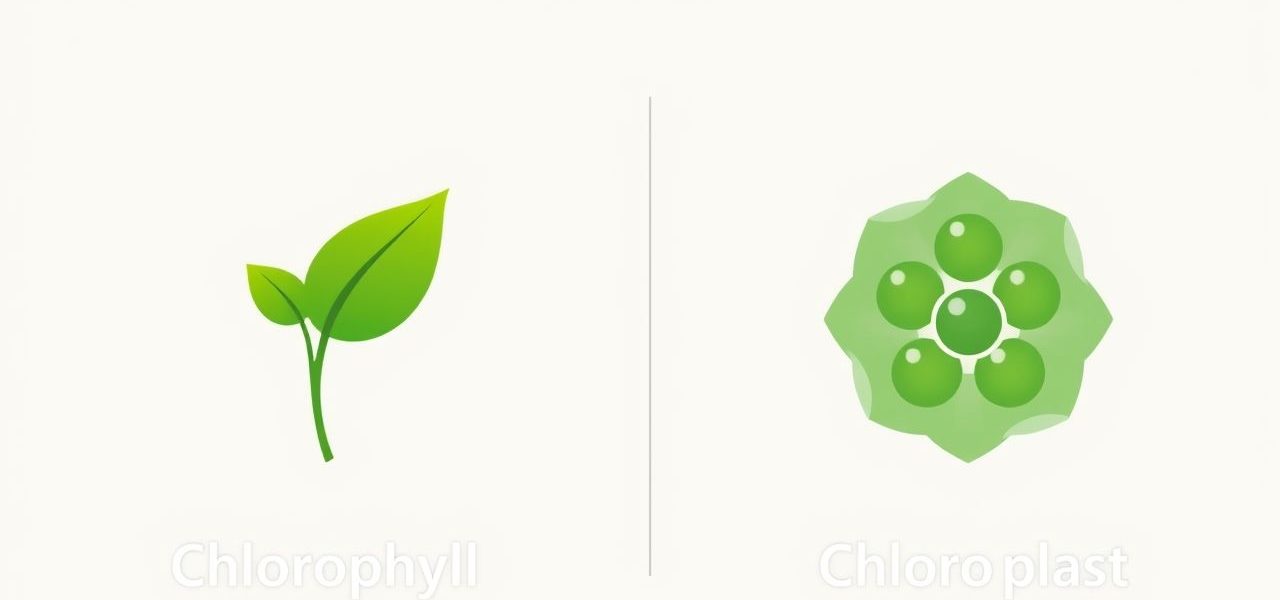
Photosynthesis is one of the most important processes in the biological world, allowing plants to convert sunlight into chemical energy. Two essential components involved in this process are chlorophyll and chloroplasts. While they are closely related, they are not the same. Many people confuse chlorophyll and chloroplast because both terms often appear in the context of photosynthesis. Understanding the difference between chlorophyll and chloroplast is crucial for students, researchers, and anyone interested in plant biology. This topic explains what they are, their functions, and how they differ from each other.
What Is Chlorophyll?
Chlorophyll is a green pigment found in plants, algae, and some bacteria. It plays a vital role in absorbing light energy during photosynthesis. The green color of leaves is due to the presence of chlorophyll, which reflects green wavelengths of light while absorbing mostly red and blue wavelengths. Chlorophyll is not a structure but a pigment molecule that enables the conversion of solar energy into chemical energy.
Types of Chlorophyll
- Chlorophyll a: The primary pigment involved in photosynthesis, found in all plants and algae.
- Chlorophyll b: An accessory pigment that helps capture light energy and passes it to chlorophyll a.
Some organisms also have chlorophyll c, d, or f, but these are less common and mainly found in algae and cyanobacteria.
Function of Chlorophyll
The main function of chlorophyll is to absorb sunlight for photosynthesis. When light energy hits chlorophyll molecules, it excites electrons, initiating the process of converting carbon dioxide and water into glucose and oxygen. Without chlorophyll, plants could not capture solar energy effectively.
What Is a Chloroplast?
A chloroplast is a specialized organelle found in plant cells and some algae. It is the site where photosynthesis occurs. Unlike chlorophyll, which is a pigment, chloroplast is a complex structure that contains chlorophyll and many other components needed for energy production.
Structure of Chloroplast
- Outer and Inner Membrane: Protect the organelle and regulate the movement of molecules in and out.
- Stroma: The fluid-filled space inside chloroplasts where the Calvin cycle (light-independent reactions) takes place.
- Thylakoid Membranes: Flattened sacs arranged in stacks called grana, where chlorophyll is located and light-dependent reactions occur.
Function of Chloroplast
The chloroplast is responsible for carrying out photosynthesis. It uses sunlight, water, and carbon dioxide to produce glucose and oxygen. Apart from photosynthesis, chloroplasts are involved in fatty acid synthesis, amino acid production, and storage of energy in the form of starch.
Key Differences Between Chlorophyll and Chloroplast
Although both are essential for photosynthesis, chlorophyll and chloroplast have distinct roles and characteristics. Here are the main differences:
1. Nature and Composition
- Chlorophyll: A pigment molecule responsible for capturing light energy. It is a chemical compound and not a cellular structure.
- Chloroplast: A cellular organelle that contains chlorophyll along with other structures necessary for photosynthesis.
2. Location
- Chlorophyll: Found embedded in the thylakoid membranes inside the chloroplast.
- Chloroplast: Located in the cytoplasm of plant cells and some algae cells.
3. Function
- Chlorophyll: Absorbs sunlight and initiates the conversion of light energy into chemical energy.
- Chloroplast: Provides the site and machinery for photosynthesis, storing energy and producing food for the plant.
4. Size and Structure
- Chlorophyll: A microscopic pigment molecule with a complex chemical structure based on a porphyrin ring and a magnesium ion at its center.
- Chloroplast: A large, membrane-bound organelle with multiple internal components such as stroma and thylakoid stacks.
Comparison Table
| Aspect | Chlorophyll | Chloroplast |
|---|---|---|
| Type | Pigment molecule | Cell organelle |
| Function | Captures light energy | Site of photosynthesis |
| Location | Inside thylakoid membranes | Cytoplasm of plant cells |
| Structure | Chemical compound | Membrane-bound organelle |
How Do They Work Together?
Chlorophyll and chloroplasts work together to make photosynthesis possible. The chloroplast provides the environment and machinery, while chlorophyll captures light energy. Light-dependent reactions occur in the thylakoid membranes, where chlorophyll molecules absorb sunlight. This energy drives the production of ATP and NADPH, which are then used in the stroma during the Calvin cycle to synthesize glucose.
Importance in the Ecosystem
The difference between chlorophyll and chloroplast might seem technical, but both are essential for life on Earth. They enable plants to produce oxygen and food, which sustain most organisms. Without chlorophyll, chloroplasts could not perform photosynthesis. Without chloroplasts, plants would lack the site and systems required to convert light into energy.
Common Misconceptions
- Some believe chlorophyll and chloroplast are the same, but they are different entities with distinct roles.
- Chlorophyll does not produce energy by itself; it only captures light for use in the chloroplast.
- Chloroplasts do more than hold chlorophyll they carry out complex biochemical processes.
Understanding the difference between chlorophyll and chloroplast is fundamental in biology. Chlorophyll is a green pigment responsible for absorbing light energy, while the chloroplast is an organelle where photosynthesis occurs. Both are interconnected, but they are not interchangeable. Chlorophyll acts as the light-harvesting component, and chloroplast provides the structure and mechanisms to convert that light into chemical energy. Together, they form the basis of life on Earth by enabling plants to create food and oxygen. Recognizing this distinction helps us appreciate the complexity and beauty of plant biology.