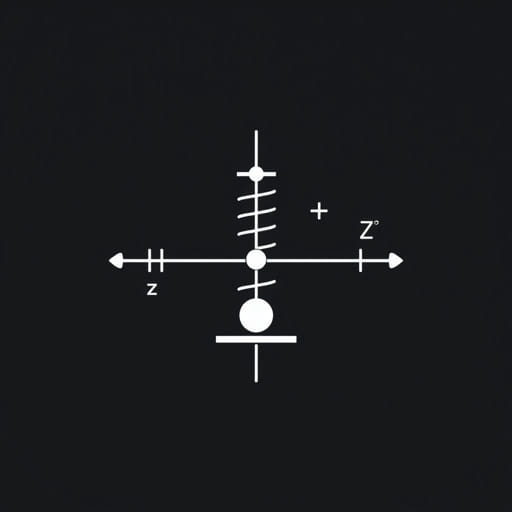
The concept of zero point energy in a harmonic oscillator represents one of the most intriguing and fundamental ideas in quantum mechanics. Unlike classical oscillators, which can theoretically have zero energy at rest, a quantum harmonic oscillator retains a finite minimum energy even at absolute zero temperature. This minimum energy, called the zero point energy, has profound implications in physics, chemistry, and materials science. Understanding its formula, derivation, and applications allows scientists and engineers to explore quantum behavior in molecules, solids, and nanostructures, providing insight into phenomena ranging from atomic vibrations to the Casimir effect.
Understanding the Harmonic Oscillator
A harmonic oscillator is a system that experiences a restoring force proportional to its displacement from equilibrium. In classical mechanics, this system is often exemplified by a mass attached to a spring or a pendulum oscillating at small angles. The motion is sinusoidal, and the energy of the system can vary continuously depending on amplitude and velocity. However, in quantum mechanics, the harmonic oscillator exhibits discrete energy levels due to the quantization of energy.
The Hamiltonian for a one-dimensional quantum harmonic oscillator is given by
- H = (p² / 2m) + (1/2) m ϲ x²
wherepis the momentum operator,mis the mass, Ï is the angular frequency, andxis the position operator. Solving the Schrödinger equation for this Hamiltonian reveals quantized energy levels
- En= (n + 1/2) âÏ, where n = 0, 1, 2,
The Zero Point Energy Formula
The zero point energy corresponds to the lowest possible energy state of the quantum harmonic oscillator, where n = 0. Plugging n = 0 into the energy level equation gives
- E0= (1/2) âÏ
This formula shows that even at the ground state, the oscillator possesses finite energy equal to one-half the reduced Planck constant (â) multiplied by the angular frequency (Ï). This nonzero energy arises from the Heisenberg uncertainty principle, which prevents the simultaneous exact determination of position and momentum. As a result, the ptopic cannot be completely at rest and must exhibit zero point motion.
Implications of Zero Point Energy
Zero point energy has far-reaching implications in various areas of physics and chemistry. It affects molecular vibrations, lattice dynamics in solids, and even vacuum energy in quantum field theory. In molecules, the zero point energy contributes to bond energies, influencing reaction rates and equilibrium constants. In crystalline solids, the vibrational zero point energy impacts specific heat, thermal conductivity, and phase transitions at low temperatures.
Derivation of the Zero Point Energy Formula
The derivation begins with the Schrödinger equation for a harmonic oscillator
- â(â² / 2m) (dÂ²Ï / dx²) + (1/2) m ϲ x² Ï = E Ï
Solving this differential equation using methods such as ladder operators or Hermite polynomials yields discrete energy levels
- En= (n + 1/2) âÏ
The ground state energy is obtained by setting n = 0, resulting in E0= 1/2 âÏ. This derivation demonstrates that the zero point energy is a direct consequence of quantum mechanics rather than classical expectations. Unlike classical oscillators, a quantum oscillator cannot have zero kinetic and potential energy simultaneously.
Mathematical Perspective
From a mathematical perspective, the zero point energy is linked to the properties of the creation and annihilation operators. Defining the operators as
- a = â(mÏ / 2â) (x + (i / mÏ)p)
- a = â(mÏ / 2â) (x â (i / mÏ)p)
leads to the Hamiltonian in operator form
- H = âÏ (a a + 1/2)
Here, the a a term represents the number operator, counting quanta of energy. Even when no quanta are present (n = 0), the 1/2 âÏ term remains, confirming the existence of zero point energy. This operator approach emphasizes the inherent quantum nature of the energy floor in oscillatory systems.
Experimental Observations
Zero point energy can be indirectly observed in phenomena such as the vibrational spectra of molecules, low-temperature heat capacities, and tunneling rates in quantum systems. In spectroscopy, the vibrational ground state of molecules reflects the presence of zero point motion, leading to measurable energy shifts. In solids, Debye’s theory of specific heat at low temperatures accounts for zero point vibrations to accurately predict thermal behavior. Additionally, zero point energy contributes to the Casimir effect, where vacuum fluctuations exert measurable forces between closely spaced conducting plates.
Applications in Technology and Science
Understanding zero point energy is essential in several advanced technologies and scientific areas
- Quantum ComputingThe behavior of qubits in harmonic potentials is influenced by zero point energy, affecting coherence and error rates.
- NanomechanicsVibrations in nanoscale resonators are governed by zero point motion, influencing sensitivity and performance.
- Chemical PhysicsReaction rates and vibrational energies in molecules are adjusted for zero point contributions, critical for accurate modeling.
- Cosmology and Field TheoryZero point energy of fields contributes to vacuum energy density and has implications for dark energy studies.
Limitations and Considerations
While the zero point energy formula E0= 1/2 âÏ is elegant and universal for quantum harmonic oscillators, it applies strictly to idealized systems. Real oscillators may experience anharmonicity, damping, or environmental interactions that modify energy levels. Additionally, measuring zero point energy directly is challenging; experimental confirmation relies on indirect effects such as energy differences, spectra, or quantum fluctuations.
Summary
The zero point energy of a harmonic oscillator, expressed as E0= 1/2 âÏ, exemplifies the fundamental departure of quantum mechanics from classical physics. This minimal energy, arising from the Heisenberg uncertainty principle, ensures that even at absolute zero, a quantum system retains intrinsic motion. The formula is crucial for understanding molecular vibrations, solid-state physics, quantum field theory, and advanced technologies. Through careful study, application, and interpretation, the zero point energy of harmonic oscillators continues to provide insights into the underlying principles of the quantum world.