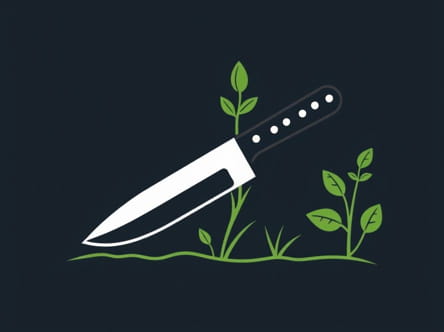
In agriculture, especially in horticulture and plant propagation, the use of specialized tools can significantly influence success rates and plant health. One such tool is the budding knife, a simple yet highly effective instrument used by farmers and gardeners for a variety of delicate tasks. Its precise design and sharp edge allow for controlled cutting, making it ideal for budding, grafting, and other plant propagation techniques. Understanding the uses of a budding knife in agriculture not only helps improve the quality of work but also enhances the overall productivity of plant cultivation.
What is a Budding Knife?
A budding knife is a small, single-bladed tool designed specifically for horticultural use. It typically features a sharp, narrow blade with a slightly curved tip that facilitates clean and accurate cuts. Some budding knives also have a blunt end on the opposite side of the blade, which is used to lift or open bark without causing unnecessary damage.
Key Features of a Budding Knife
- Single, razor-sharp blade for precise incisions
- Compact and lightweight design for easy handling
- Curved tip to follow plant contours
- Optional bark lifter for ease in budding techniques
These features make the budding knife a valuable tool in many types of plant propagation, particularly when accuracy is essential.
Primary Uses of Budding Knife in Agriculture
While the budding knife is named after one specific technique budding it has a wide range of uses in agriculture. From grafting fruit trees to repairing bark damage, this tool offers functionality that supports plant health and development.
1. Budding (Bud Grafting)
The most common use of a budding knife is in bud grafting, a method of plant propagation where a bud from one plant (the scion) is inserted into the bark of another plant (the rootstock). The budding knife allows the user to make precise T-shaped or shield-shaped cuts in the rootstock, into which the bud is carefully inserted.
- Ensures clean cuts that promote successful bud union
- Reduces the risk of infection or tissue damage
- Allows better control over bud placement and depth
2. Grafting Techniques
Besides budding, the budding knife is used in other grafting methods such as whip and tongue grafting or chip budding. These methods require clean, angled cuts that can be accurately made using the sharp blade of the budding knife. The success of grafting largely depends on the precision of these cuts to ensure proper cambial contact.
3. Bark Lifting
In budding and certain grafting techniques, it is necessary to lift or open the bark slightly to insert the bud or scion. Many budding knives include a blunt end or bark lifter specifically for this purpose. The bark lifter allows the operator to separate bark layers gently without tearing the plant tissue.
4. Removing Unwanted Shoots
Budding knives are also used to remove suckers, shoots, or unwanted growth from rootstocks or grafted trees. Because the blade is small and sharp, it can be used to cut close to the base of a shoot without damaging surrounding tissue, helping maintain plant health and desired form.
5. Repairing Damaged Bark
In cases where a tree has suffered bark damage from pests, machinery, or weather, the budding knife can be used to clean and smooth the wound. Removing rough or torn bark edges helps the tree heal more efficiently and prevents the entry of pathogens.
Advantages of Using a Budding Knife
Compared to other general-purpose cutting tools, the budding knife offers distinct benefits tailored to agricultural and horticultural tasks.
Precision and Control
The sharp, narrow blade of a budding knife allows for intricate work with a high degree of control. This is especially important in budding and grafting, where alignment and accuracy directly impact the outcome.
Minimally Invasive
Because the knife is designed for delicate plant work, it minimizes injury to the plant. Clean cuts heal faster and reduce the risk of disease, increasing the overall success rate of propagation techniques.
Durability and Portability
Most budding knives are compact and built with durable materials such as stainless steel, making them easy to carry and long-lasting in the field. Their simplicity also makes them easy to clean and maintain.
Proper Use and Care
To get the most out of a budding knife, proper handling and maintenance are essential. Improper use not only reduces efficiency but can also damage both the plant and the tool.
Handling Tips
- Hold the knife firmly and cut away from your body to prevent injury
- Use steady pressure to make a smooth, single stroke
- Keep your hands dry to avoid slipping
Maintenance Tips
- Clean the blade after each use to remove sap and debris
- Sharpen regularly to maintain cutting efficiency
- Store in a dry place to prevent rust or corrosion
Proper maintenance not only extends the life of the budding knife but also ensures that every cut made is clean and effective.
Applications in Various Crops
The budding knife is used across a wide variety of crops in both small-scale gardening and commercial agriculture. Its application is particularly common in the propagation of fruit trees and ornamental plants.
Fruit Trees
- Apples
- Peaches
- Citrus trees
- Mangoes
These trees benefit from budding and grafting to ensure uniform fruit quality, disease resistance, and faster maturity.
Ornamentals and Roses
Many ornamental plants, especially roses, are propagated using budding techniques. The budding knife enables fine cuts that are essential for achieving desirable traits such as color and fragrance.
The budding knife is an essential tool in agriculture, particularly for those involved in plant propagation. Its precise design and versatility make it ideal for budding, grafting, bark lifting, and other horticultural practices. By supporting healthy plant development and ensuring the success of delicate techniques, the budding knife contributes to more efficient and productive agricultural operations. Farmers, horticulturists, and gardeners who invest in a good budding knife and learn its proper use can enjoy long-term benefits in plant quality, yield, and sustainability.