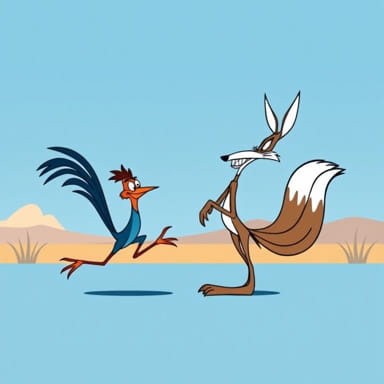
The endless chase across sun-baked canyons between Roadrunner and Wile E. Coyote has become one of the most unforgettable duos in animation history. For decades, audiences have delighted in the wild pursuit where the wily bird effortlessly outsmarts his hapless yet tenacious pursuer. Though built on simplicity, their rivalry showcases inventive slapstick, visual storytelling, and a timeless theme of ambition versus hubris. As Roadrunner zooms off with a trademark Beep Beep! and Wile E. Coyote hatches a new scheme, viewers of all ages share in the humor and well-earned consequences of overambition.
Origins and Creative Team
Early Beginnings
The Roadrunner and Wile E. Coyote cartoons debuted in 1949, created by animation director Chuck Jones at Warner Bros. The characters appeared in the Looney Tunes and Merrie Melodies series. Their desert-set rivalry provided a fresh contrast to traditional cartoon dynamics by focusing on a predator who is perpetually outsmarted by his prey.
Creative Contributors
Chuck Jones crafted the basic formula and comedic timing for the series. The distinctive animation style was supported by layout artist Maurice Noble, composer Carl Stalling (later Eugene Poddany), and a team of animators who brought vivid desert landscapes and explosive gags to life. These collaborators helped establish the comedic logic and enduring appeal of each episode.
Characters and Their Traits
Wile E. Coyote
Wile E. Coyote is determined and resourceful, yet chronically overestimates his intellect. Armed with ACME gadgets rockets, mail-order traps, elaborate machines he pursues Roadrunner across cliffs and valleys. Every plot he devises ends in his own downfall, often dramatically and explosively. Despite the pain, he never gives up, showcasing a type of comedic resilience.
Roadrunner
The Roadrunner is clever, confident, and almost always silent except for his signature Beep Beep! His speed is phenomenal, and he uses simple moves darting, stopping, turning to thwart Coyote’s plans. He rarely initiates aggression, reacting instead with near-perfect timing and agility.
Signature Gags and Comedy Structure
Recurring Formula
Episodes typically follow a dependable structure:
- Coyote spots Roadrunner and prepares a trap.
- The scheme involves an ACME product.
- Roadrunner appears barely in time to escape.
- The plan backfires spectacularly, often with exaggerated visuals.
This cyclical pattern creates anticipation and humor as viewers watch Coyote’s over-engineered setups collapse in creative ways.
Visual and Physical Comedy
Since dialogue is minimal, visual storytelling takes center stage. Reactions, pauses, and silent moments build comedic tension. The infamous moment of Coyote plummeting off a cliff, suspended mid-air before reality sets in, is a classic animation gag that speaks to both timing and exaggeration.
Themes and Symbolism
Persistence vs. Failure
A central theme is persistence in the face of repeated failure. Coyote never abandons his goal despite repeated setbacks. His failures illustrate human ambition taken too far driven by determination but often blinded to the practical.
Technology and Overconfidence
ACME gadgets represent blind faith in technology. Coyote believes he can outsmart nature with elaborate contraptions, but each malfunction demonstrates how technology can fail when it lacks intuition or respect for reality.
The Underdog Advantage
Despite being the intended prey, Roadrunner thrives through simplicity and natural skill. His success is comedic but resonates with the idea that overthought aggression often fails against calm competence.
Popular Episodes and Highlights
Fast and Furry-ous (1949)
The debut episode where the basic formula took shape. Wile E. attempts to catch Roadrunner with rockets and traps, while the Roadrunner’s speed remains unmatched. The desert setting and the comedic Beep Beep theme were introduced here.
Beep, Beep (1952)
Here, high-speed granite offerings involve roller skates and explosives. The humor emerges when Coyote’s plan backfires and he ends up flattened by his own rock trap.
Going! Going! Gosh! (1952)
This episode highlights exaggerated visual gags, especially when Coyote ends up catapulted into oblivion by his own dynamite. Timing and build-up make the explosive ending a favorite moment for fans.
Influence and Legacy
Animation Techniques
The series pioneered visual comedy without dialogue, influencing later cartoons that rely on physical humor. Techniques like timing, pacing, and layout design can be seen in modern animated shorts and global comedy.
Pop Culture Impact
Coyote and Roadrunner have appeared in video games, commercials, films, and parodies. Their presence is celebrated through homages in shows like *The Simpsons*, *Family Guy*, and *Space Jam*.
Merchandise and Adaptations
From plush toys and posters to video games and comic strips, the characters have found extended life across different media. Although few new animated shorts are produced today, their popularity endures through reruns, streaming, and nostalgia.
Modern and Fan Engagement
Streaming Availability
The original shorts remain accessible through digital platforms, bringing a new generation into the Roadrunner-Coyote universe. Streaming ensures the physical comedy remains memorable and relevant.
Fan Creativity
Online communities create their own meme versions, remixes, and references. The universal language of silent comedy makes it easy for international fans to celebrate the duo.
Tributes and Celebrations
Anniversary events, retrospectives, and pop-culture exhibits continue to honor the animation work of Chuck Jones and the Warner Bros. team. Roadrunner and Coyote are celebrated as icons of cartoon history.
The enduring chase between Roadrunner and Wile E. Coyote combines ingenious animation, expressive timing, and emotional depth behind a simple premise. Their rivalry captures the humor of ambition, the folly of overconfidence, and the surprising power of perseverance. Though Coyote’s gadgets always fail and his plans implode, viewers cheer his undying spirit and respect Roadrunner’s cool wit. In a wordless desert landscape packed with visual gags, the duo delivers entertainment that outpaces decades, proving that great comedy transcends language and time.