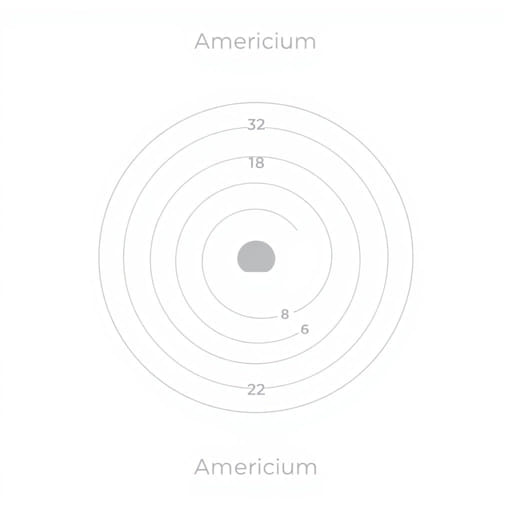
Americium is a synthetic element that belongs to the actinide series in the periodic table, with the atomic number 95. It is a radioactive metal with significant applications in smoke detectors and nuclear research. Understanding the full electron configuration of americium is crucial for chemists and physicists, as it explains the element’s chemical behavior, bonding properties, and reactivity. Electron configuration provides insight into the arrangement of electrons in various shells and orbitals, which influences properties such as magnetism, ionization energy, and oxidation states. Studying americium’s electron configuration also helps in comparing it with other actinides and predicting its interaction with ligands in coordination chemistry.
Basic Principles of Electron Configuration
Electron configuration refers to the distribution of electrons in the orbitals of an atom according to the Pauli exclusion principle, Hund’s rule, and the Aufbau principle. The Aufbau principle states that electrons fill orbitals starting from the lowest energy level to higher ones. The Pauli exclusion principle ensures that no two electrons in an atom have the same set of quantum numbers, while Hund’s rule indicates that electrons occupy degenerate orbitals singly before pairing. These rules collectively determine the full electron configuration of elements, including americium.
Periodic Table Position of Americium
Americium is located in period 7 of the actinide series, positioned between plutonium (Pu) and curium (Cm). Its electron configuration is influenced by the filling of 5f, 6d, and 7s orbitals. As an actinide, americium exhibits complex electron interactions because the 5f electrons are partially shielded by filled 6s and 6p orbitals. This results in unique chemical and physical properties that are distinct from lanthanides or transition metals.
Full Electron Configuration of Americium
The atomic number of americium is 95, meaning it has 95 electrons that must be arranged in available orbitals. Following the Aufbau principle, electrons occupy orbitals in the sequence of increasing energy levels. For americium, the full electron configuration can be expressed as follows
Stepwise Configuration
- 1s² → The first two electrons occupy the lowest energy level, the 1s orbital.
- 2s² 2p⁶ → Electrons fill the second shell, completing the s and p orbitals.
- 3s² 3p⁶ 3d¹⁰ → The third shell is filled, including the 3d subshell.
- 4s² 4p⁶ 4d¹⁰ 4f¹⁴ → The fourth shell accommodates s, p, d, and f electrons.
- 5s² 5p⁶ 5d¹⁰ 5f⁷ → The fifth shell includes partially filled f-orbitals, crucial for actinide chemistry.
- 6s² 6p⁶ 6d¹ → The sixth shell begins filling, contributing to chemical reactivity.
- 7s² → The seventh shell contains the outermost valence electrons of americium.
Combining these steps, the full electron configuration of americium can be written as
1s² 2s² 2p⁶ 3s² 3p⁶ 3d¹⁰ 4s² 4p⁶ 4d¹⁰ 4f¹⁴ 5s² 5p⁶ 5d¹⁰ 5f⁷ 6s² 6p⁶ 6d¹ 7s²
Condensed Electron Configuration
For simplification, the electron configuration of americium can also be written using noble gas notation, which replaces filled inner shells with the symbol of the preceding noble gas. The nearest noble gas preceding americium is radon (Rn), which accounts for the first 86 electrons. Therefore, the condensed electron configuration is
[Rn] 5f⁷ 6d¹ 7s²
Significance of Americium’s Electron Configuration
The electron configuration of americium has several implications for its chemical and physical properties. The partially filled 5f orbitals contribute to its ability to form multiple oxidation states, typically +3 and +4, which are common in actinide chemistry. The presence of one electron in the 6d orbital also affects bonding characteristics and metallic behavior. Understanding this configuration allows scientists to predict how americium interacts with ligands, its magnetic properties, and its role in nuclear reactions.
Chemical Reactivity
Americium’s electron configuration explains why it predominantly forms trivalent compounds in solution. The 5f electrons are relatively accessible for bonding, and the 7s electrons participate in valence interactions. Its reactivity is influenced by the energy difference between the 5f, 6d, and 7s orbitals, which can be affected by the chemical environment.
Magnetic and Spectroscopic Properties
The seven 5f electrons in americium give rise to unique magnetic behavior, which can be studied using spectroscopic methods. The electronic transitions among 5f, 6d, and 7s orbitals are responsible for characteristic absorption spectra. These properties are essential for identifying americium in various chemical and nuclear contexts.
Applications in Nuclear Science
Americium’s electron configuration also contributes to its nuclear characteristics. Americium-241, an isotope with 95 protons and 146 neutrons, is commonly used in smoke detectors and neutron sources. The arrangement of electrons in outer shells affects how americium atoms interact with neutrons, influencing its suitability for these applications.
Comparison with Other Actinides
Comparing americium with neighboring actinides, such as plutonium and curium, highlights the role of electron configuration in chemical behavior. For instance, plutonium has a configuration of [Rn] 5f⁶ 7s², while curium is [Rn] 5f⁷ 6d¹ 7s². The gradual filling of 5f orbitals across the actinide series explains trends in oxidation states, ionic radii, and metallic properties, making electron configuration a vital concept for understanding actinide chemistry.
Oxidation States and Stability
The electron configuration helps predict the most stable oxidation states of americium. The 5f⁷ configuration favors the +3 oxidation state due to half-filled orbital stability, while the +4 state is also achievable under specific conditions. Knowledge of these states is crucial for handling americium safely and for designing chemical processes in nuclear chemistry.
The full electron configuration of americium, [Rn] 5f⁷ 6d¹ 7s², provides deep insight into its chemical and physical properties. Its arrangement of electrons in 5f, 6d, and 7s orbitals explains the element’s oxidation states, magnetic behavior, and reactivity. Understanding the stepwise filling of orbitals and the condensed configuration allows scientists to predict chemical bonding, nuclear interactions, and placement in the actinide series. Electron configuration is not only a fundamental concept in chemistry but also a practical tool for applications in nuclear science, materials research, and advanced chemical studies involving actinides. The study of americium’s electron arrangement highlights the complex interplay between atomic structure and material properties, offering valuable knowledge for scientific and technological advancements.