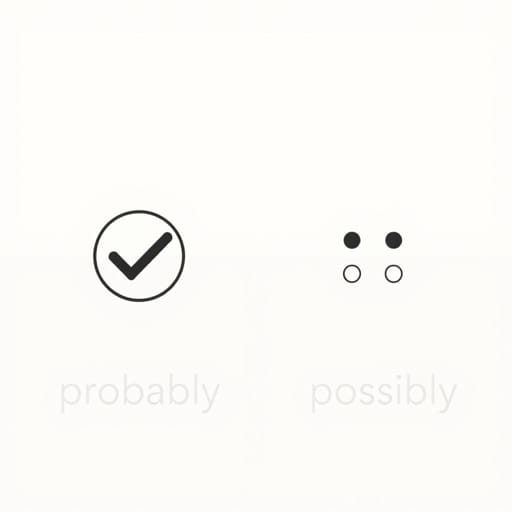
In everyday English communication, the words ‘probably’ and ‘possibly’ are often used to express likelihood or chance, but they carry different nuances and degrees of certainty. Understanding the difference between these two adverbs is crucial for anyone who wants to convey ideas clearly and accurately. While both words relate to the probability of an event occurring, ‘probably’ implies a higher likelihood than ‘possibly,’ which leaves more room for doubt. This topic will explain their meanings, uses, and distinctions in detail to help you master their proper application in speaking and writing.
Meaning of ‘Probably’
The word ‘probably’ is an adverb used to indicate that something is likely to happen or be true. It suggests a strong chance or high probability, typically more than 50%. When you say something will ‘probably’ occur, you are expressing confidence, though not absolute certainty.
Examples of ‘Probably’ in Sentences
- It will probably rain tomorrow, so take an umbrella.
- She is probably the best candidate for the job.
- They probably arrived early since the meeting started on time.
‘Probably’ helps speakers and writers express an expectation based on evidence or logical deduction. It indicates a reasonable degree of confidence without guaranteeing certainty.
Meaning of ‘Possibly’
‘Possibly’ is also an adverb, but it implies that something might happen or be true, without strong assurance. It refers to something that is within the realm of possibility but with less likelihood than ‘probably.’ When you use ‘possibly,’ you leave more space for uncertainty or doubt.
Examples of ‘Possibly’ in Sentences
- He could possibly join us later if he finishes work early.
- The missing keys are possibly under the couch.
- They will possibly announce the results next week.
‘Possibly’ is often used when the outcome is uncertain or when there are several potential results. It suggests that an event can occur, but there is no strong evidence to say how likely it is.
Key Differences Between ‘Probably’ and ‘Possibly’
- Degree of Likelihood: ‘Probably’ indicates a higher chance (more than 50%), while ‘possibly’ implies a lower or uncertain chance.
- Level of Certainty: ‘Probably’ reflects greater confidence in the event occurring. ‘Possibly’ reflects more doubt or less confidence.
- Usage in Context: ‘Probably’ is used when there is some evidence or reason to believe something will happen. ‘Possibly’ is used when the situation is more hypothetical or speculative.
- Tone: ‘Probably’ sounds more definitive. ‘Possibly’ sounds more cautious or tentative.
How to Choose Between ‘Probably’ and ‘Possibly’
Choosing the right word depends on the context and how sure you are about the event or fact you are discussing. If you have good reason to believe something will happen, ‘probably’ is appropriate. If you are less sure or just want to acknowledge a chance without commitment, ‘possibly’ fits better.
Situations for Using ‘Probably’
- When forecasting weather based on data: ‘It will probably snow tonight.’
- When predicting someone’s actions based on past behavior: ‘She probably won’t come to the party.’
- When estimating outcomes with some supporting evidence: ‘The project will probably finish on time.’
Situations for Using ‘Possibly’
- When considering multiple options or unknown factors: ‘He could possibly take the job offer.’
- When acknowledging an unlikely but not impossible event: ‘We might possibly see a miracle.’
- When unsure about details or facts: ‘The documents are possibly in the filing cabinet.’
Examples Comparing ‘Probably’ and ‘Possibly’
Examining similar sentences with both words can highlight their different impacts.
- Probably: ‘She will probably finish the report by Friday.’ (The speaker expects a high chance of completion.)
- Possibly: ‘She will possibly finish the report by Friday.’ (The speaker considers it an option but is uncertain.)
- Probably: ‘They probably took a taxi because they were late.’ (High confidence in the explanation.)
- Possibly: ‘They possibly took a taxi, but maybe they walked.’ (Acknowledges multiple possibilities.)
Common Mistakes to Avoid
- Using ‘possibly’ when you mean ‘probably,’ which can weaken your statement and confuse the listener or reader.
- Using ‘probably’ in highly uncertain contexts, which may lead to overconfidence or incorrect assumptions.
- Mixing the two in formal writing without understanding their distinct meanings.
Synonyms and Related Words
Understanding synonyms can also clarify how ‘probably’ and ‘possibly’ differ.
- Synonyms of ‘Probably’: likely, apparently, evidently, presumably.
- Synonyms of ‘Possibly’: maybe, perhaps, conceivably, potentially.
Summary
‘probably’ and ‘possibly’ are both useful adverbs to talk about chances and likelihoods but differ in the degree of certainty they convey. ‘Probably’ suggests a stronger expectation that something will happen, backed by evidence or reasoning. ‘Possibly’ indicates that something might happen but with less certainty, allowing for doubt and alternative outcomes. Correctly distinguishing between these words helps improve communication by making your statements clearer and more precise.
Practical Tips for Remembering the Difference
- Think of ‘probably’ as ‘more likely than not’ the event will happen in most cases.
- Think of ‘possibly’ as ‘it could happen’ the event is one of many options.
- Use ‘probably’ when you want to express confidence without absolute certainty.
- Use ‘possibly’ when you want to remain open to different outcomes.