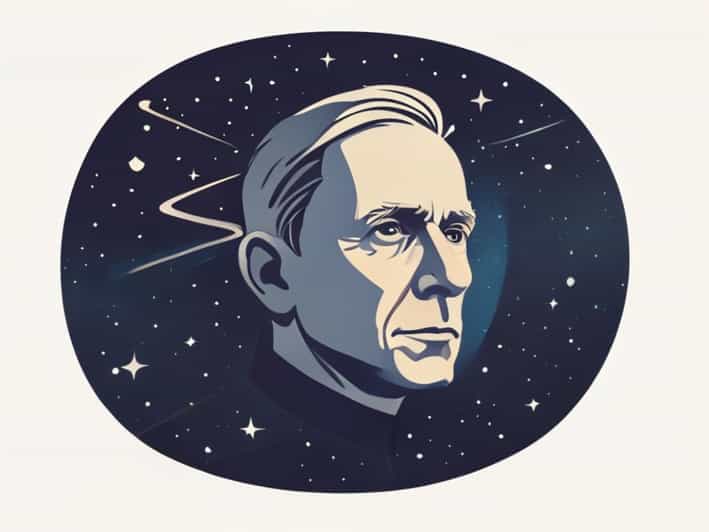
Carl Sagan had a rare ability to speak about the vastness of space in a way that felt both humbling and deeply personal. For many people, his words were the first invitation to think beyond Earth and consider humanity’s place in the universe. He did not treat space as a cold, distant emptiness, but as a grand context that gives meaning to life, science, and responsibility. When Carl Sagan spoke about the cosmos, he connected astronomy with philosophy, curiosity, and compassion, making the immensity of space feel relevant to everyday human existence.
Carl Sagan and His View of the Cosmos
Carl Sagan was an astronomer, scientist, and science communicator who dedicated much of his life to explaining the universe to the public. He believed that understanding the vastness of space could change how people see themselves and each other.
For Sagan, the cosmos was not just a collection of stars and galaxies. It was a story billions of years in the making, one that humans had only recently begun to understand.
The Vastness of Space as Perspective
One of Carl Sagan’s most enduring ideas was that the vastness of space provides perspective. When compared to the immense scale of the universe, human conflicts and divisions appear small and temporary.
He often emphasized that Earth is a tiny world in a cosmic ocean. This idea was not meant to make humanity feel insignificant, but to highlight how rare and precious life is.
Why Scale Matters
- Space contains billions of galaxies
- Each galaxy holds billions of stars
- Many stars likely host planets
By understanding these scales, Sagan encouraged humility and awe rather than fear.
The Pale Blue Dot Concept
One of Carl Sagan’s most famous reflections on the vastness of space came from the image known as the Pale Blue Dot. This photograph of Earth, taken from far beyond our planet, shows Earth as a tiny speck suspended in a sunbeam.
Sagan used this image to remind humanity that every human who ever lived did so on that small dot. All history, culture, and struggle occurred there.
Lessons from the Pale Blue Dot
- The fragility of Earth
- The shared home of all humanity
- The need for kindness and cooperation
Through this idea, Sagan linked the vastness of space with moral responsibility.
Science as a Way to Understand the Universe
Carl Sagan believed that science was humanity’s best tool for exploring the cosmos. He saw science not as a collection of dry facts, but as a method of thinking that allows humans to uncover the universe’s secrets.
In the face of vast space, science becomes a bridge between curiosity and understanding.
Human Curiosity in an Infinite Universe
Despite the enormous scale of space, Sagan remained optimistic about humanity’s ability to explore and learn. He viewed curiosity as a defining human trait that connects us to the stars.
The vastness of space, rather than discouraging exploration, inspired him to support space missions and scientific discovery.
Exploration as a Human Drive
- Desire to understand origins
- Search for meaning beyond Earth
- Hope for discovering other life forms
For Sagan, exploration was not about conquest, but about understanding.
Life Beyond Earth
Another key theme in Carl Sagan’s thinking about the vastness of space was the possibility of life beyond Earth. Given the sheer number of stars and planets, he believed it was reasonable to consider that life might exist elsewhere.
This idea was not presented as science fiction, but as a scientific question grounded in probability and observation.
The Emotional Impact of Cosmic Scale
The vastness of space can evoke feelings of wonder, fear, or insignificance. Carl Sagan acknowledged these emotions and addressed them directly.
He argued that understanding the universe should inspire awe rather than despair. The fact that humans can comprehend the cosmos at all is, in itself, remarkable.
Human Responsibility in a Vast Universe
For Sagan, recognizing the vastness of space also meant recognizing responsibility. Earth may be small, but it is the only known home for life.
This realization led him to speak about environmental protection, nuclear disarmament, and global cooperation.
Responsibility Through Awareness
- Protecting Earth’s ecosystems
- Avoiding self-destruction
- Working together as a species
The cosmic perspective made these responsibilities clearer, not less important.
Cosmos as a Story
Carl Sagan often described the universe as a story that humans are part of. From the formation of stars to the emergence of life, the cosmos is an ongoing narrative.
By placing humanity within this story, Sagan helped people see science as something deeply human and meaningful.
The Role of Wonder and Imagination
Wonder played a central role in how Carl Sagan spoke about the vastness of space. He believed imagination and curiosity were essential for scientific progress.
Without wonder, the universe becomes distant and abstract. With wonder, it becomes a source of inspiration.
Education and Public Understanding
Sagan was passionate about making complex ideas accessible. He believed that everyone deserved to understand the universe, not just scientists.
By explaining the vastness of space in simple language, he empowered people to think critically and ask big questions.
The Legacy of Carl Sagan’s Cosmic Vision
Carl Sagan’s thoughts on the vastness of space continue to influence scientists, educators, and thinkers today. His work helped shape public interest in astronomy and space exploration.
More importantly, his ideas encouraged empathy, humility, and a sense of shared destiny.
Why the Vastness of Space Still Matters
In a world filled with immediate concerns, Sagan’s cosmic perspective remains relevant. The vastness of space reminds us that our time is limited and our planet is precious.
This awareness can guide better choices and foster a deeper sense of unity.
Carl Sagan’s reflections on the vastness of space were never just about stars and galaxies. They were about humanity’s place in the universe and the responsibilities that come with awareness.
By looking outward into the cosmos, Sagan encouraged people to look inward at their values, actions, and connections. His vision continues to inspire wonder, humility, and hope in the face of an infinite universe.