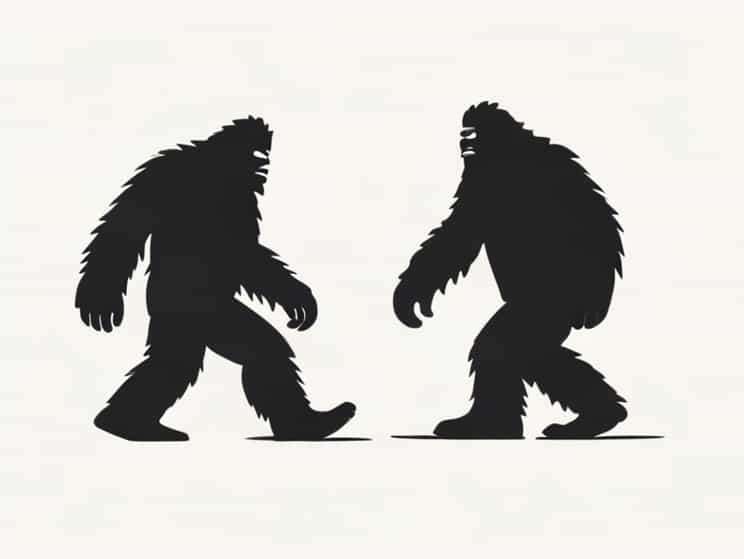
The legends of Bigfoot and Sasquatch have captivated imaginations for decades, inspiring countless sightings, folklore, and debates about their existence. Many people wonder whether these two names refer to the same creature or if they represent different entities entirely. Stories of a large, bipedal, hairy humanoid have been reported across North America, often described as elusive and mysterious. Despite numerous alleged encounters, photographs, and footprint casts, scientific confirmation remains elusive. The question of whether Bigfoot and Sasquatch are the same has both cultural and biological dimensions, making it a topic of fascination among cryptozoologists, enthusiasts, and skeptics alike.
Origins of the Names
The terms Bigfoot and Sasquatch are often used interchangeably, but their origins differ. Bigfoot is a term that became popular in the United States during the mid-20th century, particularly after the 1958 discovery of large footprints in California. The name reflects the creature’s distinctive large feet, which are a key feature in most reported sightings. Over time, Bigfoot became a cultural icon, appearing in media, documentaries, and popular culture, symbolizing the mystery of the unknown wilderness.
The Sasquatch Legend
The term Sasquatch has roots in Indigenous languages, specifically from the Halkomelem language of the Coast Salish people in British Columbia, Canada. In their folklore, the Sasquatch is described as a wild, human-like creature that roams forests and mountains. Stories about Sasquatch predate modern Bigfoot reports by centuries, with Indigenous communities passing down knowledge and sightings through oral traditions. These narratives emphasize the creature’s connection to nature, spiritual significance, and its role as a guardian of the wilderness.
Physical Descriptions
Descriptions of Bigfoot and Sasquatch are strikingly similar, which is why many consider them to be the same entity. Witnesses frequently describe a large, muscular, bipedal creature covered in dark brown or black hair, standing between six to ten feet tall. Reports often include observations of broad shoulders, long arms, and facial features that resemble a mix of human and ape-like traits. Both creatures are said to emit strong odors, move silently through dense forests, and avoid human contact, contributing to their legendary elusiveness.
Footprints and Evidence
Footprints are among the most cited evidence for both Bigfoot and Sasquatch. The tracks are typically enormous, ranging from 15 to 24 inches in length, with five distinct toes and deep impressions indicating considerable weight. Some casts show dermal ridges, suggesting they were made by a living being rather than a hoax. Researchers and enthusiasts have collected footprint evidence in areas across the Pacific Northwest, the Rocky Mountains, and even parts of the United States and Canada. Despite these findings, skeptics argue that footprints can be fabricated or misinterpreted, making conclusive evidence difficult to obtain.
Cultural Significance
Bigfoot and Sasquatch hold important places in popular culture and Indigenous folklore, respectively. Bigfoot has become a symbol of the mysterious and unexplored aspects of nature, often featured in movies, TV shows, and literature. It represents humanity’s curiosity and fear of the unknown, capturing imaginations around the world. Conversely, Sasquatch holds a deeper cultural and spiritual significance for Indigenous communities, often regarded as a protector of the forest and a being with intelligence and awareness beyond humans. Both narratives share the theme of an elusive creature that challenges our understanding of the natural world.
Scientific Perspectives
From a scientific standpoint, Bigfoot and Sasquatch remain unverified. While numerous sightings and anecdotal reports exist, physical evidence such as hair samples, bones, or DNA has yet to conclusively prove the existence of these creatures. Many researchers believe sightings may be misidentifications of known animals, hoaxes, or the result of psychological factors such as pareidolia, where humans perceive familiar shapes in ambiguous patterns. Cryptozoologists, however, continue to investigate with field research, motion-activated cameras, and footprint analysis, seeking credible evidence to support the existence of these legendary beings.
Are Bigfoot and Sasquatch the Same?
Considering the similarities in physical description, behavior, and habitat, many experts and enthusiasts argue that Bigfoot and Sasquatch are indeed the same creature. The different names primarily reflect regional and cultural contexts rather than separate entities. Bigfoot is the term popularized in the United States, while Sasquatch is rooted in Indigenous folklore and Canadian vernacular. Both describe a large, hairy, bipedal creature that inhabits forests and mountains, is elusive, and leaves behind footprints and other trace evidence. Therefore, despite the varying terminology, the general consensus among cryptozoology communities is that they refer to the same legendary creature.
Regional Variations and Stories
While the core concept of a large, forest-dwelling humanoid remains consistent, regional stories often include unique details. For example, some Pacific Northwest sightings describe the creature as vocal, using howls or whistles, while other regions emphasize its intelligence or supernatural qualities. Indigenous accounts may describe spiritual attributes, such as the ability to vanish or influence natural events. These variations enrich the lore surrounding Bigfoot and Sasquatch, highlighting how cultural context shapes the way humans perceive and describe the unknown.
Challenges in Verification
One of the main reasons the question of Bigfoot and Sasquatch remains unresolved is the difficulty in obtaining verifiable evidence. These creatures are reported in remote, densely forested regions, making encounters rare and fleeting. Hoaxes, misidentifications, and anecdotal reports further complicate scientific investigation. Motion-activated cameras, audio recordings, and footprint casts provide some data, but none have delivered definitive proof. This elusiveness reinforces the mythic status of Bigfoot and Sasquatch while fueling continued interest and debate.
Ongoing Research
Researchers continue to explore the possibility of Bigfoot and Sasquatch being real, using modern technology and investigative techniques. DNA analysis of hair samples, environmental DNA (eDNA) studies, and high-resolution camera traps are increasingly employed to seek concrete evidence. Additionally, citizen scientists and enthusiasts contribute sightings, photographs, and videos, expanding the database for researchers to analyze. While conclusive proof remains elusive, ongoing research maintains the intrigue and encourages open-minded investigation.
Bigfoot and Sasquatch are widely considered to be the same legendary creature, with differences in name reflecting cultural and regional variations. Both represent a large, bipedal, hairy humanoid that inhabits forests and mountains, evades human contact, and has become a symbol of mystery and the unknown. While scientific verification is still lacking, the stories, sightings, and cultural significance of Bigfoot and Sasquatch continue to captivate imaginations worldwide. Understanding the similarities and origins of these names helps clarify that, whether called Bigfoot or Sasquatch, the creature embodies humanity’s fascination with unexplored wilderness, the thrill of the unknown, and the enduring power of folklore and legend.