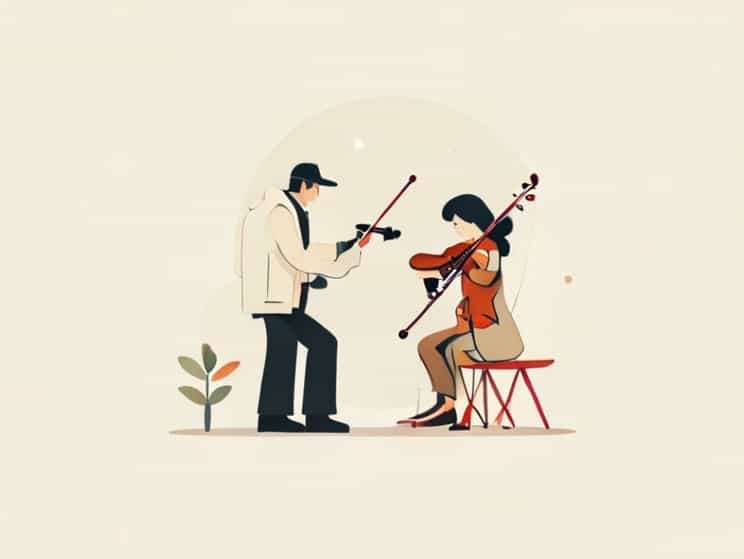
When an astronomer meets a violinist, the encounter brings together two worlds that may seem far apart but are deeply connected by a shared appreciation for patterns, harmony, and exploration. One studies the vastness of the cosmos, searching for meaning in stars and galaxies, while the other creates beauty through sound, shaping emotions with music. Their meeting symbolizes how science and art, often thought of as opposites, can complement and inspire one another. This combination of astronomy and music highlights the human desire to understand and express the universe in multiple ways, blending logic with creativity, and discovery with expression.
The Astronomer’s Perspective
An astronomer spends countless hours observing celestial bodies, running calculations, and interpreting data. The work requires precision, patience, and a deep curiosity about what lies beyond Earth. To an astronomer, the night sky is not just beautiful but a map filled with questions about the origin of galaxies, the nature of stars, and the possibilities of life elsewhere. This perspective is deeply analytical, focused on evidence and theories that can explain the unknown.
The Language of the Stars
Astronomers communicate in the language of mathematics, physics, and observation. When they look through a telescope, they see not just twinkling lights but ancient histories, distances measured in light years, and chemical compositions written in the light spectrum. This structured way of interpreting the universe relies on facts and data, yet it is also filled with wonder and awe.
The Violinist’s Perspective
A violinist, on the other hand, views the world through melody and emotion. Their instrument becomes a tool for expressing feelings that words cannot capture. Through practice and performance, the violinist learns to translate inner emotions into music that resonates with others. The sound of a violin can mimic joy, sadness, longing, or even the vastness of the universe itself.
The Language of Music
Music has its own language rhythm, pitch, harmony, and dynamics that connects directly to human emotion. A violinist may not think in terms of scientific formulas, but the vibrations of strings and the resonance of wood are grounded in physics. The act of playing is both artistic and scientific, guided by intuition and technique. Just as astronomers seek patterns in the sky, violinists seek patterns in sound.
When the Astronomer Meets the Violinist
The meeting of an astronomer and a violinist creates a bridge between two different yet compatible ways of understanding the world. Imagine a conversation where the astronomer describes galaxies colliding, and the violinist responds by playing a piece of music that captures that sense of cosmic movement. This exchange allows each to see the universe from a fresh perspective, blending intellectual curiosity with emotional resonance.
Shared Curiosity
Both astronomy and music thrive on curiosity. An astronomer asks, What lies beyond the horizon of space? while a violinist asks, What lies beyond the horizon of sound? Their meeting is not about replacing one perspective with another but about expanding the possibilities of how humans can interpret existence.
The Intersection of Science and Art
The story of an astronomer and a violinist meeting is more than a poetic metaphor. Throughout history, science and art have influenced each other. Astronomical discoveries have inspired composers to write music that reflects the cosmos, and musicians have often drawn parallels between harmony in sound and harmony in the universe.
Examples of Cosmic Inspiration in Music
- Composers like Gustav Holst created orchestral works inspired by planets and celestial movements.
- Modern musicians often use cosmic themes in their lyrics and performances, drawing inspiration from space exploration.
- Scientific data, such as the sounds of pulsars, has been converted into music, merging astronomy directly with art.
Different Approaches, Same Goal
Though an astronomer and a violinist may approach life differently, both are driven by the search for meaning. The astronomer looks outward into the universe to uncover the mysteries of existence. The violinist looks inward, using sound to express the mysteries of human emotion. Both journeys, though opposite in direction, aim at connection whether with the stars or with other people.
The Role of Imagination
Imagination plays a critical role in both fields. Astronomers must imagine unseen phenomena to develop theories, while violinists must imagine emotions and stories to shape their performances. Without imagination, neither science nor art could thrive. Their meeting demonstrates that creativity and logic are not enemies but partners.
Lessons from Their Meeting
The symbolic meeting of an astronomer and a violinist teaches valuable lessons about balance, collaboration, and perspective. It reminds us that
- Knowledge is not limited to one field; learning can come from unexpected places.
- Beauty can be found in both data and music, in the measurable and the unmeasurable.
- Human expression takes many forms, and none is superior to another.
- True understanding comes from blending both analytical and creative insights.
Expanding Horizons
When science and art intersect, possibilities expand. Imagine lectures on astronomy accompanied by live violin performances, where the audience not only hears about galaxies but feels their vastness through music. Similarly, imagine concerts where visuals of stars and galaxies accompany the violin, blending senses into a unified experience. Such collaborations show that the universe is not only to be studied but also to be felt.
The meeting of an astronomer and a violinist represents the harmony between two human pursuits understanding the external universe and expressing the internal one. Though their methods differ, both seek truth, meaning, and connection. The astronomer may map the stars, and the violinist may weave melodies, but together they remind us that life is richer when science and art walk hand in hand. By uniting the vastness of space with the intimacy of sound, they show that the human spirit is capable of exploring both the infinite and the deeply personal, creating a balance that resonates far beyond the limits of either discipline alone.