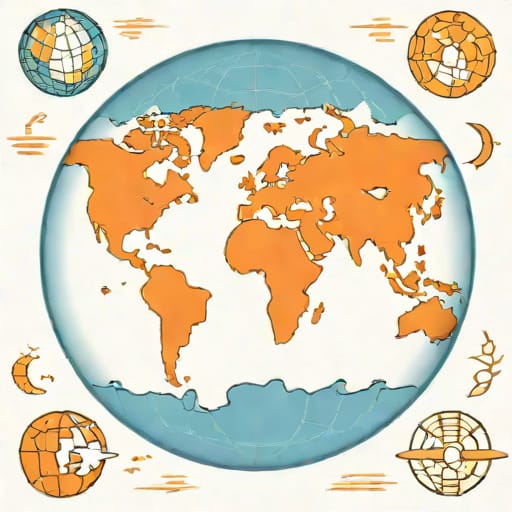
When we look at a world map, it is easy to notice how the edges of some continents, such as South America and Africa, seem to fit together like puzzle pieces. This observation has fascinated scientists for centuries and eventually gave rise to the concept of the continental drift theory. This theory, first proposed in the early 20th century, suggests that continents were once joined together and have since moved apart over millions of years. It plays a key role in modern geology, helping to explain earthquakes, volcanic activity, and the formation of mountains. Understanding what continental drift theory is and how it developed gives us insight into the dynamic nature of Earth’s surface.
Definition of Continental Drift Theory
The continental drift theory is a scientific idea that explains how continents move slowly across Earth’s surface. It suggests that the landmasses we see today were once part of a single supercontinent calledPangaea. Over time, this supercontinent broke apart, and the pieces drifted to their current positions. The term continental drift emphasizes the gradual but continuous motion of continents caused by forces beneath the Earth’s crust.
The Origin of the Theory
The idea of shifting continents was proposed by Alfred Wegener, a German meteorologist and geophysicist, in 1912. He noticed that the coastlines of continents seemed to match and that geological and fossil evidence supported the possibility of connected landmasses. Although Wegener lacked a detailed mechanism for how continents moved, his observations laid the foundation for one of the most important theories in Earth science.
Wegener’s Evidence
- Fossil DistributionIdentical fossils of plants and animals, such as the Mesosaurus, were found on continents separated by oceans, suggesting they were once connected.
- Geological FeaturesSimilar mountain ranges and rock formations appeared on opposite sides of the Atlantic Ocean, indicating they were once part of the same chain.
- Climate CluesEvidence of glacial deposits was found in now tropical regions, showing that landmasses had shifted over time.
Challenges and Criticism
When Wegener introduced the continental drift theory, many scientists criticized it. The main issue was that Wegener could not explain what force was powerful enough to move entire continents. At that time, the understanding of Earth’s mantle and tectonic activity was limited. Because of this, the theory was dismissed by many as speculative rather than scientific. It took decades of further research and new discoveries to validate Wegener’s ideas.
The Role of Plate Tectonics
The breakthrough that supported continental drift came in the mid-20th century with the development of plate tectonic theory. Scientists discovered that Earth’s lithosphere is divided into large plates that float on the semi-fluid asthenosphere beneath them. The movement of these tectonic plates explained how continents drift. This theory provided the missing mechanism that Wegener could not identify, transforming his idea into an accepted scientific principle.
Connection Between Theories
While continental drift theory explains that continents move, plate tectonics explains how and why they move. The plates shift due to convection currents in Earth’s mantle, spreading at mid-ocean ridges and sinking at subduction zones. Together, these processes confirm the concept of drifting continents and provide a complete picture of Earth’s geological dynamics.
Scientific Evidence Supporting Continental Drift
Over time, new scientific evidence has strongly supported the continental drift theory. These discoveries include
- Seafloor SpreadingStudies of the ocean floor revealed that new crust is formed at mid-ocean ridges, pushing continents apart.
- PaleomagnetismPatterns in the magnetic alignment of rocks on the ocean floor showed symmetrical stripes, proving that the seafloor was spreading from a central ridge.
- Earthquake DistributionEarthquakes and volcanic activity were found to align along plate boundaries, supporting the movement of plates and continents.
Impact of the Theory on Earth Science
The acceptance of continental drift and plate tectonics has revolutionized geology. It provides a unifying explanation for many natural phenomena. For example, the collision of tectonic plates explains the rise of mountain ranges like the Himalayas. The drifting apart of plates accounts for the widening of oceans. It also helps explain patterns of biodiversity, as shifting continents separated populations and allowed species to evolve differently.
Applications in Modern Science
Continental drift theory is not just a historical concept but continues to influence modern research. It helps scientists understand natural hazards, predict volcanic eruptions, and assess earthquake risks. It also aids in the exploration of natural resources such as oil and minerals, which often form in regions shaped by tectonic activity.
Misconceptions About Continental Drift
While the concept is widely accepted today, there are still misconceptions about what it means
- Continental drift does not mean continents float freely like boats. Instead, they are part of massive tectonic plates that move as a whole.
- The movement is extremely slow, averaging only a few centimeters per year. However, over millions of years, this results in dramatic changes.
- The theory is not outdated; rather, it is the foundation of plate tectonics, which is one of the most important frameworks in geology.
Examples of Continental Drift in Action
There are visible and measurable examples of how continental drift continues to shape our planet
- Atlantic Ocean ExpansionThe Atlantic Ocean is slowly widening as North and South America move away from Europe and Africa.
- Himalayan MountainsIndia’s collision with Asia continues to push the Himalayas higher each year.
- Pacific Plate MovementThe shifting Pacific Plate contributes to earthquakes and volcanic activity along the Ring of Fire.
Future of Continental Drift
Continental drift is an ongoing process that will continue to reshape Earth’s geography. Scientists predict that millions of years from now, continents will form new configurations. For example, Africa may eventually collide with Europe, closing the Mediterranean Sea, and the Atlantic Ocean may continue to expand until it looks very different from today. These predictions highlight the dynamic and ever-changing nature of our planet.
The continental drift theory, first introduced by Alfred Wegener, revolutionized our understanding of Earth’s surface. Although initially rejected, it gained acceptance once plate tectonic theory provided a mechanism for the movement of continents. Supported by evidence from fossils, geology, seafloor spreading, and earthquakes, the theory explains many natural processes and continues to influence modern science. By studying continental drift, we gain a deeper appreciation for the powerful forces that shape our planet and the continuous transformation of the Earth’s surface.