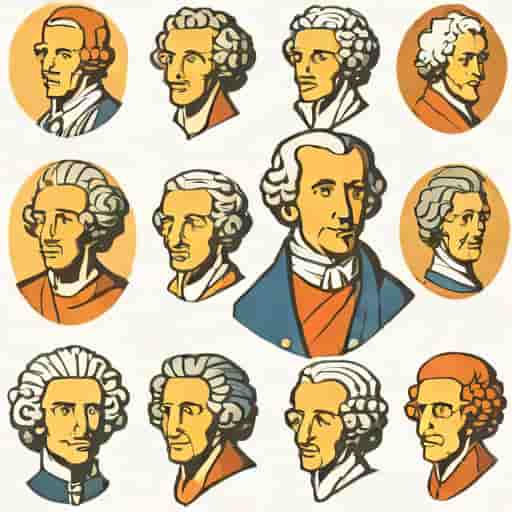
Images of Montesquieu, the renowned 18th-century French philosopher and political thinker, provide a fascinating window into the life and legacy of one of the Enlightenment’s most influential figures. Born Charles-Louis de Secondat, Baron de La Brède et de Montesquieu, in 1689, he is best known for his theories on the separation of powers, which have shaped modern democratic governance. Visual representations of Montesquieu, ranging from portraits and engravings to statues and illustrations in books, not only document his appearance but also convey the cultural and historical context of his era. Exploring these images helps us understand how Montesquieu was perceived by his contemporaries and how his legacy has been visually preserved through the centuries.
Early Portraits of Montesquieu
The earliest images of Montesquieu were created during his lifetime, primarily as painted portraits or engraved illustrations. These depictions often portray him in the formal attire of an 18th-century French aristocrat, reflecting his status as a baron and member of the intellectual elite. Early portraits emphasize his refined appearance, with powdered wig, high-collared coat, and composed expression, suggesting his role as a thoughtful and scholarly figure. These visual representations were not merely decorative but served to communicate his intellectual authority to audiences both in France and across Europe.
Significance of Engravings
Engravings of Montesquieu became particularly popular in books and journals during the Enlightenment. Unlike painted portraits, engravings could be reproduced and distributed widely, helping to disseminate his image alongside his ideas. These engravings often included symbolic elements, such as books, scrolls, or writing implements, highlighting his contributions to philosophy, law, and political theory. By examining these images, we can see how Montesquieu was presented not just as a man, but as a symbol of reason, intellectual inquiry, and progressive thought.
Montesquieu in Book Illustrations
Many of Montesquieu’s writings, including his most famous work,The Spirit of the Laws, were accompanied by illustrations or frontispieces featuring his likeness. These images often depict him in a reflective pose, sometimes with a quill in hand or seated at a desk, emphasizing his role as a thinker and writer. Such illustrations helped readers visualize the author as they engaged with his text, creating a personal connection between the philosopher and his audience. In addition, these images reinforced the intellectual authority of Montesquieu’s ideas, providing a visual reminder of the man behind the groundbreaking theories on government, liberty, and law.
Symbolism in Visual Representations
Images of Montesquieu frequently include symbolic references to justice, law, and reason. For example, some portraits feature a globe or maps, indicating his interest in the influence of geography and climate on political systems. Others incorporate books, columns, or classical architecture to suggest his engagement with history and political philosophy. These elements help contextualize his work and reinforce his reputation as a foundational figure in Enlightenment thought. By studying these symbols, historians and art enthusiasts gain insight into how Montesquieu was understood and celebrated in visual culture.
Statues and Public Monuments
Beyond printed images, Montesquieu has also been commemorated through statues and public monuments, particularly in France. Sculptors have created busts and full-length statues that capture his intellectual presence, often depicting him in formal attire or with writing implements to symbolize his scholarly achievements. These physical representations serve as lasting tributes to his impact on political theory and democratic thought. They are frequently displayed in universities, libraries, and public squares, reinforcing the continued relevance of Montesquieu’s ideas in contemporary society.
Modern Reproductions and Digital Images
In the modern era, digital technology has enabled widespread access to images of Montesquieu. Museums, academic institutions, and online archives offer high-resolution photographs of paintings, engravings, and statues, allowing students, researchers, and enthusiasts worldwide to study his likeness. These digital reproductions provide opportunities for comparative analysis, helping viewers understand how visual representations of Montesquieu have evolved over time and how his image has been adapted for educational and cultural purposes.
Artistic Styles and Techniques
The depiction of Montesquieu reflects the artistic styles and techniques of his time. Baroque and Rococo influences are evident in the elaborate costumes, detailed backgrounds, and careful attention to texture in early paintings. Engravings, on the other hand, rely on line work and shading to convey depth and character. Later artistic interpretations, including neoclassical statues, emphasize symmetry, restraint, and idealized features. Studying these variations provides insight into the evolving ways in which artists and society represented intellectual figures like Montesquieu, highlighting both artistic trends and cultural priorities.
Color and Composition
Color and composition in images of Montesquieu are often used to convey authority and dignity. In painted portraits, muted tones, rich fabrics, and formal poses suggest respectability and wisdom. The careful composition of elements, such as placing him near books or classical motifs, emphasizes his scholarly identity. Even in monochrome engravings, the placement of symbolic objects, posture, and facial expression work together to communicate his status as a thinker whose ideas shaped political discourse.
Montesquieu’s Influence Through Imagery
Images of Montesquieu have played a role in shaping public perception of the philosopher and his ideas. By portraying him as a composed, reflective, and scholarly figure, these images reinforced his credibility and authority. The circulation of his likeness in books, journals, and public spaces helped establish Montesquieu not only as a leading intellectual of his era but also as a lasting symbol of Enlightenment values, including reason, liberty, and the rule of law. In this way, visual representations have complemented his written works in promoting his influence worldwide.
Educational and Cultural Impact
Portraits and illustrations of Montesquieu are frequently used in educational settings to introduce students to the Enlightenment and the history of political thought. By providing a face to the name, these images make the study of philosophy and political theory more tangible and engaging. Cultural institutions also use images of Montesquieu in exhibitions and publications to highlight his contributions, ensuring that new generations recognize both the man and his enduring ideas.
Images of Montesquieu offer more than a visual record of his appearance-they provide insight into his intellectual legacy, the cultural context of his era, and the ways in which society honors influential thinkers. From early portraits and engravings to modern digital reproductions and public statues, these representations help preserve his memory and communicate the significance of his work. By studying these images, we gain a richer understanding of Montesquieu as both a historical figure and an enduring symbol of Enlightenment ideals, reminding us of the lasting impact of his ideas on political thought, governance, and modern democracy.