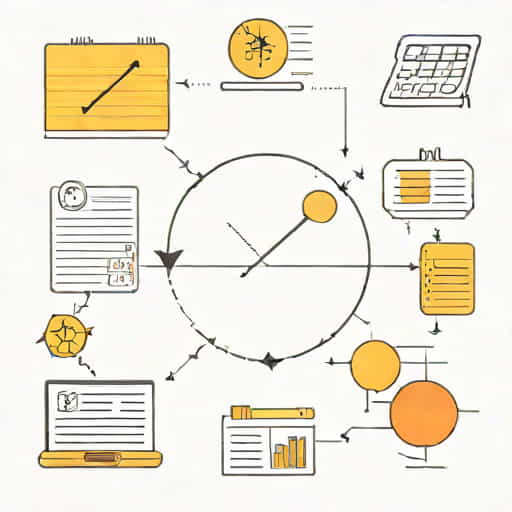
The accounting cycle is a fundamental concept in financial management and bookkeeping, providing a structured process for recording, processing, and reporting financial transactions. Understanding the accounting cycle is essential for business owners, accountants, and students, as it ensures accuracy, consistency, and compliance in financial reporting. Writing down the accounting cycle schematically can help simplify the process, making it easier to understand and follow. By breaking down each step and illustrating the flow of transactions from initial recording to the preparation of financial statements, learners can gain a clear overview of how financial data is managed and reported in a business environment.
Introduction to the Accounting Cycle
The accounting cycle refers to the sequence of steps that accountants follow to capture, process, and report financial information for a specific period. These steps ensure that all financial transactions are accurately recorded and summarized in a way that reflects the business’s financial position. The cycle is repetitive and occurs in every accounting period, such as monthly, quarterly, or annually, providing consistent and reliable financial statements.
Purpose of the Accounting Cycle
The primary purpose of the accounting cycle is to maintain accurate and complete financial records. It allows businesses to track revenues, expenses, assets, liabilities, and equity systematically. Additionally, the cycle ensures that financial statements, including the income statement, balance sheet, and cash flow statement, are prepared correctly and can be used for decision-making, tax reporting, and regulatory compliance.
Schematic Representation of the Accounting Cycle
Writing down the accounting cycle schematically involves presenting each step in a visual or sequential format that highlights the flow of information. Here is a structured outline of the accounting cycle
Step 1 Identifying Transactions
The accounting cycle begins with identifying and analyzing business transactions. Every financial activity, such as sales, purchases, payroll, or loan payments, constitutes a transaction that affects the company’s financial position. Proper identification is essential for accurate recording.
- Collect source documents like invoices, receipts, and bank statements.
- Determine the accounts affected by each transaction.
- Classify the transactions as revenue, expense, asset, liability, or equity.
Step 2 Recording in the Journal
Once transactions are identified, they are recorded in the general journal in chronological order. This step, also known as journalizing, ensures that all financial activities are documented before posting to the ledger.
- Enter each transaction as a journal entry.
- Include date, accounts affected, debit and credit amounts, and a brief description.
- Maintain accuracy to ensure debits equal credits.
Step 3 Posting to the Ledger
Journal entries are then posted to the general ledger, where transactions are categorized by account. The ledger provides a detailed record of all financial activities for each account and is used to prepare trial balances and financial statements.
- Transfer journal entries to corresponding ledger accounts.
- Track balances for each account throughout the accounting period.
- Ensure consistency between journal and ledger entries.
Step 4 Preparing the Trial Balance
After posting to the ledger, a trial balance is prepared to verify that total debits equal total credits. The trial balance helps detect errors in journalizing or posting before financial statements are prepared.
- List all accounts with their respective debit or credit balances.
- Calculate total debits and total credits.
- Ensure that the trial balance is balanced to proceed to the next step.
Step 5 Adjusting Entries
Adjusting entries are made to account for revenues earned or expenses incurred that have not yet been recorded. These adjustments ensure that financial statements reflect the correct financial position at the end of the accounting period.
- Record accrued revenues and expenses.
- Adjust prepaid expenses and unearned revenues.
- Ensure accuracy in reporting for the accounting period.
Step 6 Adjusted Trial Balance
After making adjusting entries, an adjusted trial balance is prepared to confirm that debits and credits remain balanced. This adjusted trial balance serves as the basis for preparing financial statements.
- Update account balances with adjustments.
- Verify that total debits equal total credits.
- Use the adjusted trial balance for financial statement preparation.
Step 7 Preparing Financial Statements
The adjusted trial balance is then used to prepare financial statements, which provide information to stakeholders about the company’s performance and financial position.
- Income Statement Reports revenues and expenses to determine net income or loss.
- Balance Sheet Summarizes assets, liabilities, and equity at a specific point in time.
- Statement of Cash Flows Shows cash inflows and outflows from operating, investing, and financing activities.
Step 8 Closing Entries
Closing entries are made at the end of the accounting period to transfer temporary account balances, such as revenues and expenses, to permanent accounts like retained earnings. This resets temporary accounts for the next accounting period.
- Close revenue accounts to Income Summary.
- Close expense accounts to Income Summary.
- Transfer net income or loss to retained earnings.
Step 9 Post-Closing Trial Balance
After closing entries, a post-closing trial balance is prepared to ensure that all temporary accounts have been closed properly and that debits still equal credits. This confirms the readiness of the ledger for the next accounting cycle.
- List only permanent accounts with balances.
- Verify the equality of total debits and credits.
- Ensure accuracy before starting a new accounting period.
Visual Schematic of the Accounting Cycle
To write the accounting cycle schematically, imagine it as a circular or sequential flow chart where each step leads to the next. The cycle begins with transaction identification and ends with a post-closing trial balance, ready for the next period. This circular representation emphasizes that the accounting process is continuous and repetitive.
- Transaction Analysis → Journalizing → Posting to Ledger → Trial Balance → Adjusting Entries → Adjusted Trial Balance → Financial Statements → Closing Entries → Post-Closing Trial Balance → Start Next Period
The accounting cycle is a comprehensive and systematic process that ensures financial information is accurately captured, processed, and reported. Writing down the accounting cycle schematically simplifies the understanding of this essential process, showing the flow from identifying transactions to preparing financial statements and closing accounts. By following each step carefully, businesses can maintain accurate financial records, comply with regulations, and provide stakeholders with reliable financial information. Understanding and applying the accounting cycle is crucial for accountants, students, and business professionals, as it forms the foundation of effective financial management and reporting. Using a schematic representation reinforces clarity, making it easier to grasp the interconnected steps that support accurate and consistent financial record-keeping.