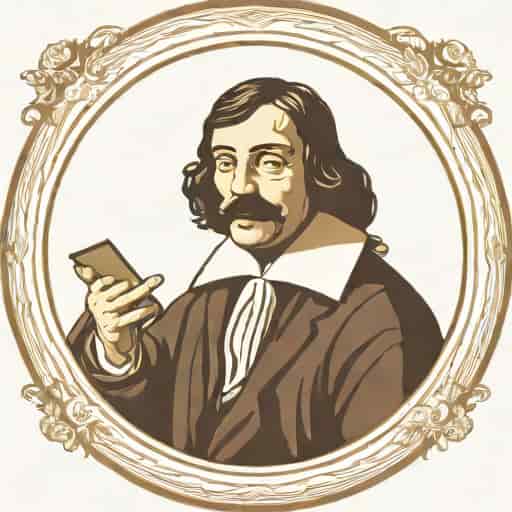
René Descartes is often remembered as a philosopher who questioned everything, even the most basic assumptions about the world. Many people encounter the idea that Descartes believed reality is unknowable, and at first glance this seems to fit his reputation as a radical skeptic. He famously doubted the existence of the physical world, the reliability of the senses, and even the truths taught by tradition. However, this idea deserves a deeper and more careful explanation. Descartes’ philosophical project was not simply about rejecting reality, but about understanding what can truly be known with certainty and what kind of knowledge humans can trust.
Descartes and the Method of Doubt
To understand why Descartes is often associated with the claim that reality is unknowable, it is important to look at his method of doubt. Descartes believed that many beliefs accepted as true were actually uncertain. Instead of building knowledge on weak foundations, he proposed systematically doubting everything that could possibly be doubted.
This method did not mean that Descartes thought all knowledge was impossible. Rather, he used doubt as a tool to strip away false beliefs. Anything that could be doubted, even slightly, was temporarily set aside. This included sensory experience, mathematical reasoning, and even the existence of the external world.
Why the Senses Were Questioned
Descartes argued that the senses sometimes deceive us. Objects can appear smaller at a distance, straight sticks look bent in water, and dreams can feel just as real as waking life. Because the senses are not always reliable, Descartes believed they could not serve as a secure foundation for certain knowledge.
This line of reasoning led many readers to think Descartes denied that reality can be known at all. In truth, he was highlighting the limits of sensory knowledge, not denying the possibility of knowledge altogether.
The Role of Radical Skepticism
Descartes took skepticism further by imagining extreme scenarios. One of the most famous is the idea of an evil demon, a powerful being capable of deceiving us about everything we experience. If such a deceiver existed, then even basic truths about reality could be false.
This thought experiment pushed doubt to its absolute limit. If an evil demon could manipulate perceptions and thoughts, then reality as we perceive it would indeed be unknowable. At this stage of Descartes’ argument, reality appears deeply uncertain.
Is This Descartes’ Final Position?
It is crucial to understand that this extreme skepticism was not Descartes’ final conclusion. He introduced it to test whether any belief could survive such radical doubt. The appearance that Descartes believed reality is unknowable comes mainly from focusing on this stage of his philosophy rather than the full structure of his argument.
Cogito Ergo Sum and Certainty
Descartes famously arrived at one belief that could not be doubted I think, therefore I am. Even if an evil demon were deceiving him, Descartes reasoned that the act of thinking itself proved his existence. Doubt required a thinker, and that thinker must exist.
This moment marked a turning point. Descartes demonstrated that at least one truth was absolutely certain. Reality was not completely unknowable, because the existence of the thinking self could be known with certainty.
The Thinking Mind as a Starting Point
From the certainty of the thinking mind, Descartes attempted to rebuild knowledge. He argued that clear and distinct ideas, perceived by reason rather than the senses, could provide a reliable foundation for understanding reality.
This approach shifted the focus from external objects to internal reasoning. While the external world remained uncertain at first, the mind’s ability to think and reason became the key to knowledge.
God and the Guarantee of Reality
One of the most controversial parts of Descartes’ philosophy is his argument for the existence of God. Descartes believed that a perfect, non-deceptive God would not allow humans to be systematically deceived about reality.
According to Descartes, once God’s existence is established, the fear of constant deception disappears. A benevolent God would ensure that clear and distinct perceptions correspond to reality. This step is essential in understanding why Descartes did not ultimately believe reality is unknowable.
Criticism of This Argument
Many philosophers have criticized Descartes’ reliance on God as a guarantor of truth. Some argue that his reasoning is circular, depending on clear and distinct ideas to prove God’s existence while also relying on God to validate those ideas.
Despite these criticisms, Descartes himself believed this step restored confidence in the knowability of reality.
The External World and Physical Reality
After establishing the reliability of reason and the existence of God, Descartes argued that the external world does exist and can be known, at least in a limited way. Physical reality, according to Descartes, is characterized by extension, shape, and motion.
However, Descartes maintained a distinction between the mental and physical realms. The mind is known directly through thought, while the physical world is known indirectly through reason and perception.
Limits of Knowledge About Reality
Although Descartes believed reality could be known, he acknowledged important limits. Sensory experience alone is insufficient, and knowledge of the external world is never as certain as knowledge of one’s own mind.
This nuanced position often leads to the simplified claim that Descartes believed reality is unknowable. In fact, he believed reality is partially knowable, but only through careful reasoning and philosophical reflection.
Common Misinterpretations of Descartes
Descartes is often portrayed as a philosopher who rejected the possibility of knowing reality. This interpretation overlooks the constructive side of his philosophy. His skepticism was a method, not a destination.
- He doubted reality to find certainty, not to deny it.
- He questioned the senses to elevate reason.
- He used skepticism to build a stronger foundation for knowledge.
When taken out of context, his early doubts can appear nihilistic. When viewed as part of his full system, they reveal a careful attempt to secure knowledge.
Influence on Modern Philosophy
Descartes’ exploration of doubt and knowledge has had a lasting influence on modern philosophy. His work inspired later thinkers to examine the relationship between mind and reality, perception and truth.
Philosophers such as Locke, Hume, and Kant responded to Descartes in different ways, each addressing the question of how reality can be known. The idea that reality might be unknowable became a central theme in epistemology, even for those who rejected Descartes’ conclusions.
Why the Question Still Matters
The question of whether reality is knowable remains relevant today. Debates about perception, consciousness, and artificial intelligence continue to echo Descartes’ concerns. His willingness to doubt deeply encourages critical thinking and intellectual humility.
The claim that Descartes believed reality is unknowable is an oversimplification. Descartes used radical doubt to challenge assumptions and uncover certainty, not to abandon the idea of truth. While he acknowledged serious limits to human knowledge, he believed that through reason, clear thinking, and philosophical inquiry, reality could be known in meaningful ways. His legacy lies not in denying reality, but in reshaping how humans search for knowledge and understand the foundations of truth.