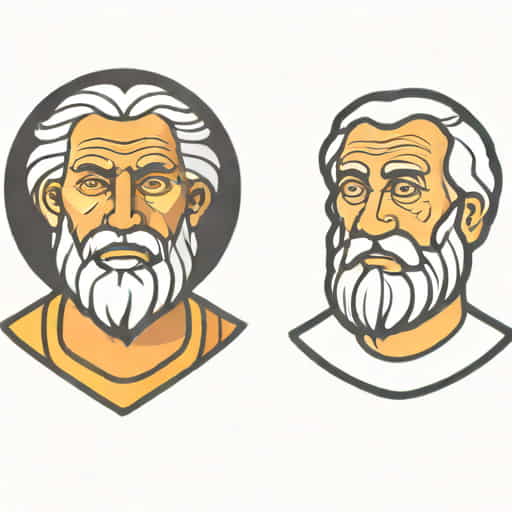
The history of philosophy is filled with influential thinkers who shaped the way humans understand the world. Among these thinkers, Democritus and Aristotle stand out for their profound contributions to natural philosophy, metaphysics, and the understanding of reality. Both philosophers explored the nature of matter, the causes of change, and the principles underlying existence, yet their approaches and conclusions were remarkably different. Comparing and contrasting Democritus and Aristotle provides valuable insight into the evolution of scientific and philosophical thought, highlighting the tension between early atomistic theories and systematic observation-based philosophy.
Background and Philosophical Context
Democritus, often known as the laughing philosopher, was a pre-Socratic thinker born in Abdera, Greece, around 460 BCE. He is best known for developing one of the earliest atomistic theories, suggesting that all matter is composed of small, indivisible units called atoms. Democritus’ philosophy focused on explaining the natural world through reason and observation, though he lacked experimental tools. His ideas were largely speculative, yet they laid the foundation for later scientific thought.
Aristotle, born in 384 BCE in Stagira, Greece, was a student of Plato and tutor to Alexander the Great. Unlike Democritus, Aristotle developed a comprehensive system of thought that integrated logic, ethics, biology, and metaphysics. He emphasized observation, categorization, and empirical analysis, making his philosophy more systematic and methodical. Aristotle’s work became highly influential, dominating Western thought for centuries.
Core Philosophical Ideas
Democritus and Atomism
Democritus’ central contribution to philosophy was his atomic theory. According to him
- All matter consists of tiny, indivisible ptopics called atoms.
- Atoms differ in shape, size, and arrangement, which explains the diversity of materials.
- The void, or empty space, exists to allow atoms to move and combine.
- Change and motion are results of atoms interacting mechanically without purpose or design.
Democritus’ philosophy was materialistic, suggesting that everything, including the soul and mind, is composed of atoms. His approach was speculative, relying heavily on reason rather than empirical observation.
Aristotle and Hylomorphism
Aristotle, in contrast, rejected atomism and proposed a theory called hylomorphism. Key points of Aristotle’s philosophy include
- Matter (hyle) and form (morphe) are inseparable components of substances.
- Everything has an inherent purpose (telos), and change occurs to fulfill this purpose.
- Four causes explain phenomena material, formal, efficient, and final causes.
- Knowledge is gained through sensory experience, observation, and logical reasoning.
Aristotle’s philosophy was teleological and systematic. He believed that understanding the purpose and function of objects was as important as analyzing their material composition.
Epistemology How They Know What They Know
Democritus’ Rationalism
Democritus relied primarily on rational thought to understand the world. He believed that sensory experience could be misleading and that reason was the key to discovering the true nature of reality. Although he acknowledged the role of perception, he argued that atoms and void could not be directly observed, so knowledge of them came from logical deduction.
Aristotle’s Empiricism
Aristotle emphasized observation and empirical evidence as the basis for knowledge. He studied animals, plants, and natural phenomena extensively, creating detailed classifications. For Aristotle, knowledge begins with sensory experience, which is then processed through reason to form general principles. His approach influenced the scientific method and laid the groundwork for systematic inquiry.
View of Nature and the Universe
Democritus’ Mechanistic Universe
Democritus viewed the universe as a vast, deterministic system in which atoms move randomly in the void. Natural events are the result of atomic interactions, not divine intervention or inherent purpose. His universe is essentially mechanistic, with no teleology, meaning that events happen due to necessity rather than design or final cause.
Aristotle’s Teleological Universe
Aristotle’s perspective was more organized and purpose-driven. He believed that everything in nature has a purpose and that change occurs to achieve that purpose. For example, acorns grow into oak trees because it is their nature or telos to do so. Aristotle’s universe is hierarchical and interconnected, with each substance existing to fulfill its function within the broader system.
Ethics and Human Life
Democritus’ Ethical Philosophy
Although Democritus focused on natural philosophy, he also developed ethical ideas. He emphasized moderation, rationality, and the pursuit of happiness (eudaimonia) through the cultivation of virtue and knowledge. Since the universe is material and purposeless, human beings must create meaning in their lives through reason and ethical conduct.
Aristotle’s Ethical Philosophy
Aristotle’s ethics were deeply connected to his metaphysical ideas. He argued that humans have a unique function, which is rational activity, and that living a virtuous life in accordance with reason leads to true happiness. Virtue is achieved through habituation and balance, expressed in his concept of the golden mean, which emphasizes moderation in all aspects of life.
Influence and Legacy
Democritus’ ideas influenced later atomists, scientists, and philosophers, including Epicurus and modern chemistry. His emphasis on rationalism and the mechanical nature of the universe anticipated scientific thought and the eventual development of atomic theory. However, his ideas were less systematically recorded, and much of his work survives through secondary sources.
Aristotle’s influence is far-reaching. His writings shaped Western philosophy, science, and education for centuries. His systematic approach to knowledge, classification, and empirical study set the stage for the Renaissance and the development of modern science. Aristotle’s philosophy provided a comprehensive framework for understanding both the natural world and human life.
Key Similarities and Differences
Similarities
- Both sought to understand the natural world and the principles governing it.
- Both valued reason as a tool for understanding reality.
- Both contributed to early scientific and philosophical thought, influencing later generations.
Differences
- Democritus believed in atomism and a mechanistic universe; Aristotle believed in hylomorphism and teleology.
- Democritus emphasized rational deduction; Aristotle emphasized empirical observation and categorization.
- Democritus’ universe lacked inherent purpose; Aristotle’s universe is purposeful and hierarchical.
- Ethically, Democritus focused on individual moderation; Aristotle emphasized achieving virtue through rational activity and balance.
Comparing and contrasting Democritus and Aristotle reveals two distinct approaches to understanding reality. Democritus represents an early, materialistic, and rationalist perspective, envisioning a universe made of indivisible atoms moving in the void. Aristotle, by contrast, offers a systematic, empirical, and teleological approach, emphasizing observation, classification, and the inherent purpose of natural entities. Both philosophers significantly influenced subsequent thought, shaping the development of science, metaphysics, and ethics. Studying their similarities and differences provides a richer appreciation for the diversity and depth of ancient philosophy, demonstrating how two thinkers can approach the same questions about existence in profoundly different ways.