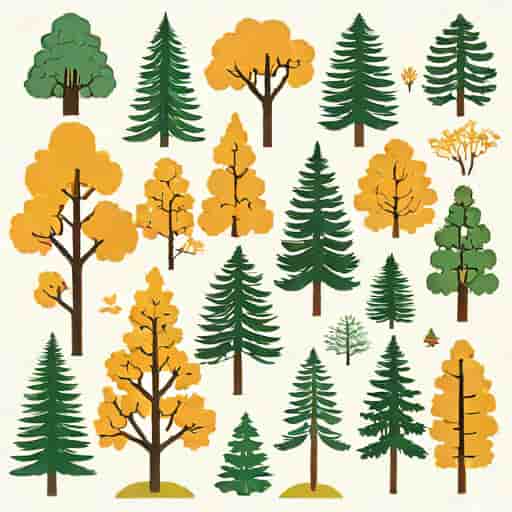
Coniferous forests are one of the most important types of forests in the world, playing a crucial role in maintaining ecological balance, supporting biodiversity, and providing resources for human use. These forests are primarily composed of coniferous trees, which are characterized by needle-like leaves and the production of cones. Among the various varieties of coniferous forests, the Taiga, also known as the Boreal Forest, stands out as one of the most significant. Covering vast areas of North America, Europe, and Asia, the Taiga is not only the largest terrestrial biome but also a vital carbon sink, influencing global climate patterns and supporting a wide range of plant and animal species.
Definition and Characteristics of Coniferous Forests
Coniferous forests are dominated by conifer trees, which are mostly evergreen and adapted to cold climates. These trees have needle-like leaves with a waxy coating, which helps reduce water loss during harsh winters. Coniferous forests can be found in regions with long, cold winters and short, mild summers. The soil in these forests is often acidic and nutrient-poor due to slow decomposition of the needle litter. Despite these challenges, coniferous forests are highly productive ecosystems that sustain a variety of flora and fauna.
Key Features of Coniferous Forests
- Dominated by evergreen trees such as pine, spruce, fir, and larch.
- Adapted to cold climates with long winters and short growing seasons.
- Soil tends to be acidic and low in nutrients.
- Supports diverse wildlife including mammals, birds, and insects.
- Plays a crucial role in carbon sequestration and oxygen production.
The Taiga An Important Variety of Coniferous Forest
The Taiga, or Boreal Forest, is one of the most important varieties of coniferous forest globally. It stretches across Canada, Alaska, Scandinavia, and Russia, forming a continuous belt that encircles the northern hemisphere. This forest type is primarily composed of conifers such as spruce, pine, fir, and larch. The Taiga experiences extremely cold winters with heavy snowfall and short, mild summers. These climatic conditions shape the structure and function of the forest, influencing the types of species that can survive there.
Flora of the Taiga
The plant life in the Taiga is dominated by coniferous trees, which are well-adapted to the harsh climate. Spruce trees are common and provide dense canopy cover, while pines are resilient and can thrive in poorer soils. Larch trees are unique in that they shed their needles in winter, which helps conserve energy. Understory vegetation includes mosses, lichens, and small shrubs, which play an important role in nutrient cycling and provide habitat for various organisms.
Fauna of the Taiga
The Taiga supports a wide range of animal species adapted to cold environments. Large mammals like moose, bears, and wolves are iconic residents of this biome. Smaller mammals, such as snowshoe hares, lynx, and squirrels, thrive under the canopy and among the understory vegetation. Birds, including owls, woodpeckers, and migratory species, utilize the Taiga for nesting and feeding. Aquatic ecosystems within the Taiga, such as rivers and lakes, support fish species and amphibians. The forest’s biodiversity is highly specialized, reflecting adaptations to extreme temperature and seasonal changes.
Ecological Importance of Coniferous Forests
Coniferous forests, particularly the Taiga, are ecologically vital. They act as significant carbon sinks, absorbing large amounts of carbon dioxide from the atmosphere and helping mitigate climate change. These forests regulate temperature, influence precipitation patterns, and prevent soil erosion through their extensive root systems. They also maintain freshwater cycles by capturing snow and facilitating gradual water release during the spring melt. The ecological services provided by coniferous forests are critical for both local and global environmental stability.
Economic and Cultural Significance
In addition to their ecological role, coniferous forests have considerable economic and cultural value. Timber from spruce, pine, and fir trees is a major resource for construction, paper production, and furniture. Non-timber products, such as berries, mushrooms, and medicinal plants, also contribute to local economies. Indigenous communities have traditionally relied on the Taiga for food, shelter, and cultural practices. Modern tourism, including hiking, skiing, and wildlife observation, further highlights the economic potential of these forests.
Threats to Coniferous Forests
Despite their resilience, coniferous forests face significant threats from human activity and climate change. Deforestation for timber, agriculture, and urban development reduces forest cover and disrupts ecosystems. Pollution, including acid rain, affects soil quality and tree health. Climate change is altering temperature and precipitation patterns, leading to increased vulnerability to pests, wildfires, and disease outbreaks. Conservation efforts are essential to preserve these vital forests for ecological stability and human well-being.
Conservation Measures
- Establishing protected areas and national parks to preserve large tracts of forest.
- Promoting sustainable forestry practices that balance timber production with ecosystem health.
- Monitoring and controlling pests and diseases to maintain forest resilience.
- Reforestation and afforestation programs to restore degraded lands.
- Public education and community involvement in forest conservation efforts.
Global Distribution of Coniferous Forests
Coniferous forests are distributed across the northern hemisphere, primarily in North America, Europe, and Asia. The Taiga covers large portions of Canada, Alaska, Scandinavia, and Russia, forming the world’s largest terrestrial biome. Smaller patches of coniferous forests are found in mountainous regions and temperate zones, where conditions support evergreen tree growth. These forests provide habitat connectivity and act as migration corridors for wildlife, ensuring genetic diversity and ecological stability.
Role in Climate Regulation
The global distribution of coniferous forests contributes to climate regulation. By storing carbon, these forests help reduce atmospheric greenhouse gases. Their vast canopy influences local and regional weather patterns, affecting temperature and precipitation. Additionally, snow accumulation in coniferous forests reflects sunlight, helping regulate Earth’s energy balance. Protecting and sustainably managing these forests is therefore crucial for maintaining a stable climate and mitigating the impacts of global warming.
One important variety of coniferous forest is the Taiga, which exemplifies the ecological, economic, and cultural significance of this forest type. Coniferous forests are characterized by evergreen trees, needle-like leaves, and adaptation to cold climates. They provide essential ecosystem services, including carbon sequestration, climate regulation, and habitat for a wide range of species. Additionally, they supply timber and non-timber products and hold cultural value for indigenous and local communities. Despite their resilience, coniferous forests face threats from deforestation, pollution, and climate change. Understanding their importance and implementing conservation measures is critical to preserving these vital ecosystems for future generations. The Taiga, as a representative of coniferous forests, reminds us of the intricate connection between forests and global environmental health.