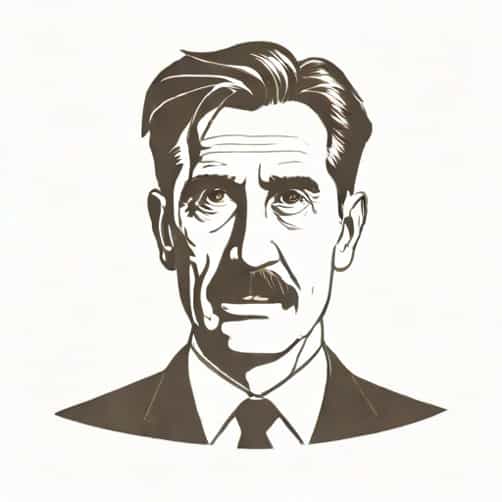
Many readers often wonder whether George Orwell truly wrote the famous novel1984. The answer is yes-George Orwell, whose real name was Eric Arthur Blair, is indeed the author ofNineteen Eighty-Four, commonly known as1984. Published in 1949, the book has become one of the most influential works of literature in the twentieth century. It explores themes of surveillance, totalitarianism, and the loss of individual freedom. Orwell’s writing style, deep political insight, and ability to create a dark and believable dystopia make this novel a lasting cultural and political landmark.
Who Was George Orwell?
George Orwell was born on June 25, 1903, in Motihari, India, when the country was still under British colonial rule. He grew up in England and attended Eton College, one of the country’s most prestigious schools. Although Orwell came from a modest background, his education exposed him to intellectual and political ideas that would later shape his worldview.
Before becoming a full-time writer, Orwell worked as a colonial police officer in Burma (now Myanmar). His experiences there deeply affected him, making him critical of imperialism and social injustice. After returning to England, he began writing essays, novels, and reviews that focused on class inequality, politics, and the misuse of power. These experiences would eventually lead to the creation of1984, one of his most powerful critiques of political control.
The Inspiration Behind 1984
George Orwell wrote1984in the years following World War II, a period marked by political upheaval, fear, and the rise of authoritarian regimes. Totalitarian governments such as Nazi Germany and Stalinist Russia provided Orwell with a real-world backdrop for his fictional dystopia. He was disturbed by how governments used propaganda, censorship, and fear to manipulate and control citizens.
Orwell’s earlier works, such asAnimal Farm(1945), already criticized totalitarianism through allegory. However,1984took a more direct and grim approach, portraying a future where individual freedom is destroyed by an all-seeing government. The novel reflects Orwell’s belief that unchecked political power could lead to the erasure of truth and the destruction of humanity’s independent thought.
Writing and Publication of 1984
George Orwell began writing1984in 1947 while living on the remote Scottish island of Jura. He was in poor health at the time, suffering from tuberculosis, but he was determined to complete the novel. The isolation of the island helped him focus, allowing him to pour all his energy into the manuscript. Despite his illness, Orwell worked tirelessly, typing the entire novel himself on a manual typewriter.
The book was published on June 8, 1949, by Secker & Warburg in the United Kingdom. It quickly gained attention for its chilling vision of the future and its sharp critique of political systems. Although it was controversial at first,1984soon became recognized as one of the greatest novels ever written, often studied in schools and discussed in political debates around the world.
The Main Themes of 1984
1984explores several powerful and timeless themes that continue to resonate with readers today. Some of the most important include
- TotalitarianismThe novel depicts a society controlled by a single ruling party, The Party, led by the mysterious figure Big Brother. Every aspect of life is monitored, and independent thought is forbidden.
- Surveillance and ControlOrwell describes a world where citizens are constantly watched through telescreens, cameras, and informants. This theme has become increasingly relevant in modern discussions about privacy and government surveillance.
- Manipulation of TruthThe government in1984rewrites history and controls language through the invention of Newspeak, a language designed to limit freedom of expression.
- Loss of IndividualityThe Party seeks to eliminate personal identity, replacing human relationships and emotions with loyalty to the state.
These themes make1984not only a political warning but also a philosophical reflection on what it means to be human in a world where truth is constantly under threat.
Characters in 1984
The story of1984centers around Winston Smith, a low-ranking member of the Party who works in the Ministry of Truth, where he alters historical records to match the government’s propaganda. Winston secretly despises the Party and dreams of rebellion. His relationship with Julia, a fellow dissenter, gives him hope, but their love is ultimately destroyed by the oppressive system.
Other key characters include O’Brien, a high-ranking Party member who pretends to be an ally but later betrays Winston, and Big Brother, the symbolic leader of the Party whose image dominates society. Each character reflects a different aspect of control, fear, and resistance within Orwell’s dystopian world.
Language and Style of the Novel
Orwell’s writing in1984is clear, powerful, and emotionally striking. He uses simple but impactful language to describe the bleakness of the world he created. His invention of terms like Big Brother, thoughtcrime, doublethink, and Newspeak has entered everyday vocabulary and continues to influence political and social discussions.
What makes Orwell’s style remarkable is his ability to make complex political ideas accessible. Through vivid imagery and realistic dialogue, he shows how power can corrupt truth and how language itself can be used as a tool of oppression.
The Impact and Legacy of 1984
Since its publication,1984has had a profound effect on literature, politics, and culture. The book introduced concepts that are still used to describe real-world situations of government overreach and propaganda. Phrases like Orwellian and Big Brother is watching you have become part of global political discourse.
In addition to shaping political thought,1984has inspired countless films, television shows, and artistic works. Its influence can be seen in modern dystopian stories such asThe Hunger GamesandBlack Mirror. Even in the digital age, Orwell’s warning about surveillance and censorship feels more relevant than ever before.
Orwell’s Health and Final Years
Unfortunately, George Orwell’s health deteriorated rapidly after finishing1984. He was diagnosed with severe tuberculosis, which worsened during the book’s publication process. Despite receiving treatment, he passed away on January 21, 1950, at the age of 46. Although his life was short, his literary contributions left a lasting mark on the world.
Orwell never lived to see the full impact of his work, but his vision continues to influence readers, scholars, and political thinkers.1984stands as a powerful reminder of the dangers of tyranny and the importance of defending truth and freedom.
final remarkss
To answer the question clearly – yes, George Orwell wrote1984. More than just a novel, it is a timeless warning about the fragility of truth and the power of resistance. Orwell’s insight into human nature and political corruption makes his work as relevant today as it was in 1949. Through1984, Orwell continues to challenge readers to question authority, think critically, and protect the principles of freedom and honesty in a changing world.
George Orwell’s authorship of1984is undisputed, and his words remain a guiding light for those who value democracy and truth. The novel endures not only as a literary masterpiece but also as a moral compass that reminds us to stay vigilant in the face of control and deception.