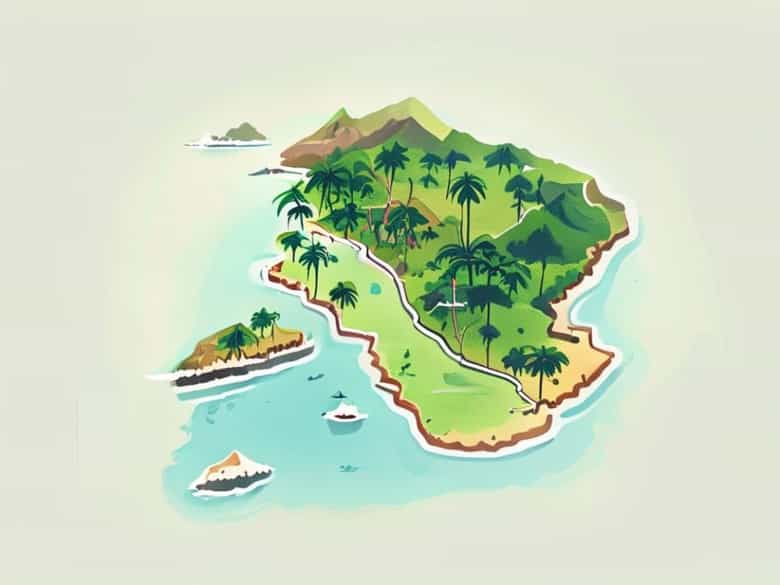
A map of Papua New Guinea offers far more than a simple outline of land and sea. It reveals a country shaped by rugged mountains, dense rainforests, winding rivers, and scattered islands spread across the southwestern Pacific Ocean. For students, travelers, and geography enthusiasts, studying a map of Papua New Guinea helps explain why this nation is one of the most culturally and environmentally diverse places on Earth. Each line, boundary, and label on the map tells a story of geography, history, and human settlement.
Geographic Location of Papua New Guinea
Papua New Guinea is located north of Australia and east of Indonesia. On a world map, it occupies the eastern half of the island of New Guinea, while the western half belongs to Indonesia. A map of Papua New Guinea also shows numerous smaller islands, including New Britain, New Ireland, and the islands of the Bismarck Archipelago.
This strategic location places Papua New Guinea between Southeast Asia and the Pacific Islands, which has influenced its trade routes, cultural exchanges, and biodiversity over thousands of years.
Political Boundaries Shown on the Map
When looking at a political map of Papua New Guinea, clear boundaries divide the country into provinces and districts. The national border with Indonesia is one of the most prominent features, running along the western edge of the mainland.
Within the country, the map shows administrative divisions that help manage governance across difficult terrain. These boundaries are important for understanding how services, infrastructure, and representation are organized.
Provinces and Administrative Regions
Papua New Guinea is divided into several provinces, each with its own capital and local government. On a detailed map, these provinces are labeled to help identify different regions.
- Highlands provinces in the central mountain areas
- Coastal provinces along the northern and southern shores
- Island provinces spread across nearby seas
- The National Capital District around Port Moresby
Physical Features Highlighted on the Map
A physical map of Papua New Guinea emphasizes the country’s dramatic natural landscape. The central mountain range, often called the Highlands, runs across the mainland and is one of the most dominant features visible on the map.
These mountains create natural barriers that have historically limited movement and communication, contributing to the development of many distinct cultures and languages.
Mountains, Rivers, and Plains
Major rivers such as the Sepik and the Fly are clearly marked on most maps of Papua New Guinea. These rivers flow from the highlands toward the sea, forming fertile floodplains that support agriculture and settlements.
Lowland areas along the coast are also visible on the map, showing where many towns and villages have developed due to easier access and trade opportunities.
Islands and Surrounding Seas
A map of Papua New Guinea would be incomplete without showing its many islands. These islands are scattered across the Bismarck Sea, Solomon Sea, and Coral Sea. Each island group has its own geographic characteristics and cultural traditions.
New Britain and New Ireland are among the largest islands and are often clearly labeled on maps. Smaller islands may appear as clusters, highlighting the country’s maritime nature.
Climate Zones and Natural Environment
Maps that include climate information show Papua New Guinea as a largely tropical country. The equator lies just north of the mainland, contributing to warm temperatures and high rainfall throughout the year.
This climate supports dense rainforests, which cover large portions of the land. On some maps, forested areas are shaded or marked to indicate vegetation zones.
Environmental Importance
The map helps explain why Papua New Guinea is considered a biodiversity hotspot. Its varied terrain and climate zones create habitats for countless plant and animal species, many of which are found nowhere else.
Cities and Human Settlements
On a map of Papua New Guinea, major cities and towns are marked to show population centers. Port Moresby, the capital city, is located on the southern coast and is often prominently labeled.
Other important towns appear along the coast or near rivers, reflecting the challenges of building infrastructure in mountainous interiors.
Transportation and Connectivity
Maps showing transportation routes reveal limited road networks, especially in the highlands. Many areas rely on air travel or river transport, a fact that becomes clear when examining how settlements are spread across the map.
This lack of connectivity has played a major role in preserving traditional lifestyles in remote regions.
Cultural Diversity Reflected Through Geography
Although culture is not directly visible on a map, the geography of Papua New Guinea helps explain its cultural diversity. The mountains, rivers, and islands shown on the map have historically isolated communities from one another.
As a result, Papua New Guinea is home to hundreds of distinct languages and cultural groups. The map provides context for understanding how such diversity developed.
Economic Activities and Land Use
Some maps of Papua New Guinea include information about land use and resources. These maps may highlight areas used for agriculture, mining, or forestry.
By studying these features, readers can see how geography influences economic activities. Coastal and river regions often support farming and fishing, while mountainous areas may be rich in minerals.
Educational Value of Studying the Map
For students, a map of Papua New Guinea is an essential learning tool. It helps build spatial awareness and encourages understanding of how physical geography affects human life.
In classrooms, maps are used to explain topics such as climate, population distribution, natural resources, and regional development.
Skills Developed Through Map Study
- Reading symbols and legends
- Understanding scale and distance
- Identifying physical and political features
- Connecting geography with culture and economy
Modern Relevance of Maps
In the modern world, digital maps of Papua New Guinea are used for navigation, planning, and environmental monitoring. These maps help governments and organizations manage resources and respond to natural disasters.
Despite technological advances, the basic information shown on traditional maps remains essential for understanding the country’s structure.
A map of Papua New Guinea is a powerful tool that reveals the complexity of a nation shaped by nature and history. From towering mountains and winding rivers to scattered islands and diverse provinces, the map helps explain why Papua New Guinea is so unique.
By studying the map carefully, readers gain insight into geography, culture, and development. Whether used for education, travel planning, or general knowledge, a map of Papua New Guinea opens a window into one of the most fascinating regions of the world.