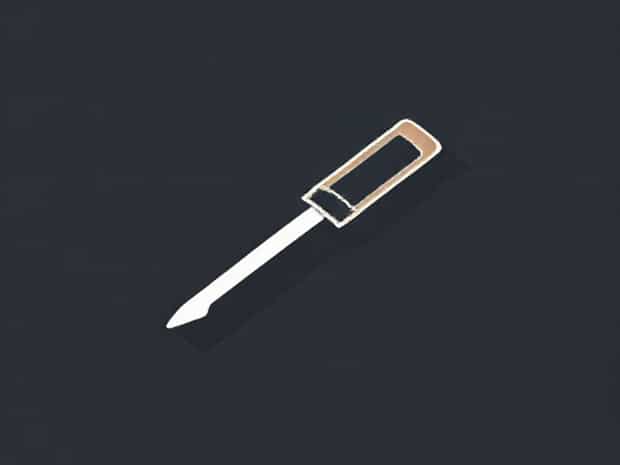
When learning how to represent tools in technical drawings, one of the most common examples is the flat head screwdriver drawing. This tool has a simple yet precise design that makes it easy to illustrate for educational, engineering, or artistic purposes. By understanding its basic shapes, dimensions, and functional features, anyone can create an accurate representation of a flat head screwdriver. Whether you are practicing drafting techniques, working on a mechanical illustration, or simply sketching for design purposes, learning the correct way to draw a flat head screwdriver helps build confidence in visual communication skills.
Understanding the Flat Head Screwdriver
A flat head screwdriver, also known as a slotted screwdriver, is one of the oldest and most widely used tools. Its defining characteristic is a flat, wedge-shaped tip designed to fit into the single slot of a screw. Because of its simplicity, it is often the first screwdriver students learn to draw in mechanical or technical illustration classes. When creating a flat head screwdriver drawing, it is important to recognize the tool’s main components and how they connect to form a functional design.
Main Parts to Include in a Drawing
- HandleUsually cylindrical or slightly contoured for grip, sometimes with textured patterns.
- ShaftA straight, narrow piece of metal connecting the handle to the tip.
- Blade or TipThe flat wedge that fits into slotted screws.
Step-by-Step Guide to Drawing a Flat Head Screwdriver
When creating a flat head screwdriver drawing, breaking the process into manageable steps ensures accuracy and proportion. While styles may differ depending on whether you are sketching freehand or creating a technical diagram, the overall approach is similar.
Step 1 Outline the Handle
Begin by sketching the handle. Handles are often oval or circular in cross-section, with a taper at the end where the shaft connects. Use smooth, rounded lines to represent the ergonomic design that allows comfortable grip.
Step 2 Add the Shaft
From the center of the handle, draw a straight line extending outward. This line forms the base of the shaft. Make sure it is proportional neither too thick nor too thin compared to the handle. A precise shaft adds realism to the drawing.
Step 3 Shape the Tip
At the end of the shaft, sketch the flat blade. This part should be slightly tapered, with a rectangular shape that narrows to a flat edge. Pay close attention to this detail since it defines the difference between a flat head screwdriver and other types like Phillips screwdrivers.
Step 4 Add Details
Include small details such as grooves on the handle for grip, metallic shine lines on the shaft, and shading to indicate depth. These extra touches make the drawing more realistic and professional.
Technical Drawing Considerations
If you are creating a flat head screwdriver drawing for technical purposes, accuracy is essential. Instead of freehand sketches, technical drawings require measurements, scales, and often multiple views.
Types of Views
- Orthographic ViewShows the screwdriver from the front, side, and top angles with exact measurements.
- Isometric ViewProvides a three-dimensional perspective, making the drawing more visually engaging.
- Exploded ViewUseful if you are illustrating the components of the screwdriver separately, such as handle and shaft.
Dimensioning
Technical drawings often include exact dimensions. Indicate the length of the shaft, the diameter of the handle, and the width of the blade. Accurate labeling ensures the drawing can be used for design and manufacturing purposes.
Tips for Improving a Flat Head Screwdriver Drawing
Even though the tool appears simple, beginners sometimes struggle with proportions and accuracy. Here are practical tips to refine your work
- Study real screwdrivers to understand how the handle tapers into the shaft.
- Use light sketching lines first and darken them once proportions look correct.
- Practice shading to show depth, especially where the shaft meets the handle.
- Pay attention to symmetry uneven handles or shafts can distort the drawing.
- If making technical illustrations, always work with a ruler and proper scale.
Applications of Screwdriver Drawings
Drawing tools like a flat head screwdriver is not only an exercise in practice but also has several practical applications across industries and education.
Educational Use
Students in drafting, engineering, or design courses often learn how to illustrate common tools. A flat head screwdriver drawing helps them practice proportion, precision, and technical labeling.
Instructional Manuals
Technical illustrations of screwdrivers are often used in user guides, assembly instructions, and repair manuals. Clear drawings ensure users understand which tool to use.
Art and Design
Artists sometimes include tool illustrations in sketches, blueprints, or concept art. A flat head screwdriver drawing can add realism to creative projects involving workshops or mechanical themes.
Common Mistakes to Avoid
When sketching or drafting a flat head screwdriver, beginners may overlook important details. Avoiding these mistakes improves accuracy and presentation.
- Making the shaft disproportionately short or long compared to the handle.
- Drawing a rounded tip instead of a flat blade.
- Ignoring perspective in three-dimensional drawings.
- Adding too much decoration that distracts from the tool’s simple design.
Using Digital Tools for Drawings
While traditional pencil and paper sketches remain common, digital platforms now make it easier to create precise and detailed flat head screwdriver drawings. Software such as CAD (Computer-Aided Design) allows professionals to create scaled, accurate illustrations suitable for manufacturing. Even basic drawing apps can be used for practice, making it accessible for students and hobbyists.
Advantages of Digital Drawings
- Easy corrections without erasing or redrawing everything.
- Ability to add layers for handle, shaft, and tip separately.
- Precise scaling for technical purposes.
- Exporting options for manuals, presentations, and educational materials.
Why Focus on a Flat Head Screwdriver Drawing?
The simplicity of the tool makes it ideal for practice, while its universal design ensures that the drawing is instantly recognizable. Learning to illustrate a flat head screwdriver also helps prepare students and professionals for more complex technical drawings. It is a foundational exercise that builds confidence in capturing proportions, textures, and functions in a visual format.
Creating a flat head screwdriver drawing is a valuable skill that combines artistic ability with technical accuracy. By understanding the parts of the tool, practicing step-by-step methods, and paying attention to details like proportion and shading, anyone can create a drawing that looks professional and functional. Whether you are learning drafting, preparing illustrations for manuals, or practicing for artistic projects, focusing on a flat head screwdriver provides a solid foundation in technical drawing. With practice and patience, the simple design of this everyday tool becomes an excellent subject for improving both creativity and precision.