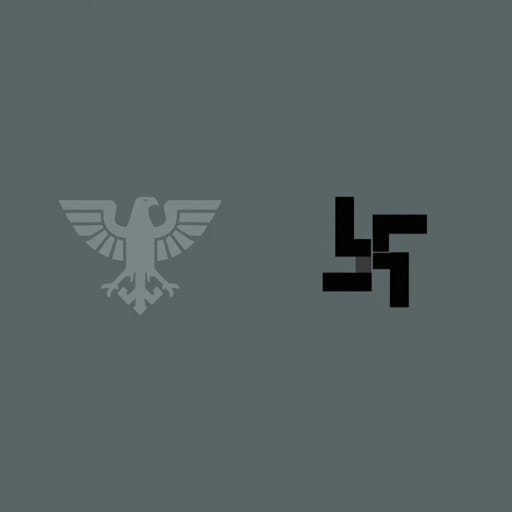
During the time of Nazi Germany, the military and paramilitary forces operated under a complex structure, with distinct roles and ideologies. Two of the most prominent and often confused organizations were the Wehrmacht and the SS. Although both were deeply tied to the regime of Adolf Hitler, they had very different origins, purposes, and reputations. Understanding the difference between the Wehrmacht and the SS provides essential context to World War II and Nazi Germany’s operations, revealing the layers of military strategy, political control, and ideology that influenced this period in history.
Origins and Formation
The Wehrmacht
The Wehrmacht was the unified armed forces of Nazi Germany from 1935 to 1945. It consisted of three branches:
- Heer (Army)
- Luftwaffe (Air Force)
- Kriegsmarine (Navy)
Formed after the dissolution of the Reichswehr, the Wehrmacht was Germany’s official military force. It was initially designed for national defense but was expanded and modernized under Hitler’s rule, becoming the main tool for German aggression across Europe.
The SS (Schutzstaffel)
The SS began as Hitler’s personal bodyguard in the 1920s but later evolved into one of the most powerful and feared organizations in the Nazi regime. Led by Heinrich Himmler, the SS had a dual role: enforcing ideological loyalty and acting as a paramilitary force. It was divided into several branches, including:
- Allgemeine SS responsible for general policing and administration
- Waffen-SS the armed wing that fought alongside the Wehrmacht
- Totenkopfverbände managed concentration and extermination camps
Structure and Chain of Command
Wehrmacht Command
The Wehrmacht was under the direct control of the German High Command (OKW Oberkommando der Wehrmacht), with Adolf Hitler as the supreme commander. While Hitler interfered increasingly with military decisions, the Wehrmacht retained a traditional military hierarchy and included professional officers trained in formal academies.
SS Command
The SS answered primarily to Heinrich Himmler and ultimately to Hitler. It functioned more independently from the regular military chain of command and was driven by Nazi ideology more than by military tradition. SS officers were often selected based on racial purity and loyalty rather than professional military training.
Ideological Differences
The Wehrmacht’s Role
The Wehrmacht, although operating under a Nazi regime, was not inherently ideological in its structure. It was focused more on traditional military objectives such as battlefield strategy, territorial conquest, and national defense. However, many Wehrmacht officers collaborated with Nazi policies and participated in war crimes, especially on the Eastern Front.
The SS as an Ideological Force
The SS was deeply ideological and saw itself as the racial and political elite of the Third Reich. Its members were indoctrinated in Nazi ideology, especially beliefs in Aryan superiority, antisemitism, and absolute loyalty to Hitler. The SS played a central role in carrying out the Holocaust, including mass shootings, deportations, and operating death camps.
Military Roles in World War II
Wehrmacht Operations
The Wehrmacht was responsible for nearly all of Germany’s conventional military operations during World War II. It invaded Poland, France, the Soviet Union, and other nations. Its forces fought on land, in the air, and at sea, and included millions of soldiers. Although a professional army, the Wehrmacht became involved in atrocities, particularly in the Soviet Union, where it often cooperated with SS units.
Waffen-SS in Combat
The Waffen-SS was created to serve as an elite fighting force, and its divisions participated in many key battles. Despite lacking the same training and logistics as the Wehrmacht, the Waffen-SS was often deployed in critical combat situations. It became infamous for brutality and committed numerous war crimes, such as the massacre of civilians and POWs.
Recruitment and Membership
Wehrmacht Recruitment
Wehrmacht service was mandatory for most German men during the war. While officers often came from traditional military backgrounds, soldiers were drafted from the general population. Foreign volunteers and conscripts also served in the Wehrmacht, especially in occupied areas.
SS Recruitment
The SS was initially highly selective, admitting only those who met strict racial and ideological standards. Over time, especially as the war dragged on, recruitment standards were lowered. The Waffen-SS expanded to include foreign divisions, including volunteers from occupied countries like France, the Netherlands, and the Baltics.
Post-War Consequences
Wehrmacht Legacy
After the war, the Wehrmacht was dissolved. While many individual soldiers were not prosecuted, some generals were tried at Nuremberg for war crimes and crimes against humanity. In post-war Germany, a myth known as the clean Wehrmacht persisted for years, falsely portraying the army as apolitical and uninvolved in Nazi crimes.
SS Condemnation
The SS was declared a criminal organization by the Nuremberg Tribunal due to its direct involvement in war crimes and genocide. SS members were often barred from government positions or pension rights in post-war Germany. The Waffen-SS, despite being a combat unit, was also included in this judgment due to its widespread atrocities.
Public Perception and Historical Debate
Views of the Wehrmacht
Public perception of the Wehrmacht has shifted over time. While once seen as a professional and honorable force, later scholarship exposed its complicity in Nazi crimes. Memorials and museums in Germany now address these issues with more honesty, acknowledging the Wehrmacht’s role in the Holocaust and other atrocities.
Views of the SS
The SS is universally condemned in historical literature for its central role in implementing Nazi ideology and orchestrating crimes against humanity. The black SS uniform and its death’s head insignia have become symbols of terror and oppression. The organization’s legacy remains one of the darkest aspects of Nazi Germany.
Key Differences Summarized
- Function: Wehrmacht was the regular armed forces; SS was a paramilitary and ideological force.
- Control: Wehrmacht under military command; SS under the Nazi Party and Himmler.
- Ideology: Wehrmacht was less ideological; SS was deeply committed to Nazi ideals.
- Military Role: Wehrmacht led conventional battles; Waffen-SS was elite but brutal in combat.
- Criminal Accountability: Wehrmacht had individual culpability; SS was declared criminal as a whole.
While the Wehrmacht and the SS both served Nazi Germany during World War II, they were fundamentally different in structure, ideology, and purpose. The Wehrmacht represented the professional military arm of the state, while the SS embodied the ideological and oppressive apparatus of the Nazi regime. Both organizations played roles in the war’s devastation, but the SS’s legacy is especially marked by its central involvement in the Holocaust and other crimes against humanity. Recognizing the distinction between the Wehrmacht and the SS helps us better understand the machinery of tyranny and the responsibilities of those who serve within it.