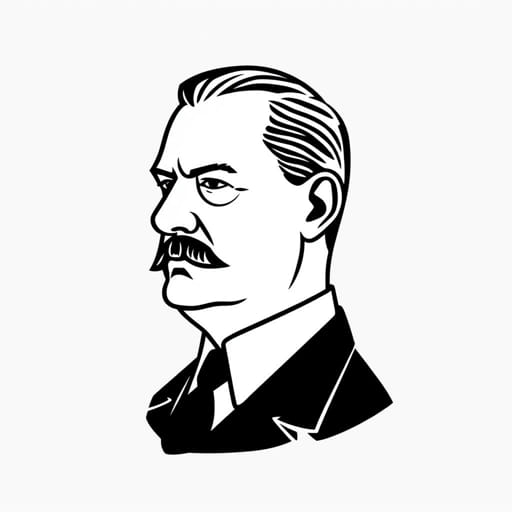
Paul von Hindenburg, a towering figure in German military and political history, is often remembered for his role as the second president of the Weimar Republic and as the man who appointed Adolf Hitler as chancellor. Yet behind this prominent legacy lies a deeper ideological question that continues to intrigue historians and political analysts: was Paul von Hindenburg truly a monarchist? His military background, political decisions, and personal beliefs reflect a complex and evolving relationship with Germany’s monarchical traditions, particularly during a period of dramatic national transformation following World War I.
Hindenburg’s Prussian Roots and Monarchical Culture
Born in 1847 to an aristocratic Prussian family, Paul von Hindenburg was raised in a culture deeply embedded in loyalty to the Kaiser and the traditional structures of monarchy. His upbringing, military education, and early career were shaped by the values of the Kingdom of Prussia, a state defined by a hierarchical and disciplined society. For Hindenburg, the monarchy was not simply a form of government; it was the embodiment of German unity, military pride, and social order.
Throughout his decades in the military, Hindenburg served under Kaiser Wilhelm I and Kaiser Wilhelm II, and his loyalties to the House of Hohenzollern remained publicly unshaken until the fall of the German Empire in 1918. His belief in a strong centralized authority and his disdain for liberal democracy made monarchy a natural fit for his worldview.
Support for the Monarchy During World War I
During World War I, Hindenburg’s leadership as Chief of the General Staff elevated him to a legendary status in Germany. Working closely with Erich Ludendorff, Hindenburg effectively operated a military dictatorship under the authority of the Kaiser. His power, however, was always exercised in the name of the monarchy. He did not seek to overthrow the Kaiser, but rather to use the emperor’s authority to prosecute the war and maintain internal order.
Even in the war’s final days, when Germany faced defeat and revolution, Hindenburg remained committed to the preservation of the monarchy. He urged the Kaiser to abdicate only as a last resort, not because he supported republicanism, but because he believed it was the only way to prevent civil war and total collapse.
The Weimar Republic and a Shifting Political Landscape
With the establishment of the Weimar Republic in 1919, Germany became a democratic state. Hindenburg, retired from public life, remained a revered symbol of the old imperial order. However, the fragile democracy struggled with economic hardship, political extremism, and public disillusionment. Monarchist sentiment still ran deep among conservatives, and many looked to Hindenburg as a potential restorer of traditional authority.
When Hindenburg ran for president in 1925, he did so reluctantly and was elected with the support of monarchists, conservatives, and nationalists who viewed him as a living link to the old regime. His election was seen by many as a symbolic rejection of the Weimar Republic and a quiet affirmation of monarchical ideals. Yet as president, Hindenburg took his constitutional role seriously, and he did not immediately seek to dismantle the republic.
Did Hindenburg Want to Restore the Monarchy?
The evidence suggests that while Hindenburg personally favored monarchical principles, he recognized the practical limitations of restoring the crown. Germany’s political landscape had changed dramatically after the war, and many Germans, even conservatives, accepted the republic as a reality. Although Hindenburg surrounded himself with monarchist advisers and sympathizers, he never launched a serious campaign to reinstall the Kaiser or crown a new monarch.
Nonetheless, Hindenburg’s governance was often characterized by efforts to undermine democratic norms. He relied increasingly on emergency powers under topic 48 of the Weimar Constitution, bypassing the Reichstag and issuing decrees without parliamentary approval. These actions aligned more with authoritarian tendencies than democratic ideals and echoed monarchical authority, even in a republican framework.
Hindenburg and the Rise of Hitler
One of the most consequential decisions of Hindenburg’s presidency was his appointment of Adolf Hitler as chancellor in 1933. Despite deep personal distrust of Hitler, Hindenburg believed that by including him in a conservative cabinet, he could control the growing power of the Nazi Party and stabilize the government.
This decision, however, proved catastrophic. Hitler quickly consolidated power, eliminated political opposition, and dismantled the Weimar Republic. Within a year, Hindenburg died, and Hitler merged the presidency with the chancellorship, ending Germany’s experiment with democracy. While Hindenburg did not support fascism or the destruction of the republic, his actions enabled the very forces that would obliterate both democracy and monarchy.
Final Years and Reflections
In his final years, Hindenburg continued to show respect for monarchical values. He kept portraits of the Kaiser in his office and maintained correspondence with members of the deposed royal family. However, his failure to act decisively in defense of either the republic or the monarchy left him a tragic figure an aging soldier caught between two worlds, unable to fully commit to either.
Historians remain divided on whether Hindenburg had concrete plans to restore the monarchy. Some argue that he passively hoped for its return, while others suggest he viewed himself as a placeholder president until a more traditional order could be reestablished. Ultimately, his inaction and compromise allowed radical ideologies to fill the void.
Was Hindenburg Truly a Monarchist?
In assessing whether Paul von Hindenburg was a monarchist, the answer lies in the distinction between personal belief and political action. Clearly, Hindenburg was shaped by and loyal to the ideals of the monarchy. His upbringing, military service, and worldview were deeply aligned with hierarchical authority, national unity, and the symbolism of the crown. He preferred monarchy to democracy and saw the Weimar Republic as an unstable and temporary solution.
However, as president, he did not actively pursue the restoration of the monarchy. Whether due to pragmatism, age, or political caution, Hindenburg chose to work within the republican framework, even as he undermined it from within. His legacy is therefore one of contradiction a monarchist in principle who failed to act decisively in favor of monarchy, and whose decisions ultimately paved the way for dictatorship rather than restoration.
Paul von Hindenburg remains a complex historical figure. His monarchist sympathies are clear, but his political legacy is more ambiguous. In the end, he was a man of the past, struggling to navigate a Germany that had moved on without him, and whose cautious conservatism unintentionally opened the door to tyranny.