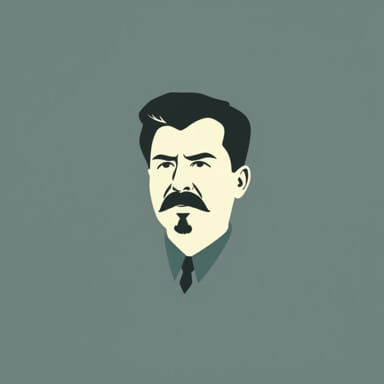
After the death of Vladimir Lenin in 1924, a fierce power struggle emerged within the Soviet leadership. Leon Trotsky, a charismatic revolutionary and Lenin’s close associate, seemed the natural heir to leadership. However, it was Joseph Stalin, a man often viewed as a bureaucratic figure with limited intellectual appeal, who ultimately emerged victorious. How Stalin outmaneuvered Leon Trotsky is a fascinating study in political manipulation, alliance-building, and calculated ruthlessness. Stalin’s rise to power reveals how strategy, timing, and control of the party apparatus can triumph over popularity and revolutionary credentials.
Stalin’s Strategic Position in the Communist Party
Joseph Stalin held the role of General Secretary of the Communist Party from 1922. Though this position appeared administrative and mundane, it granted him enormous influence over party appointments, records, and internal communications. This was the foundation of his political ascent and a major factor in how he outmaneuvered Trotsky.
Key Advantages of the General Secretary Role
- Control over party membership and personnel appointments
- Ability to build a loyal base within the party bureaucracy
- Access to sensitive information about opponents
- Capacity to shape party narratives and suppress dissent
Trotsky underestimated the power of the party machinery, focusing more on ideology and revolutionary theory. Stalin, in contrast, mastered the practical mechanics of power.
Building Alliances to Isolate Trotsky
Stalin’s ability to form and dissolve alliances played a crucial role in marginalizing Trotsky. Initially, he aligned himself with Grigory Zinoviev and Lev Kamenev, two senior Bolsheviks who feared Trotsky’s growing influence. Together, they formed the ‘Triumvirate’ or ‘Troika’ and worked to portray Trotsky as arrogant and out of step with the party line.
Propaganda Against Trotsky
- Framed Trotsky as overly individualistic and disloyal to Lenin’s vision
- Emphasized Trotsky’s Menshevik past to question his revolutionary credentials
- Accused him of ‘Bonapartism’ seeking dictatorial control
These tactics were effective in diminishing Trotsky’s standing among the broader party membership, even though he remained a brilliant orator and military strategist.
Manipulating Lenin’s Legacy
One of Trotsky’s greatest errors was his handling of Lenin’s legacy. Before his death, Lenin had grown suspicious of Stalin and wrote a political testament suggesting Stalin be removed from his post. However, Stalin and his allies suppressed the document at the 13th Party Congress in 1924, preventing it from damaging his reputation.
Exploiting the Lenin Cult
- Stalin positioned himself as the guardian of Lenin’s ideology
- Used Lenin’s image and language to legitimize his own rise
- Portrayed Trotsky as a traitor to Lenin’s memory
By tying himself to Lenin’s legacy, Stalin cultivated loyalty among the rank-and-file party members, even though Lenin’s actual words told a different story.
Exploiting Trotsky’s Missteps
Trotsky, though brilliant, often failed to navigate the murky waters of party politics. He alienated potential allies by acting independently and refusing to compromise. His belief in intellectual superiority and disdain for party bureaucracy cost him crucial support.
Notable Errors by Trotsky
- Declining to mobilize against Stalin after Lenin’s death
- Missing Lenin’s funeral due to illness and poor communication
- Refusing to build a faction to counter Stalin’s growing influence
These miscalculations allowed Stalin to tighten his grip on power while Trotsky appeared increasingly isolated and ineffectual.
Shifting Alliances and the Elimination of Rivals
After defeating Trotsky, Stalin turned on his former allies Zinoviev and Kamenev. By 1926, Stalin formed a new alliance with Nikolai Bukharin and the Right Opposition. Together, they marginalized the Left Opposition led by Trotsky, Zinoviev, and Kamenev.
Once Trotsky and the Left were expelled from the Communist Party, Stalin later moved against Bukharin as well. By the late 1920s, Stalin had eliminated or sidelined all potential rivals through internal purges and show trials.
Steps in Stalin’s Consolidation
- Expulsion of Trotsky from the Politburo in 1926
- Removal from the Communist Party in 1927
- Exile from the Soviet Union in 1929
By manipulating internal party dynamics and eliminating rivals in phases, Stalin solidified his hold on the Soviet Union’s leadership.
Control of Media and Historical Narrative
Stalin’s dominance was not limited to party politics. He also controlled the state media, education, and historical record. Through censorship and propaganda, Stalin rewrote history to minimize Trotsky’s contributions and elevate his own role.
Historical Revisionism Under Stalin
- Trotsky erased from official photographs and records
- Textbooks revised to downplay his role in the revolution and civil war
- State-sponsored denunciations labeling him as a traitor and counter-revolutionary
This campaign ensured that future generations would view Stalin as Lenin’s true successor, while Trotsky became a figure of suspicion and blame.
Trotsky’s Final Years and Assassination
After his expulsion, Trotsky lived in exile in Turkey, France, Norway, and eventually Mexico. Despite his efforts to rally opposition to Stalin through writings and the formation of the Fourth International, he remained largely powerless. Stalin, meanwhile, viewed Trotsky as a threat even in exile.
Assassination in Mexico
- In 1940, Trotsky was assassinated by Ramón Mercader, an NKVD agent
- He was attacked with an ice axe at his home in Mexico City
- His death marked the final removal of a major challenger to Stalin’s rule
The assassination was the culmination of Stalin’s long campaign to eliminate his most formidable rival, ensuring unchallenged authority within the Soviet Union.
Joseph Stalin outmaneuvered Leon Trotsky not through ideological superiority, but through political strategy, calculated alliances, control of party mechanisms, and unrelenting repression. Trotsky’s brilliance as a revolutionary and military leader could not compete with Stalin’s mastery of bureaucratic power and manipulation. The downfall of Trotsky serves as a powerful reminder that in politics, especially in authoritarian systems, survival often depends more on organizational control and alliances than on charisma or intellectual vision. Stalin’s rise was not inevitable, but it was meticulously constructed and ultimately, devastatingly effective.