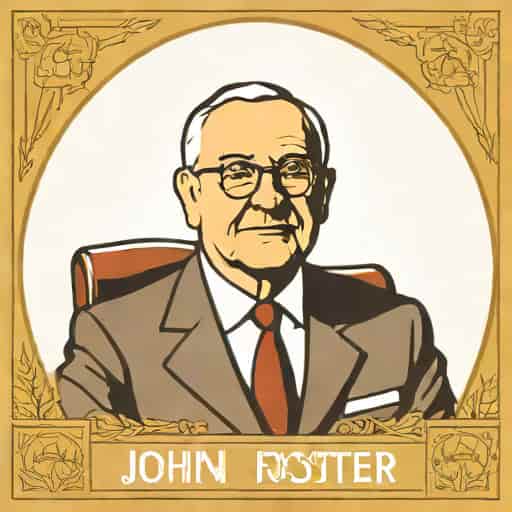
John Foster Dulles was one of the most influential and controversial figures in American foreign policy during the Cold War. Serving as United States Secretary of State from 1953 to 1959 under President Dwight D. Eisenhower, he played a central role in shaping how the United States interacted with the rest of the world during a time of intense ideological rivalry. When people ask what John Foster Dulles was responsible for creating, the answer lies not in a single institution or document, but in a broad set of policies, alliances, and doctrines that defined American global strategy for decades.
The Cold War Context of Dulles’ Influence
To understand what John Foster Dulles was responsible for creating, it is important to look at the historical context in which he operated. The Cold War was marked by deep tension between the United States and the Soviet Union, with both sides seeking to expand their influence without triggering a direct military conflict. Dulles believed that strong, decisive action was necessary to counter communism around the world.
His worldview was shaped by a belief in moral clarity. Dulles often framed international politics as a struggle between freedom and tyranny. This perspective influenced the policies he helped create and promote, many of which aimed to contain or roll back communist influence.
The Doctrine of Massive Retaliation
One of the most significant concepts John Foster Dulles was responsible for creating and promoting was the doctrine of massive retaliation. This policy stated that the United States would respond to communist aggression with overwhelming force, including nuclear weapons if necessary.
Purpose of Massive Retaliation
The goal of this doctrine was deterrence. Dulles believed that making the cost of aggression extremely high would prevent the Soviet Union and its allies from initiating conflicts. This approach also allowed the United States to reduce conventional military spending while relying on nuclear superiority.
Long-Term Impact
Massive retaliation shaped military planning throughout the 1950s and influenced how future administrations thought about nuclear strategy. While critics argued that it increased the risk of catastrophic war, supporters believed it kept the peace by discouraging direct confrontation.
The Policy of Brinkmanship
Closely related to massive retaliation was the idea of brinkmanship, another concept strongly associated with John Foster Dulles. Brinkmanship involved pushing international conflicts to the edge of war in order to force an opponent to back down.
Dulles openly argued that the ability to go to the brink without actually falling into war was a necessary skill in Cold War diplomacy. This approach was evident in crises involving Taiwan, Berlin, and other flashpoints where tensions ran high.
Creation and Expansion of Military Alliances
John Foster Dulles was also responsible for creating and strengthening a global network of alliances designed to contain communism. While some alliances predated his tenure, he played a key role in expanding and formalizing them.
Strengthening NATO
Dulles supported the North Atlantic Treaty Organization as the cornerstone of European security. He pushed for West Germany’s rearmament and integration into NATO, believing that a strong Western Europe was essential to counter Soviet power.
New Regional Alliances
Under Dulles’ leadership, the United States helped establish several regional defense pacts, including
- SEATO (Southeast Asia Treaty Organization) to counter communism in Asia
- The Baghdad Pact, later known as CENTO, to strengthen the Middle East against Soviet influence
- Bilateral defense agreements with countries such as Japan and South Korea
These alliances reflected Dulles’ belief that collective security was essential in the Cold War world.
The Policy of Containment and Rollback
Although containment began before Dulles took office, he reshaped and expanded it. He criticized earlier policies for being too passive and advocated for rollback, the idea of actively pushing back communist governments rather than merely containing them.
In practice, rollback often took the form of covert actions rather than direct military intervention. Dulles supported intelligence operations aimed at influencing or overthrowing governments seen as aligned with communism.
Covert Operations and Regime Change
One of the most controversial areas where John Foster Dulles was responsible for shaping policy involved covert operations conducted by U.S. intelligence agencies. Along with his brother Allen Dulles, who was Director of the CIA, he supported secret interventions in foreign countries.
Iran and Guatemala
Two of the most well-known examples include
- The 1953 operation in Iran that led to the overthrow of Prime Minister Mohammad Mossadegh
- The 1954 intervention in Guatemala that removed President Jacobo Árbenz
These actions were justified at the time as necessary to prevent communist expansion, but they later drew criticism for undermining democratic institutions and contributing to long-term instability.
Nuclear Diplomacy and Arms Control Skepticism
While John Foster Dulles relied heavily on nuclear deterrence, he was skeptical of arms control agreements that he believed might weaken U.S. security. He preferred strength and clarity over compromise, fearing that treaties could be exploited by adversaries.
This skepticism influenced early Cold War attitudes toward disarmament and shaped debates that continued long after his tenure as Secretary of State.
Economic and Moral Dimensions of Foreign Policy
Dulles also emphasized the moral dimension of American foreign policy. He believed that the United States had a responsibility to promote freedom, democracy, and economic development. This belief influenced foreign aid programs and diplomatic messaging during the 1950s.
However, critics argue that moral language was sometimes used to justify actions driven primarily by strategic or economic interests.
Criticism and Legacy
John Foster Dulles remains a deeply divisive figure. Supporters credit him with helping the United States navigate a dangerous period without direct war between superpowers. They argue that his policies contributed to stability and deterred aggression.
Critics, on the other hand, point to the long-term consequences of his actions, including resentment toward the United States, regional instability, and the normalization of covert intervention.
When examining what John Foster Dulles was responsible for creating, it becomes clear that his legacy is defined by ideas and strategies rather than physical structures. He helped create doctrines like massive retaliation and brinkmanship, expanded global military alliances, promoted aggressive containment policies, and supported covert actions that reshaped world politics.
His influence extended far beyond his years in office, shaping American foreign policy throughout the Cold War and beyond. Understanding John Foster Dulles is essential for understanding how the United States positioned itself on the global stage during one of the most consequential periods in modern history.